Development of applications in modern times needs to be agile, scalable, and effective. The developer must ensure that the API developed by them is effective, scalable, and maintainable. It is then here that minimal APIs have become popular among individual developers and businesses in the domain of .NET 10.
The minimal API, having been available since the early versions of .NET, has continuously been evolving, and now in .NET 10, Microsoft is providing further enhancements in the form of minimal API in order to make developer life easier through performance optimization and flexibility of APIs.
Minimal APIs are a simplified way of creating RESTful APIs in ASP.NET Core applications by using fewer configurations. As compared to the standard approach that requires controllers, routes, and more configurations, Minimal APIs allow defining API endpoints with less amount of code.
The Program.cs file is used for defining API endpoints as opposed to creating multiple controllers and route configurations. Minimal APIs focus on:
It is simplicity that makes Minimal APIs extremely attractive. Minimal APIs are ideal for developing microservices and other lightweight backend services because it is easier for developers to create endpoints with just a few lines of code.
Read More: Native AOT in .NET 10: Why Your Apps Should Publish AOT
In .NET 10, there are various advancements made to make Minimal APIs more reliable and scalable.
1. Reduced Boilerplate Code
The most significant advantage of Minimal APIs lies in their clean and concise code. Endpoints can be defined using just a few lines of code.
2. High Performance
Minimal APIs provide high performance due to the fact that there is no overhead created, as there are no extra layers present in their architecture, which was otherwise common in traditional MVC frameworks.
3. Route Grouping and Endpoint Organization
.NET 10 has improved features in relation to grouping routes, allowing easier management of endpoints. Grouped routes can be created for Product APIs, Admin APIs, and Authentication APIs.
4. Better Validation and Error Handling
.NET 10 provides better validation possibilities for Minimal APIs developers. Request validation, Problem details responses, and Input sanitization have become easier to do compared to previous versions.
5. Built-In Cloud-Native Capabilities
Minimal APIs fit very well in a cloud-native world. This is because they work well with Docker containers and Kubernetes.
Read More: AI in .NET 10: Microsoft.Extensions.AI + ML.NET Guide
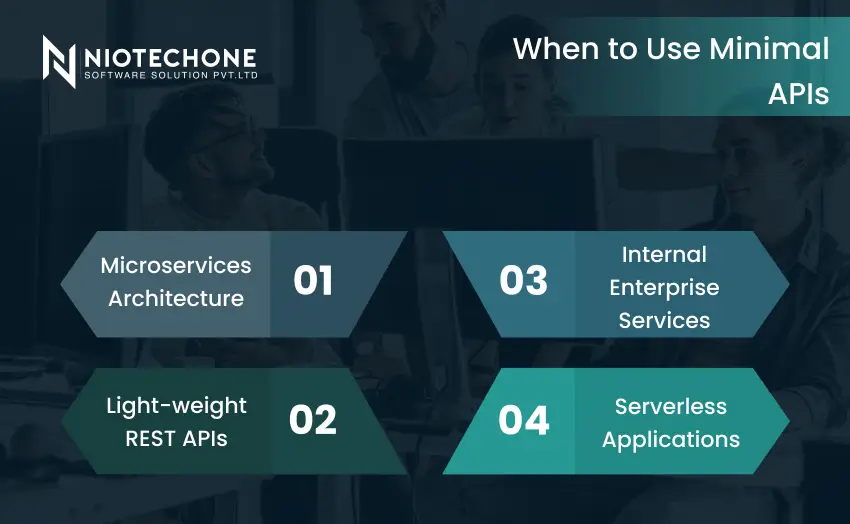
Minimal APIs work well in certain situations. It is essential to know the appropriate situations so that developers can leverage their efficiency and productivity.
1. Microservices Architecture
Minimal APIs are well-suited to microservices architecture due to their lightweight nature. In microservices architecture, services have their own responsibilities, smaller code helps in maintenance, and Faster deployment is achieved. The above characteristics fit well in the Minimal API approach.
2. Light-weight REST APIs
In case a developer has to create an API with only a few endpoints, Minimal APIs will be the way to go. Building such APIs using a heavy MVC architecture can complicate things.
3. Internal Enterprise Services
Many enterprises employ Minimal APIs for their internal tools and backend services. As these services tend to be limited in scope, the development becomes significantly easier using Minimal APIs. For instance, reporting tools and automation services.
4. Serverless Applications
The minimalistic nature of Minimal APIs is ideal for usage in serverless environments owing to their fast boot time and lightweight runtimes. These types of applications can be used in conjunction with Azure Functions, AWS Lambda, and Google Cloud Functions.
Read More: .NET MAUI 10 vs Flutter: Performance & Features 2026
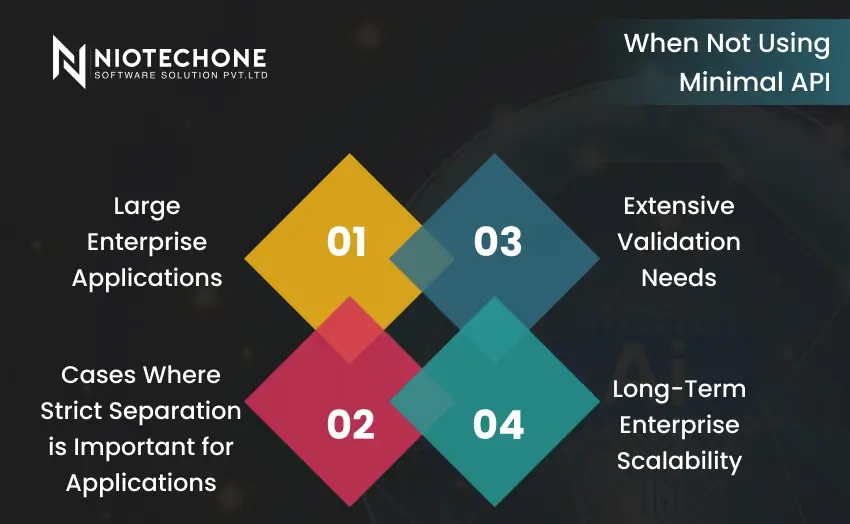
Although Minimal APIs have several benefits, they do not suit all applications. It is equally essential to know about their disadvantages.
1. Large Enterprise Applications
Enterprise-level applications consist of complicated business logic and architectures. Minimal APIs can make it challenging to maintain the application. In such instances, controller-based APIs might be preferred.
2. Cases Where Strict Separation is Important for Applications
MVC structure allows for a much better separation of controllers, services, and models. In case you require strong layering within the application, Minimal APIs would not be recommended.
3. Extensive Validation Needs
When applications require complex validation rules, it might be hard to manage such applications using only Minimal APIs. Using controller-based APIs with validation filters will make things easier.
4. Long-Term Enterprise Scalability
Although Minimal APIs can be scaled easily, managing extremely large Minimal API applications might get very hard. Using traditional layered architecture will help enterprises in the long run.
There are many benefits of using Minimal APIs for contemporary development teams.
Faster Development: APIs can be created with less amount of code, which makes the development faster.
Simplified Learning Curve: New developers will find Minimal APIs easy to learn because of their clean and simple nature.
More Optimal Cloud Deployment: Minimal APIs work best in containers and Kubernetes environments.
Increased Speed of Application Startup: The startup time of apps that use minimal APIs is often faster than that of those built using an MVC architecture.
Agile Development Process: A developer has the freedom to use minimal APIs and traditional controllers simultaneously within an app.
The Minimal APIs in .NET 10 have brought about significant innovation in the realm of API creation today. They help in achieving faster development times, cleaner code, better performance, and excellent cloud support. In scenarios involving microservices, lightweight REST APIs, quick prototyping, and serverless architecture, Minimal APIs could prove to be very useful.
By recognizing the strengths and weaknesses of Minimal APIs, developers can make better architectural choices when working on applications through ASP.NET Core development and .NET 10. Care should be exercised before going ahead with the Minimal APIs instead of the classic controller approach.
Minimal APIs are a lightweight approach for building REST APIs in ASP.NET Core with minimal configuration and reduced boilerplate code.
Yes, Minimal APIs generally offer better performance because they reduce request processing overhead and eliminate unnecessary MVC layers.
Yes, but mainly for smaller services or microservices. Large enterprise applications may benefit more from traditional layered architectures.
Yes, Their simpler structure makes them easier for beginners to learn compared to traditional MVC APIs.
Absolutely. Minimal APIs are highly suitable for microservices because they are lightweight, fast, and cloud-friendly.
3rd Floor, Aval Complex, University Road, above Balaji Super Market, Panchayat Nagar Chowk, Indira Circle, Rajkot, Gujarat 360005.
Abbotsford, BC
15th B Street 103, al Otaiba Dubai DU 00000, United Arab Emirates
3rd Floor, Aval Complex, University Road, above Balaji Super Market, Panchayat Nagar Chowk, Indira Circle, Rajkot, Gujarat 360005.
Abbotsford, BC.
15th B Street 103, al Otaiba Dubai DU 00000, United Arab Emirates.
Copyright © 2026 Niotechone Software Solution Pvt. Ltd. All Rights Reserved.