Understanding Real-Time APIs
Some applications need to show changes the moment something happens. Users usually don’t want to keep refreshing the page again and again just to see a new message, updated notification, or latest dashboard activity.
They are commonly used in things like:
- Chat applications
- Stock market dashboards
- Live analytics tools
- Team collaboration platforms
- Online gaming systems
- Notification features
Without real-time updates, there’s often a delay between when data changes and when users actually see it on the screen.
How GraphQL Subscriptions Work
GraphQL subscriptions are mainly useful in apps where information keeps changing, and users expect updates right away.
Without subscriptions, applications usually keep making repeated API requests in the background just to check if something new happened. In smaller apps, that’s manageable, but in larger systems, it can create a lot of extra traffic over time.
With subscriptions, the connection stays active, so updates can be sent directly whenever data changes.
For example:
- A new chat message appears immediately
- Live dashboard numbers change automatically
- Notifications show up the moment an action happens
Because updates arrive automatically, the application usually feels more responsive and natural for users compared to constantly refreshing data manually.
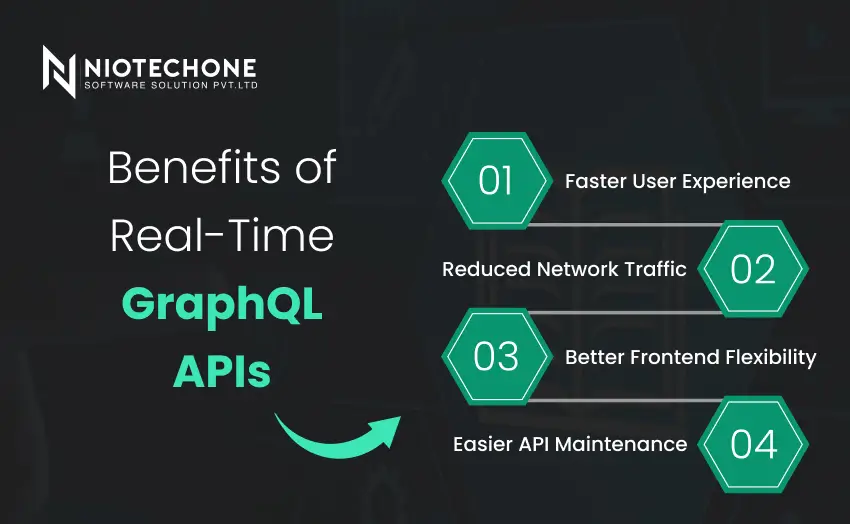
Benefits of Real-Time GraphQL APIs
Faster User Experience
Users can see changes almost instantly instead of refreshing the page repeatedly to get updated information.
Reduced Network Traffic
Since GraphQL returns only the data the frontend actually needs, applications usually avoid sending a lot of extra information unnecessarily.
Better Frontend Flexibility
Frontend developers can choose exactly which fields they want from the API instead of depending completely on fixed backend responses.
Easier API Maintenance
As applications grow, GraphQL APIs are often easier to update gradually without causing problems for older frontend implementations.
Designing Scalable GraphQL APIs
As GraphQL applications grow, scalability becomes important. Simply adding GraphQL alone is not enough if APIs are poorly designed.
Avoid Deep Nested Queries
Very large nested queries can eventually affect server performance. Applications usually need query depth limits and proper optimization strategies.
Use Pagination
Large datasets should always use pagination instead of loading everything at once. This helps improve performance and reduce server load.
Optimize Database Queries
Poor database query handling can create performance problems in GraphQL applications. Techniques like batching and caching help reduce unnecessary database requests.
Secure Subscriptions Properly
Real-time subscriptions keep long-lived connections active. Authentication and authorization become important for protecting sensitive data.
Common Challenges with GraphQL
Large Queries Can Slow Things Down
Sometimes frontend teams keep adding more fields into GraphQL queries, and after a point, those requests become heavier than expected for the server.
Caching Is Not Always Simple
With REST APIs, caching usually feels more direct. GraphQL is more flexible, which is useful, but it also makes caching a little harder to organize properly in bigger projects.
New Teams Need Adjustment Time
For developers who haven’t worked with GraphQL before, things like schemas, resolvers, and subscriptions can feel unfamiliar in the beginning.
Too Many Live Connections
Applications using subscriptions often keep lots of active connections open at the same time. As user traffic increases, managing all those connections can become difficult.
Scaling Requires Extra Planning
Once applications start growing, teams usually need better monitoring, infrastructure changes, and performance tuning to keep real-time features stable.