Modern application development practices are changing at an amazing pace. And companies are continuously on the lookout for architectures that offer scalability, maintainability, and fast development. Though microservices are widely used, they may not be the right choice for all projects.
Modular Monolith architecture turns out to be very useful in such cases. This architecture is a mix of monolithic application development and modularity. For companies using a Microsoft .NET development company in India, Modular Monolith can prove more efficient for fast development and easy maintenance.
Read More: Monolith Architecture vs Microservices Architecture in 2026
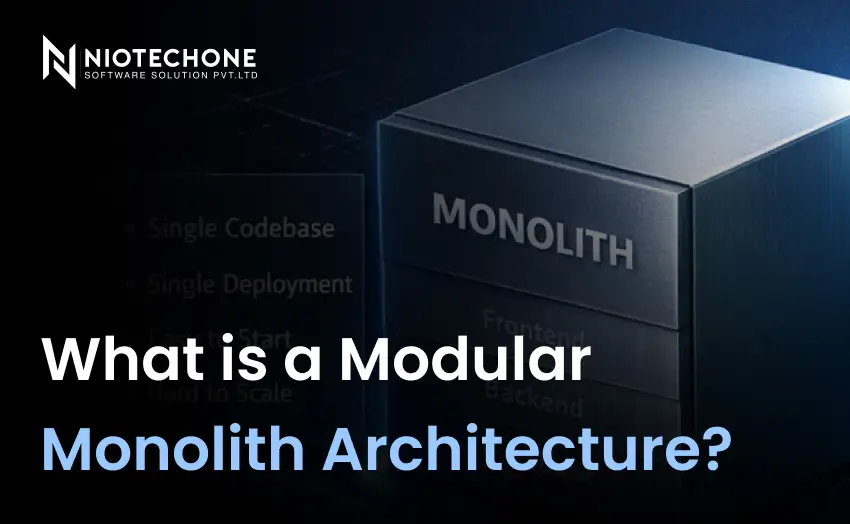
A modular monolith is a monolithic application with independent modules that process specific business functions. Each module contains its own business logic, services and responsibilities and is part of a deployable application.
In contrast to conventional monoliths, which include components that are tightly connected, modular monoliths have distinct separations between features. This helps to maintain it easily and enables the development team to function more effectively.
For an ASP.NET Core development company, modular monolith architecture provides a practical way to organize large applications without introducing the deployment complexity associated with microservices.
A modular monolith is an architecture that many modern businesses select, as it provides a balance between scalability and simplicity. It enables applications to grow while keeping development and deployment.
Simpler Deployment Process
It is easier to deploy than multiple microservices because a modular monolith is deployed as a single deployable application. At the early stages of development, teams need not think about service discovery, distributed communication, or orchestration of containers.
For a growing .NET development company, it reduces the complexity of operations and shortens project delivery schedules.
Faster Development Cycles
All the modules are part of the same application, allowing developers to work faster without worrying about inter-service communication issues. The entire system operates as a single unit, making debugging and testing easier.
An experienced ASP.NET development company can provide the features with speed without compromising the accurate organization of code.
Lower Infrastructure Costs
For microservices to work, you’ll need to use infrastructure solutions like containers, API gateways, monitoring software and orchestration software. A modular monolith reduces these infrastructure needs quite a bit.
In this way, a .NET development company can reduce costs while still building scalable applications by following clean architecture principles.
Read More: React with Micro-Frontends: Building Modular and Scalable Applications
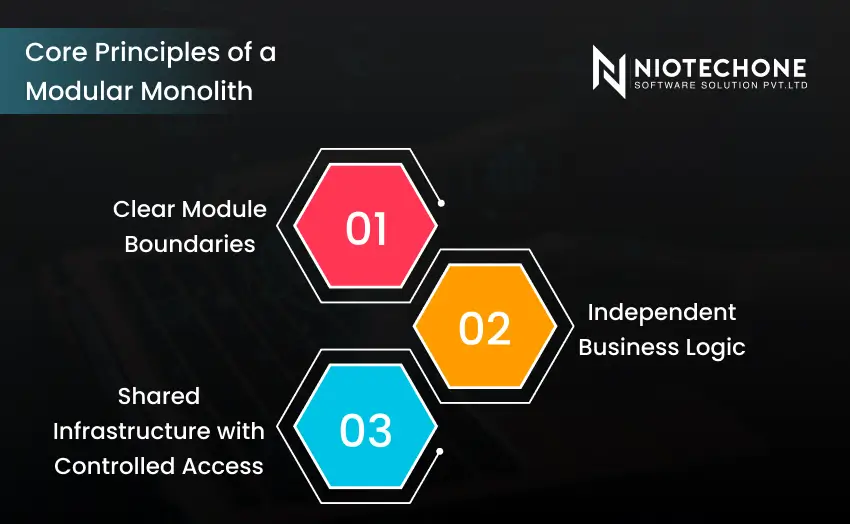
Creating a successful modular monolith involves adhering to certain architectural principles that ensure structure and scalability as the application evolves.
Clear Module Boundaries
Each module should have its own unique business capability, like authentication, notification, payments or orders. Modules should not be unnecessarily dependent on each other or other elements in the system.
A professional ASP.NET Core development company ensures that modules communicate with each other through well-defined interfaces, without direct access to the internal.
Independent Business Logic
Business rules and workflows should be managed at the module level, independently. This decreases the coupling between features and makes the code easier to maintain.
For enterprise applications created by a .NET Core development company, independent modules make future updates safer and easier to implement.
Shared Infrastructure with Controlled Access
While all modules run within an application, infrastructure resources, such as databases and services, etc., should be accessed in a controlled way.
This way, one can keep the clean architecture and refrain from creating tightly coupled modules.
A modular monolith offers long-term benefit to businesses developing scalable applications without the clutter and complexity of unnecessary infrastructure.
Easier Maintenance
Structured modules make debugging, testing and feature updating easier. Each developer can modify one module without affecting the whole application, making it a lot easier to maintain.
Better Scalability
Modular monoliths are an application made up of one or more modules, but they adhere to the principles of scalable architecture. More functionality can be added, but not all at once, nor with a major architectural redesign.
Improved Team Collaboration
Developing modules in a structured manner facilitates the development team to work together. The developers can work on a particular business area without affecting other parts of the system.
Simplified Testing
Automated Testing is easier and more reliable because modules have clear boundaries. This helps to ensure application stability and minimize long-term maintenance risks.
Both architectures have their pros and cons, and the decision on which one to use will depend on the project size, team structure, and scalability requirements.
Modular Monolith is the Better Choice when:
The modular monolith is best suited for:
For many companies, partnering with an ASP.NET Core development company in India offers the perfect balance between scalability and simplicity.
When Microservices Make More Sense
Microservices become valuable when applications require:
An experienced Microsoft .NET development company knows when it is the right time to transition gradually from modular monoliths to microservices.
While modular monolith architecture makes development easier, it can cause scalability and maintenance problems if it is not implemented well.
Creating Tight Coupling Between Modules
The direct access of each module’s internal logic makes it less maintainable in the long term and weakens the boundaries.
Sharing Too Much Database Logic
If too many database structures are shared between modules, then the system can be hard to scale and change in the future.
Ignoring Future Scalability
From the outset, any system, even a monolithic one, must be designed with the future in mind and with scalability in mind.
Overengineering the Architecture
Simply put, more complexity = less modular monolith. The architecture should continue to be functional and business-oriented.
The modular monolith is a viable design for companies that require scalability but do not want to deal with the overhead of microservices. Making the applications independent modules also facilitates the development of systems that can be more easily scaled, adapted over time, and maintained.
Businesses aiming at building reliable enterprise applications will ensure that they collaborate with a seasoned .NET development company such as Niotechone to achieve the best balance of flexibility, performance, and scalability.
A modular monolith is a single application divided into independent modules with clear business boundaries. It combines the simplicity of monolithic architecture with the structured organization of modular systems.
Many businesses prefer modular monolith architecture because it offers simpler deployment, lower infrastructure costs, and easier maintenance while still supporting application scalability.
Yes, modular monolith architecture works well for enterprise applications, especially during early and mid-scale growth stages where operational simplicity is important.
Yes, if modules are designed properly with clear boundaries and loose coupling, they can later be extracted into independent microservices when needed.
An experienced Microsoft .NET development company understands how to design scalable architectures, maintain module boundaries, and build future-ready enterprise applications efficiently.
3rd Floor, Aval Complex, University Road, above Balaji Super Market, Panchayat Nagar Chowk, Indira Circle, Rajkot, Gujarat 360005.
Abbotsford, BC
15th B Street 103, al Otaiba Dubai DU 00000, United Arab Emirates
3rd Floor, Aval Complex, University Road, above Balaji Super Market, Panchayat Nagar Chowk, Indira Circle, Rajkot, Gujarat 360005.
Abbotsford, BC.
15th B Street 103, al Otaiba Dubai DU 00000, United Arab Emirates.
Copyright © 2026 Niotechone Software Solution Pvt. Ltd. All Rights Reserved.