Building modern applications is not as simple as it used to be. Today’s users expect everything to work instantly — whether they are placing an order, making a payment, or receiving live updates. The problem is that as applications grow, the backend becomes harder to manage.
Instead of making every service directly depend on another service, applications communicate through events. That’s one reason many companies focused on .NET Core Development are moving toward event-driven systems for building scalable and reliable applications.
When something happens inside the application, an event gets triggered. Other services that need that information respond to it separately.
A simple example would be an online order. Once the order is placed, one service can handle payment, another can update stock, and another can send a confirmation email.
For example:
In older application structures, services are usually connected very tightly. If one service needs something, it directly asks another service to do it. As the project grows, this setup becomes difficult to handle because too many services start depending on one another.
RabbitMQ is commonly used in .NET applications because it solves a problem that shows up in a lot of growing systems — too many services depending on each other.
In smaller applications, direct communication between services usually feels manageable. But after adding more features, more users, and more background tasks, things slowly start becoming difficult to control. A small issue in one service can end up affecting several others.
RabbitMQ helps avoid that by using queues. One service sends a message, RabbitMQ stores it, and the required service picks it up when needed. Everything stays more organized and less tightly connected.
RabbitMQ follows a simple messaging flow.
A producer service creates and sends a message whenever an event occurs. RabbitMQ receives that message and stores it in a queue. Consumer services then listen to the queue and process the messages independently.
For example, when a customer places an order:
Each service works independently without tightly depending on another service.
The difference between traditional systems and event-driven systems becomes more noticeable as applications scale.
Traditional Architecture | Event-Driven Architecture |
Services directly depend on each other | Services communicate through events |
Mostly synchronous communication | Asynchronous communication |
Harder to scale individual services | Services scale independently |
Failures can affect the entire system | Better fault isolation |
Slower during heavy processing | Faster background processing |
This is one reason why businesses that hire .NET Core Developers often look for experience with RabbitMQ and distributed system architecture.
RabbitMQ is used in a lot of modern applications because many systems today depend on background processing and communication between multiple services.
eCommerce Applications
You’ll usually see RabbitMQ in eCommerce systems where several things happen right after an order is placed. The payment needs to be processed, stock needs updating, emails need to be sent, and shipping details may also need to be created.
Financial Systems
RabbitMQ is also used a lot in banking and finance applications because these systems handle transactions continuously throughout the day. A single payment may involve multiple checks happening in the background, like transaction verification, fraud monitoring, balance updates, or notifications.
Healthcare Platforms
Healthcare applications usually have multiple systems working together at the same time. RabbitMQ helps manage appointment scheduling, patient record updates, prescription notifications, and monitoring systems without creating too many direct dependencies between services.
SaaS Applications
Many SaaS products rely heavily on background processing. RabbitMQ is commonly used for tasks like email automation, analytics generation, scheduled reports, workflow management, and activity tracking, running behind the scenes.
These are some of the reasons modern ASP.NET Services often rely on messaging systems and asynchronous communication as applications continue growing.
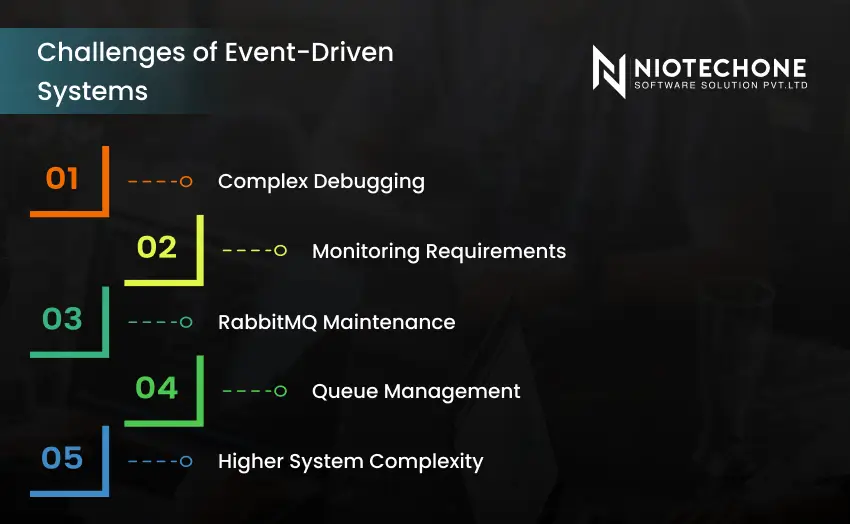
Complex Debugging
Debugging becomes harder because requests move through multiple services, queues, and background processes.
Monitoring Requirements
Teams need proper monitoring for queues, failed messages, and event processing to keep the system stable.
RabbitMQ Maintenance
RabbitMQ infrastructure also requires maintenance as traffic and workloads continue increasing.
Queue Management
Developers often need to manage queues and monitor message flow during high traffic periods.
Higher System Complexity
Event-driven systems offer flexibility, but they are usually more complex compared to traditional application architectures.
A lot of modern applications are now being built around microservices and cloud-based systems because businesses need applications that can keep growing without slowing down every few months.
As traffic increases and applications become larger, managing everything inside one tightly connected system becomes difficult.
You’ll also notice that businesses looking to hire ASP.NET developers often prefer developers who already understand RabbitMQ, background processing, and communication between microservices because these skills are becoming more common in modern application development.
Event-driven architecture is being used more in modern applications because it gives developers better control when systems start becoming larger and more complex. In many growing applications, keeping every service directly connected eventually creates performance and maintenance issues.
As companies continue building scalable .NET Core Services, event-driven architecture is becoming a more common approach in modern ASP.NET Development projects.
RabbitMQ is a message broker that allows services in .NET applications to communicate through messaging queues.
RabbitMQ helps applications process tasks asynchronously while improving scalability and reliability.
Yes. RabbitMQ is widely used in microservices because it enables independent communication between services.
Yes. RabbitMQ allows background processing, which helps applications respond faster to users.
Modern applications increasingly rely on distributed systems and messaging architecture, making RabbitMQ experience highly valuable for enterprise development.
3rd Floor, Aval Complex, University Road, above Balaji Super Market, Panchayat Nagar Chowk, Indira Circle, Rajkot, Gujarat 360005.
Abbotsford, BC
15th B Street 103, al Otaiba Dubai DU 00000, United Arab Emirates
3rd Floor, Aval Complex, University Road, above Balaji Super Market, Panchayat Nagar Chowk, Indira Circle, Rajkot, Gujarat 360005.
Abbotsford, BC.
15th B Street 103, al Otaiba Dubai DU 00000, United Arab Emirates.
Copyright © 2026 Niotechone Software Solution Pvt. Ltd. All Rights Reserved.