Design a Scalable Background Job in .NET with Hangfire

Introduction

At the beginning, many developers handle all these operations directly inside the request because it’s simpler and works fine when the application is still small. That’s usually when tools like Hangfire start becoming useful. 

In larger ASP.NET Services and enterprise applications, this becomes more important over time because background operations naturally increase as the system keeps growing.

Understanding Background Jobs in .NET

Background jobs are basically tasks that run separately instead of happening directly during the user request. This helps applications avoid making users wait while every operation finishes one by one.

Common examples include:

  • Sending confirmation emails
  • Generating invoices
  • Exporting reports
  • Processing uploaded files
  • Running scheduled cleanup tasks
  • Syncing third-party APIs

This approach helps applications feel faster because heavier operations are handled separately instead of blocking the main request flow.

Scalable Background Job in .NET with Hangfire

What Is Hangfire?

Hangfire is basically a background job library for .NET applications. Developers use it when they have tasks that shouldn’t run directly during the user request because those operations can slow the application down.

For example, instead of making users wait while emails are sent or reports are generated, Hangfire allows those tasks to continue running separately in the background.

That’s why Hangfire is often used in larger .NET Core Services where stable background processing becomes important as the application grows.

Why Businesses Use Hangfire

A lot of applications eventually need background processing once traffic and features start increasing.

Hangfire helps solve that problem by moving heavy or repetitive tasks away from the main application flow.

Some common reasons businesses use Hangfire include:

Use Case

Example

Email Processing

Sending welcome emails or notifications

Scheduled Tasks

Daily reports or cleanup operations

File Processing

Image resizing or PDF generation

API Synchronization

Syncing external services in background

Data Processing

Importing or exporting large datasets

Scalable Background Job in .NET with Hangfire

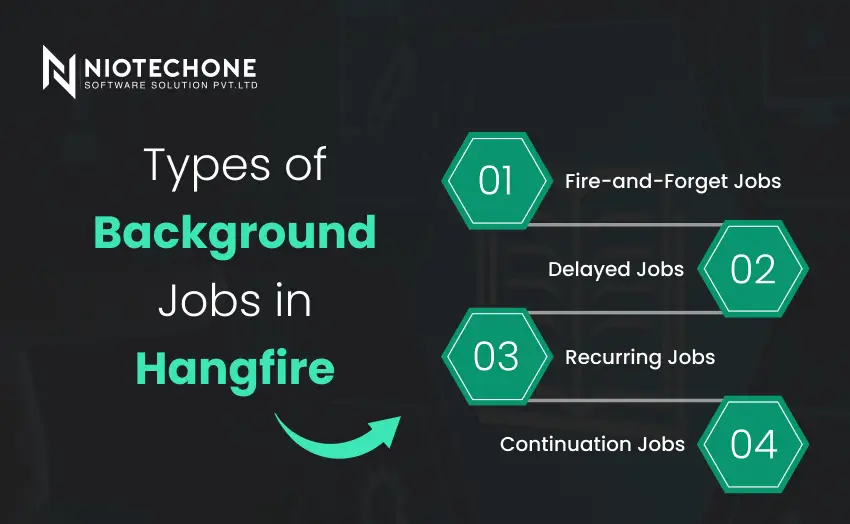
Types of Background Jobs in Hangfire

Hangfire supports multiple types of background jobs depending on application requirements.

Fire-and-Forget Jobs

These jobs run only once after being triggered.

They are commonly used for tasks like sending emails or generating notifications after user actions.

Delayed Jobs

Delayed jobs run after a specified amount of time.

For example, applications may schedule reminder emails to send a few hours later.

Recurring Jobs

Recurring jobs are scheduled repeatedly using cron expressions.

These are commonly used for:

  • Daily reports
  • Database cleanup
  • Analytics processing
  • Scheduled backups

Recurring jobs are very common in enterprise ASP.NET Services, where automated background operations run continuously.

Continuation Jobs

Continuation jobs start after another job completes successfully.

This becomes useful when multiple background processes depend on each other.

Designing Scalable Background Jobs

As applications get bigger, background jobs also need a bit more planning. Just adding background processing alone doesn’t automatically solve performance problems if the jobs themselves are poorly designed.

Keep Jobs Small

One large job trying to handle too many things together can become difficult to manage later. In most cases, smaller jobs are easier to process, monitor, and retry if something fails unexpectedly.

Avoid Long Database Locks

Background jobs should not keep database connections busy for long periods unless necessary.

Heavy queries running continuously in the background can eventually slow other parts of the application too, especially in systems handling large traffic regularly.

Use Retry Mechanisms Carefully

Hangfire supports automatic retries for failed jobs, which is useful in many situations.

But retries also need limits. If the same job keeps failing repeatedly, constant retries can create unnecessary server load and make troubleshooting harder.

Separate Critical and Non-Critical Jobs

Not all background jobs are equally important.

Tasks like payment processing or order handling are usually treated differently from lower-priority operations like analytics updates, logging, or notifications.

Scaling Hangfire in Large Applications

Smaller projects may run Hangfire on a single server without issues.

But larger enterprise systems usually require additional scaling strategies.

Multiple Job Servers

Hangfire supports running multiple job servers together.

This allows applications to process larger workloads across multiple machines or containers.

Queue Separation

Applications often separate queues based on job priority.

For example:

Queue Type

Purpose

Critical Queue

Payments and important operations

Default Queue

Standard application tasks

Low Priority Queue

Analytics or reporting

Queue separation helps applications process important jobs faster during heavy traffic.

Distributed Systems Support

Hangfire works well in distributed architectures and cloud-native environments.

Many modern ASP.NET Services combine Hangfire with:

This setup helps applications scale more efficiently as workloads increase.

Common Challenges with Hangfire

Even though Hangfire makes background processing much easier to handle in .NET applications, some challenges still start appearing once applications become larger and workloads increase.

  • Job Failures: Background jobs can fail for different reasons. Sometimes it’s a database issue, sometimes a network timeout, or even a third-party API not responding properly.
  • Queue Overload: One common issue happens when applications keep creating jobs faster than the server can process them.
  • Resource Usage: Some background jobs can also consume a lot of CPU or memory if they are not optimized properly.
  • Monitoring Complexity: As the number of background jobs increases, monitoring everything also becomes harder.


The Future of Background Processing in .NET

Modern applications are becoming more event-driven, distributed, and cloud-based.

Businesses building enterprise .NET Core Services increasingly rely on background job systems for:

  • Automation
  • Workflow processing
  • Notifications
  • Scheduled operations
  • Data synchronization

As applications continue growing in complexity, scalable background processing will remain an important part of modern .NET architecture.

Challenges When Adopting New C# Features

Team Standardization

Large development teams usually need time before introducing new syntax or coding styles across all projects.

Legacy Application Support

Older applications cannot always move to the latest .NET version immediately, so upgrades often happen gradually.

Readability Concerns

Some developers prefer simpler and more familiar syntax instead of using every new C# feature available.

Gradual Adoption Process

In most projects, teams slowly adopt newer C# features over time instead of changing everything at once.

Conclusion

A lot of applications today rely on background tasks more than people usually realize. Things like sending emails, processing reports, updating data, or running scheduled operations often continue working separately while users keep using the application normally.

For larger ASP.NET Services and enterprise .NET Core Services, this becomes more useful as the application grows and background operations start increasing every day.

Frequently Asked Questions FAQs

Hangfire is a .NET background job framework used for scheduling and processing background tasks.

Background jobs help move heavy operations away from user requests, improving application responsiveness and scalability.

Yes. Hangfire supports recurring jobs using cron-based scheduling.

Yes. Hangfire is widely used in enterprise .NET applications for handling scalable background processing.

Modern applications often rely heavily on background processing, automation, and distributed systems, making Hangfire experience valuable in scalable backend development.