Zero Trust Security in ASP.NET Core Applications

Introduction: Why Zero Trust Matters in 2026

The security paradigm of “trust but verify” is long gone. Up until recently, it was common practice to assume that anything residing on corporate networks could be trusted implicitly. Firewalls guarded your perimeter, and users on that perimeter were granted access to your resources automatically.

With Zero Trust Security, this paradigm is turned on its head. Its core principle is extremely simple: never trust; always verify. All requests, be they from outside or inside the corporate network, must undergo authentication and authorization checks and must remain under constant validation. At Niotechone Software Solution Pvt. Ltd., a Microsoft .NET development agency, implementing Zero Trust in ASP.NET Core web applications is among our top client demands.

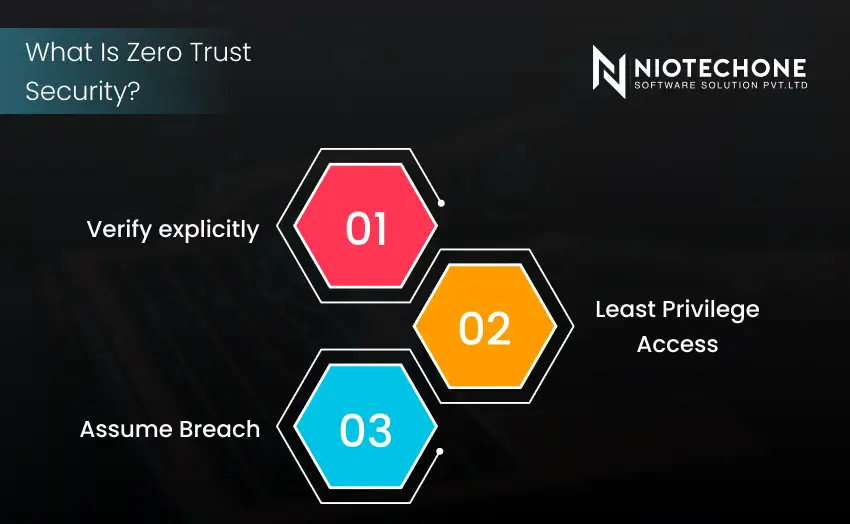
Illustration explaining Zero Trust Security principles with three connected hexagons labeled “01 Verify explicitly,” “02 Least Privilege Access,” and “03 Assume Breach” on a dark technology-themed background.

What Is Zero Trust Security?

The concept of Zero Trust was coined back in 2010 by John Kindervag of Forrester Research. What started as an unconventional approach in cybersecurity has since become standard practice: no more implicit trust. Stop trusting users and devices because they reside inside your network. Verify everything, and every time.

A Zero Trust Security Architecture follows three basic principles:

Verify explicitly – All access requests shall be authenticated, authorized and encrypted on the basis of all available data points, including user identification, device health, user location, resource sensitivity and behavioural patterns.

Least Privilege Access – Give users only the permissions necessary for the minimal time possible. JIT (Just-in-time) and JEA (Just Enough Access) access control minimize risks related to credential compromise.

Assume Breach – Run the business assuming that your network has been compromised. Segment access to resources, encrypt traffic end-to-end, and leverage analytics to detect suspicious patterns. Design systems keeping a minimal blast radius in mind.

Difference Between Zero Trust vs. Traditional Security

The difference between traditional perimeter security and Zero Trust is fundamental:

Aspect

Traditional (Perimeter)

Zero Trust

Trust model

Trust inside, restrict outside

Never trust, always verify

Network access

VPN = full network access

Access is per-application

Authentication

One-time authentication when crossing the perimeter

Contextual and continuous

Lateral movement

Easy (flat network)

Blocked (micro-segmentation)

Remote access

Access via the corporate office’s VPN tunnel

Access to resources from anywhere securely

Breach impact

Large (full network exposed)

Minimal (isolated)

Moving forward to build modern software applications, an ASP.NET development company should reconsider its security approach.

The Five Pillars of Zero Trust

It’s important to note upfront that Zero Trust is not a product or a technology. It is an architectural approach with five main pillars:

1) Identity

The new perimeter is identity. In a Zero Trust architecture, who requests access matters more than where they make the request. It means mandatory phishing-resistant multi-factor authentication (MFA) via FIDO2 keys or passkeys.

2) Device

Your application should know every device trying to reach it and ensure it is up-to-date and healthy.

3) Network

By implementing micro-segmentation, you divide your network into independent zones. Even if attackers manage to compromise one of your services, they won’t be able to move horizontally and access another part. Zero Trust Network Access (ZTNA) is what replaces outdated legacy solutions like a VPN.

4) Application

At the application level, there should be fine-grained controls to grant access to the application and related data only to those users who really need it. You can achieve this with the help of APIs, web application firewalls (WAF), or identity-aware proxies.

5) Data

Ultimately, Zero Trust protects data. Proper classification, encryption (both at rest and in transit), and DLP policies mean sensitive data is safe even if other controls are circumvented.

As a company focused on .NET Core development, Niotechone ensures implementation of all Five Pillars for our clients, identity and application controls being the key factors for ASP.NET Core.

Implementing Zero Trust in ASP.NET Core

Strong Authentication with OAuth 2.0 and OpenID Connect

The first step of Zero Trust is identifying each entity accessing an application. For ASP.NET Core apps, this means moving away from primitive cookie-based authentication to more advanced solutions like OAuth 2.0 and OpenID Connect.

Microsoft Entra ID (Azure AD formerly) is a cloud IAM solution designed with Zero Trust in mind, providing a comprehensive authentication and authorization infrastructure. With Entra ID:

  • Single Sign-On (SSO) can be set up for multiple applications
  • Multi-Factor Authentication (MFA) is enforced
  • Conditional access policies defined for various conditions: users, geography, device, and risk level
  • Audit logs are kept for compliance purposes


Our .NET developers have extensive experience integrating .NET apps with Entra ID using
Microsoft.Identity.Web library.

Continuous Verification and Monitoring

Zero Trust not only relies on authentication but also constantly verifies it. That includes:

  • Structured logging logs all access attempts, authentication failures, and authorization decisions. You can use Serilog with Application Insights or Elastic Stack to add observability to your security strategy.
  • Anomaly detection flags suspicious activity, including odd login times, impossible travel (logging in from two distant places within minutes), or an access attempt spike.
  • Short-lived tokens minimize the window of attack. Refresh tokens rotate automatically, while session times out based on inactivity.


At Niotechone for ASP.NET application development projects dealing with sensitive information, we utilize Azure Monitor and Application Insights to deliver real-time security telemetry.

ASP.NET Core 10: Zero Trust Built In

ASP.NET Core 10 (.NET 10 release – 2025) brings Zero Trust built-in capabilities to the framework. Specifically:

  • PKCE support for OAuth 2.0 flow in SPA/mobile apps that protects authorization code from interception.
  • Granular rate-limiting combined with authorization policies to protect against abuse and DoS attacks.
  • Automatic certificate rotation without downtime with Azure Key Vault or file system monitoring.


As a .NET application development company, Niotechone follows these advancements and leverages the native capabilities of frameworks for client application security.

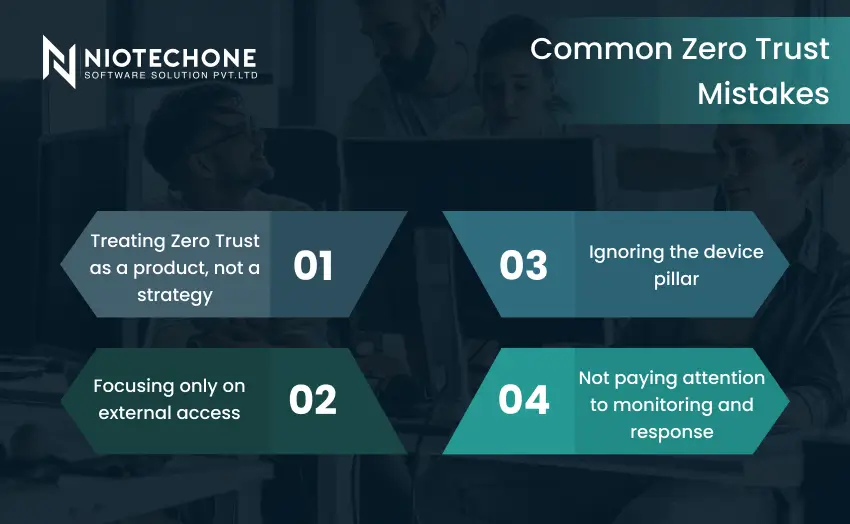
Infographic showing common Zero Trust mistakes, including treating Zero Trust as a product, focusing only on external access, ignoring the device pillar, and neglecting monitoring and response.

Common Zero Trust Mistakes

Treating Zero Trust as a product, not a strategy 

There is no vendor that provides zero trust as an out-of-the-box solution. Implementing zero trust requires architectural changes across identity, devices, networks, applications, and data. You should be cautious of any claims that promise instant zero-trust compliance. 

Focusing only on external access

The implementation of zero trust starts from within. Most cases of breach start from internal access and the use of compromised accounts. You need to segment the internal services and validate each request irrespective of where it comes from.

Ignoring the device pillar

Validation of the user is just the first step. The validation process has to consider the state of the machine in terms of patches, health, and compliance.

Not paying attention to monitoring and response 

The concept of Zero Trust means you are already breached. It is hard to detect and contain attacks without proper monitoring using SIEM and anomaly detection, among other mechanisms.

When you engage us to provide .NET development services, you will enjoy services from experts who avoid these common mistakes and do Zero Trust right from the start.


Conclusion

Now, Zero Trust Security has transcended beyond its hype and has become essential for businesses. Zero Trust Security is non-negotiable when it comes to ASP.NET development services in 2026 for businesses that deal with confidential data, payment details, or regulated operations.

Niotechone Software Solution Pvt. Ltd., being an industry-leading ASP.NET Core development company, incorporates Zero Trust Security practices in all client applications. This includes implementing security by design from the point of robust user authentication with Microsoft Entra ID to authorization policies and mTLS, among others.

Frequently Asked Questions FAQs

No. Any organization building web applications can benefit from Zero Trust principles. Start with MFA and policy-based authorization. As a .NET development company, Niotechone implements Zero Trust for startups and enterprises alike.

No, but cloud identity providers like Microsoft Entra ID make implementation easier. Zero Trust principles apply to on-premises applications, too.

With proper caching of tokens and validation results, the performance impact is minimal (milliseconds per request). The security benefits far outweigh any overhead.

MFA everywhere. It blocks 99.9% of account compromise attacks. Start there.

Niotechone provides assessment, architecture design, implementation, and training. From .NET development services to staff augmentation, we meet you where you are.