Advanced Caching Strategies in ASP.NET Core for Traffic Apps

Introduction

One of the most important aspects of any web application today is performance. With the surge in traffic, applications often struggle with slow response times, database overload, and server performance issues. That’s where advanced caching strategies come into play.

For companies that use a .NET development company, contributing to enhanced scalability and delivers a smooth user experience. Modern applications are created using ASP.NET Core applications, as it helps to minimize the number of database queries and enhance the performance of the application.

Why Caching Matters in High-Traffic Applications

Each request that an application processes uses server resources. Repeatedly accessing the database for the same data can slow the system down considerably.

The solution to this problem is to store the data that is accessed repeatedly in memory or distributed systems temporarily, which is called caching. This allows applications developed by a .NET development company to react quicker and to decrease the load on the database.

Caching is crucial for high-traffic sites like eCommerce platforms, SaaS applications, and enterprise portals to ensure performance and stability.

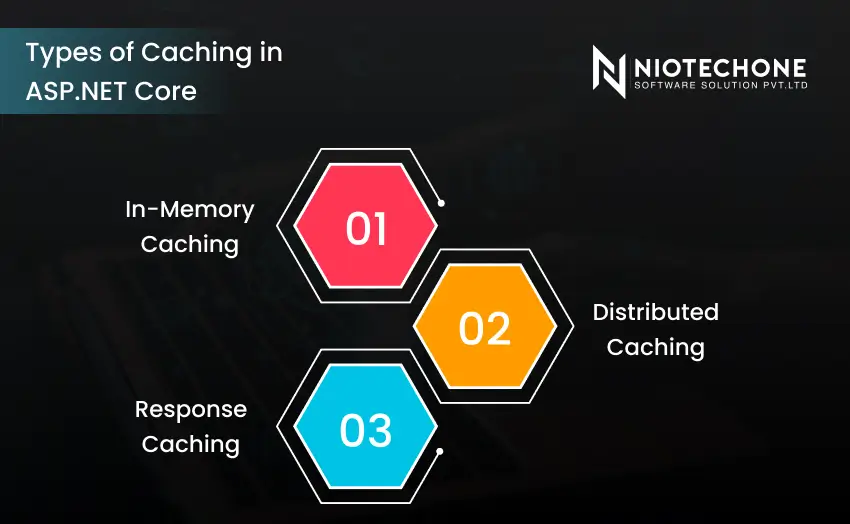
Infographic showing the three main types of caching in ASP.NET Core: In-Memory Caching, Distributed Caching, and Response Caching.

Types of Caching in ASP.NET Core

In-Memory Caching

In-memory caching is the technique of keeping data in the application server’s memory. It is one of the fastest caching techniques available in ASP.NET Core.

This is suitable for small-to-medium applications managed by an ASP.NET development company, particularly when data does not need to be shared between multiple servers.

Best Use Cases

  • Data that is accessed often and is used to configure the system.
  • User session information
  • Temporary application data


Distributed Caching

Distributed caching is the ability to store cached data in external systems like Redis or SQL Server. It allows multiple servers to access the same cached data, unlike in-memory caching.

For enterprise systems created by a Microsoft .NET development company, distributed caching is a key component of scalability and load balancing.

It has several benefits:

  • Supports large-scale applications
  • Enhances scalability on servers
  • Minimizes database traffic considerably


Response Caching

Response caching is the ability to store an HTTP response and return it to the user without re-processing the request.

This is a typical approach of an ASP.NET Core development company to enhance API performance and lower server load.

Key Advantages

  • Improved page load speeds
  • Reduced CPU usage
  • Better user experience

Advanced Caching Strategies for ASP.NET Core

Cache Aside Pattern

One of the most popular caching patterns in today’s applications is the Cache Aside pattern.

In this approach, the application first checks whether data exists in the cache. Otherwise, it fetches the data from the database and stores it in the cache for future requests.

For teams that provide professional .NET development services, this method balances between performance and data consistency.

Distributed Redis Caching

Redis is one of the most popular distributed caching solutions for enterprise applications.

Applications developed by a .NET Core development company often use Redis because of its speed, scalability, and support for distributed environments.

Why Redis is Popular

  • Extremely fast performance
  • Supports distributed architecture
  • Manages heavy traffic well

Data Expiration Strategies

It is not feasible to store data indefinitely, as it can become inconsistent if the data is outdated.

Smart expiration strategies keep the data in the cache accurate and enhance performance.

Common Expiration Approaches

  • Absolute expiration
  • Sliding expiration
  • Token-based invalidation

An experienced ASP.NET development company carefully selects expiration policies according to the requirements of the application.

Output Caching for APIs

Many APIs often process the same requests repeatedly. Output caching caches API responses and prevents repeated processing.

For companies that depend on APIs created by a Microsoft .NET development company, output caching can significantly enhance scalability and reduce infrastructure costs.

Hybrid Caching Strategy

Many enterprise applications use several caching techniques to achieve optimal performance.

For example:

  • In-memory caching for local performance.
  • Distributed systems and Redis caching.
  • Response caching for APIs

A skilled ASP.NET Core development company uses hybrid caching to optimize both speed and scalability.


Graphic outlining common ASP.NET Core caching mistakes such as caching everything, ignoring cache invalidation, poor expiration management, and overusing in-memory caching.

Common Caching Mistakes Developers Should Avoid

While caching can enhance performance, it can also cause significant problems if not implemented correctly.

Caching Everything

Not all data should be cached. Frequently changing data can become outdated quickly and create inconsistencies.

Ignoring Cache Invalidation

Failing to update or remove old cache entries can lead to incorrect application behavior.

Poor Expiration Management

If the expiration is set incorrectly, it can cause the database to become overloaded or provide stale data to users.

Overusing In-Memory Caching

The is used for large-scale applications that are managed by a .NET Core development company should avoid relying solely on server memory caching.

How Advanced Caching Improves Business Performance

Caching directly impacts both technical performance and business outcomes.

Faster User Experience

Applications load quicker, which boosts customer satisfaction and engagement.

Reduced Infrastructure Costs

Efficient caching reduces database usage and server load, which helps to lower operational costs.

Improved Scalability

Modern platforms can withstand more traffic without significant performance loss.

Better Application Stability

During peak traffic periods, it helps alleviate pressure on backend systems.

Conclusion

A security solution is essential in securing applications, APIs, and infrastructure from cyber-attacks and other malicious activities that may threaten the application infrastructure. This can be achieved through the use of .NET 10 together with Microsoft Entra ID in order to develop an authentic system that provides a highly secure and cloud-based authentication solution suitable for any enterprise today. Features such as OAuth 2.0 authentication, OpenID Connect, Multi-Factor Authentication, and tokens for securing API make it easier for enterprises to secure their identities while providing a better experience for their users.

Frequently Asked Questions FAQs

Caching stores frequently accessed data temporarily to improve application performance and reduce database load.

Distributed caching using Redis is one of the best solutions for scalable high-traffic applications.

Redis offers extremely fast performance, distributed support, and efficient handling of large traffic volumes.

Yes, proper caching reduces database usage and server workload, lowering infrastructure expenses.

Advanced caching improves application speed, scalability, and user experience while maintaining system stability during traffic spikes.