Serverless .NET: Getting Started with Azure Functions in 2026

Introduction: Why Serverless .NET in 2026?

By 2026, serverless will have evolved immensely. At Niotechone Software Solution Pvt. Ltd., we are the best ASP.NET developers and have helped hundreds of clients save 60-80% on their infrastructure costs by adopting serverless architecture. Microsoft has recently made Azure Functions capable of supporting .NET 9 and .NET 10 previews with reduced cold starts, AOT compilation, and enhanced Visual Studio tools.

As a top ASP.NET development company, you can leverage the power of Azure Functions with .NET. Azure Functions can scale to zero, which means you do not pay for any idle VMs!

What Are Azure Functions? A .NET Perspective

Azure Functions is Microsoft’s serverless compute platform that executes a small piece of code when a specific event occurs. You will only consider actual execution and not idle instances.

For a .NET development company, this is transformative. Your existing C# skills transfer directly. Azure Functions support:

  • Triggers: HTTP, Timer, Blob Storage, Queue, Event Grid, Cosmos DB 
  • Bindings: No-code data connections (no plumbing needed) 
  • Isolated Process Model: Run .NET functions out-of-process (full flexibility with the framework)

As a company in ASP.NET development, we often substitute heavy Web API implementations with functions triggered via HTTP requests.

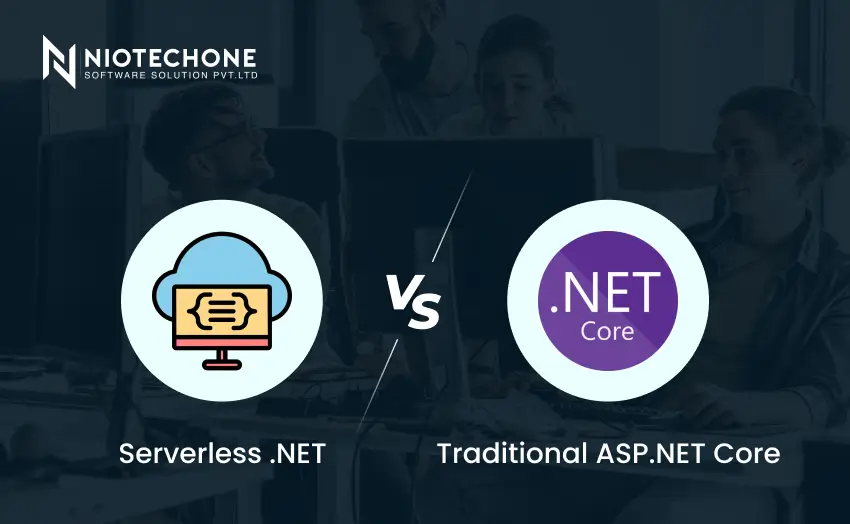
Comparison infographic showing Serverless .NET versus traditional ASP.NET Core architecture for modern cloud application development.

Serverless .NET vs. Traditional ASP.NET Core

Feature

Traditional ASP.NET Core

Azure Functions (Serverless)

Hosting

Always-on VM or container

Event-driven, scales to zero

Cost

Pay for uptime (24/7)

Charge-per-execution and GB-seconds

Cold start

Never

The first call may take a couple of seconds

Best for

APIs, websites, and real-time

Batch processing, webhooks, events handling

Step-by-Step: Your First Azure Function in 2026

We’ll create an “Order Confirmation” function triggered when a message arrives at a Queue.

Prerequisites

  • .NET 9 SDK (or .NET 10 Preview)
  • Azure Functions Core Tools version 5+
  • Azure account (even a free one is enough)
  • Visual Studio 2026 or Visual Studio Code


Step-1: Create the Project

Open a terminal and run:

💻
mkdir Niotechone.ServerlessDemo
cd Niotechone.ServerlessDemo
dotnet new func --name OrderProcessor --worker isolated
cd OrderProcessor

The –worker-isolated flag enables isolation process mode (best option for .NET 9+)

Step-2: Add a Queue Trigger Function

Create a new file ProcessOrderFunction.cs:

🔷
using Microsoft.Azure.Functions.Worker;
using Microsoft.Extensions.Logging;

namespace Niotechone.ServerlessDemo.OrderProcessor;

public class ProcessOrderFunction
{
    private readonly ILogger _logger;

    public ProcessOrderFunction(ILogger logger)
    {
        _logger = logger;
    }

    [Function(nameof(ProcessOrder))]
    public void ProcessOrder(
        [QueueTrigger("orders", Connection = "AzureWebJobsStorage")] OrderMessage message)
    {
        _logger.LogInformation($"Processing order {message.OrderId} for customer {message.CustomerEmail}");
        
        // Simulate business logic
        // In production, call your existing .NET business layer here
        
        _logger.LogInformation($"Order {message.OrderId} processed successfully");
    }
}

public class OrderMessage
{
    public string OrderId { get; set; } = string.Empty;
    public string CustomerEmail { get; set; } = string.Empty;
    public decimal Amount { get; set; }
}

Step-3: Configure Local Settings

Update local.settings.json:

📋
{"IsEncrypted":false,"Values":{"AzureWebJobsStorage":"UseDevelopmentStorage=true","FUNCTIONS_WORKER_RUNTIME":"dotnet-isolated"}}

Step-4: Run Locally

💻
dotnet build
func start

You should see:

🌐
Functions:
    ProcessOrderFunction: queueTrigger

Step-5: Deploy to Azure

📋
az login
func azure functionapp publish NiotechoneOrderProcessor --dotnet-version 9.0

A pro tip: To minimize a cold-start latency, enable Native AOT for your .NET 9 Functions.

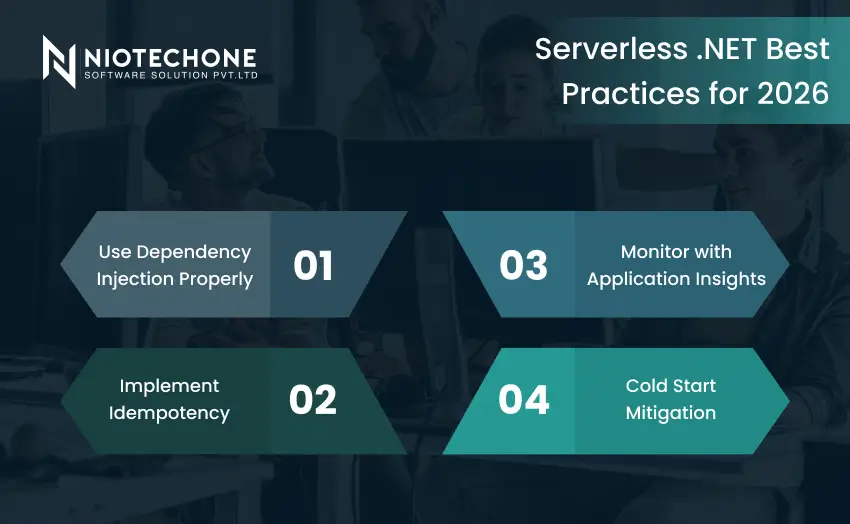
Infographic listing serverless .NET best practices including dependency injection, idempotency, monitoring with Application Insights, and cold start mitigation.

Serverless .NET Best Practices for 2026

Being a .NET application development company, Niotechone adheres to the following principles for serverless production workloads:

1) Use Dependency Injection Properly

Azure Functions (.NET Isolated) offers the same DI patterns that ASP.NET Core supports:

🔷
// Program.cs
var host = new HostBuilder()
    .ConfigureFunctionsWorkerDefaults()
    .ConfigureServices(services =>
    {
        services.AddScoped();
        services.AddHttpClient();
    })
    .Build();

host.Run();

2) Implement Idempotency

Queue trigger events may send duplicate messages. Ensure that your functions are idempotent:

🔷
// Check if already processed
if (await _orderRepository.ExistsAsync(message.OrderId))
{
    _logger.LogWarning("Order {OrderId} already processed, skipping", message.OrderId);
    return;
}

3) Monitor with Application Insights

Azure Functions integrates seamlessly with Application Insights for distributed tracing, logging, and performance monitoring. Enable it for production applications.

4) Cold Start Mitigation

  • Enable .NET 9 Native AOT – Improves cold start latency from ~2 seconds to ~50 milliseconds.
  • Choose the Azure Functions Premium plan – Always warm instances for latency-sensitive workloads.
  • Minimize dependencies – Adds startup delay for each assembly.

Real-World Use Cases for Serverless .NET

Below is how Niotechone Software Solution Pvt. Ltd. enables clients to implement serverless .NET applications through Azure Functions:

Industry

Use Case

Trigger

E-commerce

Emails for order confirmation after checkout

Queue (Service Bus)

Healthcare

Image resizing for doctors’ uploaded pictures

Blob Storage trigger

Fintech

End-of-day reconciliation reports

Timer (CRON)

Logistics

Update tracking status from IoT devices

Event Grid

SaaS

Handler for webhook notifications from external applications

HTTP trigger

Employing developers from Niotechone ensures your team knows these serverless patterns.

Why Niotechone Chooses Serverless .NET for Clients

Being among the most reputable .NET developers, we’ve successfully transformed many ASP.NET applications into serverless solutions already. Here is why:

  • 70% average cost reduction versus always-running App Service plans.
  • No need to manage any servers as scaling, patching, and high-availability features are provided by Azure itself.
  • Sub-millisecond billing – pay for the actual resource usage.
  • Quicker delivery thanks to no deployment pipeline for servers or containers.


“We have turned to Niotechone’s ASP.NET development services to migrate our batch processes to Azure Functions. This way, our monthly bill of

2,500 to under

2,500 to 400.” – CTO of a logistics startup.

Testing Your Azure Functions

Run functions triggered via queues on your local machine by means of Azurite (Azure storage emulator). Unit testing:

🔷
[Test]
public async Task ProcessOrder_Should_Log_OrderId()
{
    // Arrange
    var logger = Mock.Of<ILogger>();
    var function = new ProcessOrderFunction(logger);
    var message = new OrderMessage { OrderId = "TEST-123", CustomerEmail = "test@example.com" };

    // Act
    function.ProcessOrder(message);

    // Assert - verify logger received expected message
    // (using your preferred mocking library)
}

Conclusion

In 2026, serverless .NET with Azure Functions has come of age as a reliable, scalable, and cost-efficient platform for event-driven scenarios. We are proud to be the most professional ASP.NET and .NET Core development company that offers efficient ASP.NET and .NET Core development by leveraging Azure Functions. With our expertise in ASP.NET development and serverless architectures, we help our customers to significantly speed up their time-to-market. Contact Niotechone Software Solution Pvt. Ltd. to get started!

Frequently Asked Questions FAQs

No. For user-facing APIs with consistent traffic, use ASP.NET Core on App Service or Kubernetes. Azure Functions excel at sporadic or bursty workloads.

Yes, dramatically. With Native AOT compilation, cold starts go from 1-2 seconds to under 50ms. As a .NET application development company, we enable AOT for all production functions.

Yes, but carefully. Use EF Core for read operations with data caching. For writes, consider Dapper or direct Cosmos DB bindings to avoid connection pool exhaustion.

Consumption (pay per execution, scales to zero). Premium (always-warm instances, VNet integration, longer timeout). Choose Premium for latency-sensitive workloads.

Azure Key Vault + Managed Identity. Never store connection strings in local.settings.json for production. We inject secrets via Key Vault references in Application Settings.