Today, security breaches happen when, not if. As a .NET development company, protecting customers’ apps from attacks is not limited to programming. Your goal is to build security features directly into your development pipeline to minimize the number of threats to your customers.
As a leading .NET development company, Niotechone Software Solution Pvt. Ltd. has assisted many clients in adopting the DevSecOps approach from reactive to proactive. The result? Faster deployments, fewer vulnerabilities, and less costly compliance management.
The DevSecOps approach implies integrating security measures into all development phases, not considering them the last step. For instance, Niotechone Software Solution Pvt. Ltd. integrates automated scanning for secrets, dependencies, and other aspects into your CI/CD pipeline so that any vulnerability gets detected within minutes, not months.
DevSecOps stands for “Development, Security, and Operations” – three processes that start cooperating from day one. Automated security scans are triggered as soon as your developer makes a commit or a pull request.
It is especially transformative for a .NET Core development company that serves enterprise customers. Vulnerabilities get discovered in a matter of minutes instead of weeks. Developers get feedback instantly. Security teams are no longer the bad guys who stand in the way of shipping.
According to Niotechone Software Solution Pvt. Ltd., DevSecOps can be defined through answering three questions continuously: What are we building? Are we building it correctly? Is it safe to run?
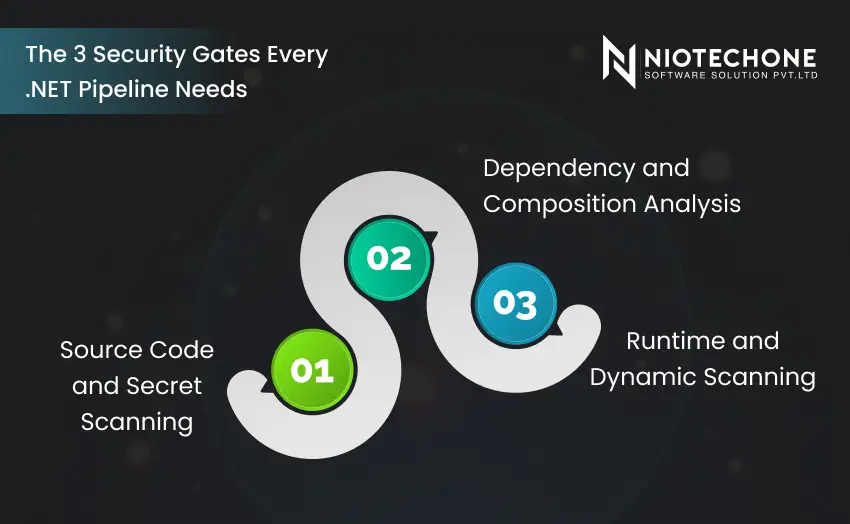
Gate-1: Source Code and Secret Scanning
This gate runs before you even review your pull request. It scans all files in your repository for credentials, tokens, and other configuration data that contains sensitive information.
Niotechone Software Solution Pvt. Ltd. sets up secret scanning so the pipeline fails immediately when any credentials match a predefined list of patterns. There are no exceptions made for “this is only a test key”. Clients of a .NET application development company often discover secrets left in commits that got deleted months ago.
Gate-2: Dependency and Composition Analysis
This gate executes when building your application. It scans each and every NuGet package your app depends upon, including packages of transitive dependencies that your code never touches.
Imagine a .NET application development company writing perfect code but pulling in a logging utility package that depended on an old version of the JSON parser known to be vulnerable to remote code execution attacks. Gate number two will catch this automatically.
Gate-3: Runtime and Dynamic Scanning
This step happens right after your application is deployed into a staging environment. While static analysis deals with your code, runtime/dynamic analysis interacts with your actual application.
However, many ASP.NET Core development company teams avoid dynamic scanning because “unit tests cover everything.” They do not. Unit tests verify expected behavior. Dynamic scans identify unexpected behavior exploited by attackers.
Scenario-1: The Hard-Coded Connection String
The .NET development services client approached Niotechone Software Solution Pvt. Ltd. after their staging database was deleted by the attacker. After the investigation, it turned out that a developer had committed the hard-coded credentials with full access to the staging database.
After implementing secret scanning, the same client caught four additional hard-coded credentials within the first week. None of their developers realized these secrets existed.
Scenario-2: The Poisoned NuGet Package
A Microsoft .NET development company creating a financial technology application nearly delivered poisoned dependencies to customers. The company’s build pipeline included a popular logging package that was typosquatted by an attacker.
However, the package was different from the real one, which contained one letter difference in the package’s name. In addition, the package was released by the attacker hours before the client’s automated build took place.
Niotechone Software Solution Pvt. Ltd. identified the package through the DevSecOps pipeline due to the mismatch between its signature and the signature of the official publisher.
Faster Compliance and Audits
By choosing the ASP.NET development company with DevSecOps practices, compliance will be a part of your everyday development process. Each security control generates audit evidence. Each remediation process creates audit documentation. Each deployment provides an attestation of scanning results.
Reduced Mean Time to Remediation
An average .NET development company needs forty-five days to deploy a solution to address a detected vulnerability. Forty-five days do not go into developing a fix. Rather, it takes a lot of time to prioritize and schedule work on other projects.
Lower Total Cost of Ownership
Accumulation of security debt follows the same path as technical debt; each day that a vulnerability is ignored means that it will cost more to fix in the future. Security debt incurred by .NET Core development company will eventually translate into investigation costs, legal costs, customer notification, and fines.
Empowering the Developer, Not Blaming the Developer
The best ASP.NET development services companies are not afraid of security; they embrace it. By adopting a DevSecOps practice, the developer can instantly get feedback without having to wait for another security team.
DevSecOps is not simply about avoiding breaches; it is about developing better software and doing it quickly. Niotechone Software Solution Pvt. Ltd., the top Microsoft .NET development company, has witnessed firsthand the benefits of having DevSecOps practices. Secure pipelines make it easier to develop high-quality software.
With immediate feedback from the automated security process, the developer avoids accumulating technical debt; the fast fixing of bugs ensures that the pipeline is always clean.
No. Niotechone Software Solution Pvt. Ltd. implements DevSecOps for startups, mid-sized companies, and large enterprises alike. The principles scale down as easily as they scale up. A solo developer can run secret scanning and dependency checking on their laptop.
Security gates add approximately three to five minutes to your build time. Most .NET Core development company clients find this tradeoff acceptable given the protection provided. Running scans only on pull requests rather than every commit reduces the impact further.
False positives occur, especially with dynamic scanning tools. Niotechone Software Solution Pvt. Ltd. helps you configure allowlists and suppression rules for confirmed false positives.
Absolutely. Niotechone Software Solution Pvt. Ltd. has implemented DevSecOps for clients with air-gapped environments, government clouds, and on-premises TFS instances. The tools we recommend work without internet access using mirrored vulnerability databases.
The average data breach cost for a .NET development company exceeds one million dollars. DevSecOps implementation costs a fraction of that. Niotechone Software Solution Pvt. Ltd. provides business case templates and risk assessment frameworks to support your internal proposal.
3rd Floor, Aval Complex, University Road, above Balaji Super Market, Panchayat Nagar Chowk, Indira Circle, Rajkot, Gujarat 360005.
Abbotsford, BC
15th B Street 103, al Otaiba Dubai DU 00000, United Arab Emirates
3rd Floor, Aval Complex, University Road, above Balaji Super Market, Panchayat Nagar Chowk, Indira Circle, Rajkot, Gujarat 360005.
Abbotsford, BC.
15th B Street 103, al Otaiba Dubai DU 00000, United Arab Emirates.
Copyright © 2026 Niotechone Software Solution Pvt. Ltd. All Rights Reserved.