The latest release mostly focuses on making code cleaner and less repetitive. A lot of developers working with APIs, backend systems, and enterprise applications will probably notice these improvements while writing regular application logic.
For teams building modern applications with .NET Core Development, keeping up with newer C# features has become more practical than optional. Many companies working on large ASP.NET Development projects are already adopting these updates to make applications easier to manage as projects continue growing.
C# has changed a lot over the years. Earlier versions focused mostly on object-oriented programming, but modern releases are designed around developer productivity and cleaner application architecture.
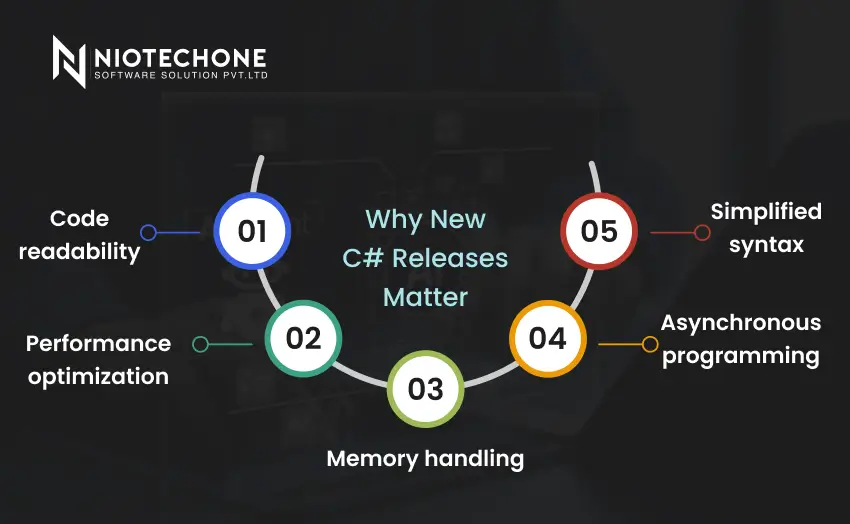
The latest updates continue improving areas like:
For developers building large-scale .NET Core Services, even small language improvements can make projects easier to maintain over time.
One of the newer additions in recent C# releases is primary constructors. This feature is mainly useful for reducing some of the repetitive constructor code that developers usually end up writing in classes.
Primary constructors simplify that process a bit by letting developers define constructor parameters directly in the class declaration instead of writing separate setup code every time.
The feature helps keep classes shorter and easier to read, particularly in modern ASP.NET Services where dependency injection and object creation happen regularly throughout the application.
Collection initialization has become a little cleaner in the newer C# release. Earlier versions usually needed more syntax while creating lists or arrays, especially when developers were working with larger collections throughout the application.
It’s not a major feature on its own, but changes like this become useful in bigger projects where the codebase keeps growing over time.
Teams working on enterprise .NET Core Development projects usually like these smaller improvements because cleaner code is easier to manage when multiple developers are involved.
Pattern matching continues getting better with every C# release. The latest improvements allow developers to write cleaner conditional logic without relying heavily on nested if-else statements.
Instead of checking multiple conditions manually, developers can handle complex logic more clearly using pattern-based expressions.
This becomes especially useful in backend APIs, validation systems, and business rule processing inside ASP.NET Development projects. Cleaner logic also makes applications easier to debug and maintain later.
Applications handling heavy traffic, APIs processing continuous requests, or systems running large background workloads can often perform better with these runtime and compiler optimizations.
For teams building scalable .NET Core Services, performance improvements like these matter because application speed and resource usage eventually affect both user experience and infrastructure costs.
Modern applications are increasingly built for cloud environments and distributed systems.
The latest C# improvements work well alongside technologies like:
Technology | Common Usage |
Docker | Containerized applications |
Kubernetes | Application orchestration |
RabbitMQ | Message-based communication |
Azure | Cloud hosting and services |
These tools are now common in enterprise ASP.NET Services, especially for applications using microservices architecture.
The newer C# features help developers build cleaner cloud-native applications with less repetitive setup code.
Asynchronous programming has become a core part of modern .NET applications.
Applications today constantly process:
The latest C# improvements continue simplifying async code handling and improving readability around asynchronous workflows.
For teams building scalable backend systems, cleaner async handling helps reduce bugs and makes applications easier to maintain.
Not every update in C# is a big feature that completely changes development. A lot of releases also include smaller improvements that developers slowly start noticing while working on projects every day.
The latest version includes updates related to:
For teams handling long-term ASP.NET Development projects, even smaller improvements like these can help keep the code more manageable as the application grows.
Some companies delay upgrading because the current application is still working fine, and in many cases, that’s understandable. But after a while, older development approaches can start creating problems when the application needs to scale or support newer features.
Most newer C# Features are not just about adding fancy syntax. That’s why businesses investing in enterprise .NET Core Development usually prefer teams that keep up with newer C# features and modern architecture patterns instead of relying completely on older approaches.
Companies looking to hire ASP.NET developers today also often expect experience with modern backend development, cloud-based systems, and scalable application design.
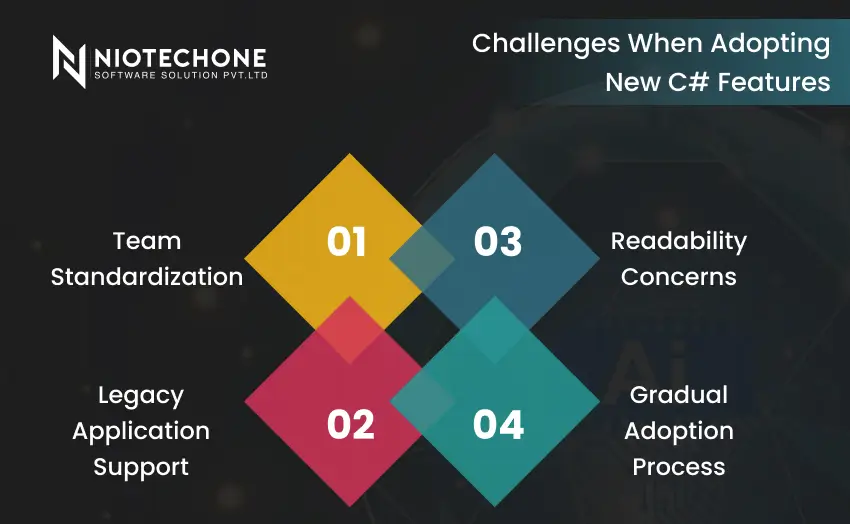
Team Standardization
Large development teams usually need time before introducing new syntax or coding styles across all projects.
Legacy Application Support
Older applications cannot always move to the latest .NET version immediately, so upgrades often happen gradually.
Readability Concerns
Some developers prefer simpler and more familiar syntax instead of using every new C# feature available.
Gradual Adoption Process
In most projects, teams slowly adopt newer C# features over time instead of changing everything at once.
C# keeps changing, along with the way modern applications are being built today. Recent updates are mostly focused on making development cleaner, improving performance, and helping developers manage larger applications more easily.
Modern .NET projects are now commonly built around:
For larger enterprise applications, newer C# features are becoming more useful because they help reduce unnecessary code and make long-term maintenance easier as projects become more complex.
New C# updates are mostly about making development easier, little by little. Some features save time, some reduce extra code, and some simply make applications easier to manage when projects start getting bigger.
For companies building large .NET Core Services or enterprise ASP.NET Services, staying updated with modern C# features can help teams keep projects cleaner and easier to maintain as applications continue growing.
The latest C# version depends on the current .NET release cycle, with new updates typically arriving alongside major .NET releases.
Newer C# versions improve code readability, performance, developer productivity, and support for modern application architectures.
Yes, Many modern C# features help reduce repetitive code and improve maintainability in large enterprise applications.
Yes, Recent C# and .NET releases include runtime and compiler optimizations that improve performance and memory efficiency.
Modern enterprise applications increasingly rely on cloud-native architectures, async programming, and scalable backend systems, making updated C# knowledge highly valuable.
3rd Floor, Aval Complex, University Road, above Balaji Super Market, Panchayat Nagar Chowk, Indira Circle, Rajkot, Gujarat 360005.
Abbotsford, BC
15th B Street 103, al Otaiba Dubai DU 00000, United Arab Emirates
3rd Floor, Aval Complex, University Road, above Balaji Super Market, Panchayat Nagar Chowk, Indira Circle, Rajkot, Gujarat 360005.
Abbotsford, BC.
15th B Street 103, al Otaiba Dubai DU 00000, United Arab Emirates.
Copyright © 2026 Niotechone Software Solution Pvt. Ltd. All Rights Reserved.