Vibe Coding Impact on .NET Engineering in 2026?

Introduction

By 2026, Vibe Coding will transform the .NET landscape through AI and context-based programming. Developers focus on being creative, designing architectures, and implementing business logic while allowing the computer to take care of the actual coding process. This new trend is made possible by ASP.NET Core and other advancements that can enhance efficiency, scalability, and performance. Numerous companies are working with a .NET development company or hiring skilled .NET developers.

Dark-themed AI software development image featuring artificial intelligence visuals and the text “What is Vibe Coding?”.

What is Vibe Coding?

Vibe Coding is basically a development technique where developers work with smart coding algorithms to develop faster software compared to traditional programming methods. Developers do not need to write each line of code; they direct with their system intentions, logical thinking, and high-level requirements. This development style combines: 

AI coding –  AI speeds up the process of writing code by providing function, logic, and structure suggestions automatically.

Context development – Systems understand the project’s context and provide intelligent coding support.

Automated testing and optimization – AI-based tools perform testing and optimize application performance with little effort.

Real-time code suggestions – AI tools make real-time suggestions when developers code.

Intelligent debugging – AI is capable of identifying, analyzing, and fixing issues in an application. 

In modern .NET programming, Vibe Coding often coexists with other technologies such as GitHub Copilot, an AI-enhanced Integrated Development Environment, automation, and DevOps.

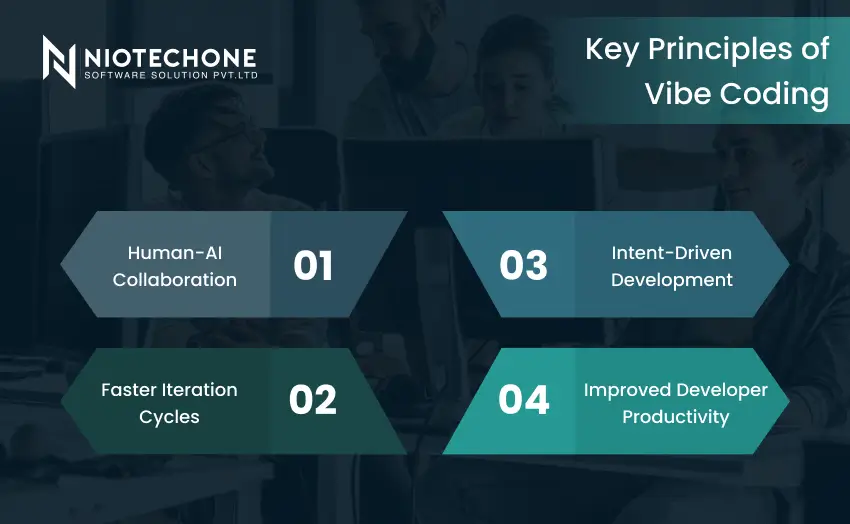
Infographic showing the key principles of vibe coding, including human-AI collaboration, faster iteration cycles, intent-driven development, and improved developer productivity.

Key Principles of Vibe Coding

1. Human-AI Collaboration 

Developers are not lone programmers anymore; instead, they have developed software that helps AI generate initial code, provide optimisation, and spot bugs. For example, in ASP.NET Core programming, you can immediately generate databases and APIs, authentication services, and unit testing frameworks.

2. Faster Iteration Cycles 

In today’s corporate world, speed is key. The Vibe Coding platform allows for continuous integration, real-time testing, and deployment, with quick debugging features. This is particularly important for companies seeking custom software development solutions with accelerated release cycles.

3. Intent-Driven Development

Conventional coding emphasizes syntax more than anything else. Vibe Coding emphasizes intent. Rather than wasting time on manual architecture configuration, developers can express their requirements, such as “Generate a secure multi-tenant ASP.NET Core API that uses JWT authentication and Azure SQL database.”

4. Improved Developer Productivity 

There is more time spent on solving actual business issues, and less time is wasted on redundant operations. Many companies looking for a .NET software development company in India consider an AI-based workflow experience an important factor.

Historical Background of .NET Development

In order to appreciate the growth of Vibe Coding, it is vital to trace the history of the evolution of .NET technology. 

Early .NET Era 

At the time Microsoft introduced .NET, most of the development work for desktop and enterprise software relied heavily on manual coding techniques and monolithic architecture. Some of these considerations include:

  • desktop application
  • structured enterprise systems
  • manual coding practices


Developers relied primarily on Visual Studio and manually handled most aspects of development. 

Rise of .NET Core and Cloud-Native Development 

.NET Core marked a new era for the framework with its ability to run across multiple platforms, its microservice architecture, cloud-native development strategy, support for Docker, and APIs. It was noticed that firms were leveraging ASP.NET Core for cloud app development.

AI-Assisted Engineering 

From the early stages until the period between 2024 and 2025, the use of AI technologies in development processes increased tremendously. AI-enabled developers to write code, test it, debug, document, and automate DevOps.

Vibe Coding Evolution

In 2026, all technologies mentioned above would be collectively known as Vibe Coding and would be an advanced form of coding that uses AI to assist humans. The focus of the developers would move away from mundane work to architecture.

Case Studies of Successful Implementations

Case Study 1: ERP Implementation for Enterprises

A logistics company implemented new technology, ASP.NET Core, and AI-enabled development environments. This made the process easier since developers could automate many mundane activities such as API generation and testing.

Real Impact: 

  • Faster enterprise software development
  • Improved system scalability
  • Reduced operational complexity


Case Study 2: Healthcare Application Modernization 

An organization in the healthcare industry modernized its old application by transitioning it to an ASP.NET Core microservices architecture with the help of AI-enabled development techniques.

Real Impact: 

  • Easier legacy modernization
  • Stronger application security
  • Faster microservices migration
  • Improved system reliability

Improvements in Code Quality and Performance

Vibe Coding provides significant improvements in terms of code quality.

1. Improved Code Architecture

Using AI-powered development tools ensures that developers follow modern coding practices such as SOLID, design patterns, and better dependency injection. In doing so, the developed code will not only be scalable but will also remain easily manageable throughout a long period of time.

2. Quick Bug Detection 

The current generation of AI can instantly detect bugs that could be related to security threats, system issues, memory usage problems, or inefficient use of database queries. The process is no longer based on trial and error but relies on intelligent suggestions and insights.

3. Automated Documentation & Testing Automation 

Vibe Coding tools automatically create documentation for APIs, provide technical comments, include deployment information, and create architectural descriptions, promoting cooperation among developers and DevOps professionals. 

Challenges and Limitations of Vibe Coding in .NET

Vibe coding in .NET also faces some limitations with it.

1. Over-Reliance on AI 

Many developers depend more on AI-powered code without necessarily having an idea of what the logic behind it is.

2. Inconsistent Code Quality 

Not all codes created by AI adhere to enterprise standards. Code reviews, architectural governance, testing process, and senior engineer supervision are needed.

3. Integration Issues 

Many enterprise applications have old frameworks, are monolithic in nature, and have complex dependencies. Integration of Vibe Coding into these legacy systems is challenging.

4. Loss of Deep Coding Skills 

Junior programmers might skip learning basic coding skills because of the use of AI in everything. However, it is very important to be knowledgeable about C#, F#, ASP.NET Core, Database optimization, and Cloud Architecture.

Conclusion

Vibe Coding is revolutionizing contemporary software engineering by fusing AI automation with human creativity in the .NET technologies. From ASP.NET Core application development to cloud-based enterprise solutions, enterprises are adopting AI-driven development processes for swift deployment and superior scalability. Enterprises searching for a dependable .NET application development firm or custom software development solutions are now giving preference to AI-savvy developers. 

Frequently Asked Questions FAQs

Vibe Coding is an AI-assisted and context-aware software development approach where developers use intelligent tools to automate repetitive coding, testing, debugging, and optimization tasks. 

It improves development speed, code quality, testing automation, scalability, and performance optimization while reducing manual development effort. 

Popular technologies include ASP.NET Core, Blazor, .NET Core, Azure cloud services, microservices architecture, and AI-powered DevOps tools. 

No, Vibe Coding supports developers rather than replacing them. 

Major challenges include overdependence on AI, inconsistent code quality, integration complexity with legacy systems, and reduced focus on core programming fundamentals.