The Future of .NET: Trends, and What’s Coming After .NET 10

Introduction

The speed at which software development has evolved is astounding. Similarly, Microsoft’s .NET platform has evolved from being an exclusively Windows platform to now being one of the most innovative, adaptable, and secure platforms available for software development. If your organisation currently works with a .NET development Company or has been developing new software through .NET, you should consider the roadmap for the .NET platform. 

The .NET Release Cycle: Reliable & Consistent

The thing about .NET is that it has a good schedule that you can count on. Every November, Microsoft puts out a major version of .NET. The numbered versions, like .NET 6 and .NET 8 and soon .NET 10, come out every two years. These versions get security patches and updates for three years. The odd-numbered versions do not get much time; they only get 18 months. 

The next big release is .NET 10, which is coming out in November 2026. This is a deal for .NET because .NET 10 has a lot of new features and improvements that will affect how companies make software for a long time. 

  • .NET versions that are considered term support or LTS get security updates for three years. 
  • The standard versions get support for 18 months. 
  • The fact that .NET comes out with versions in November every year helps companies plan and make sure they are ready for the next version of .NET. 

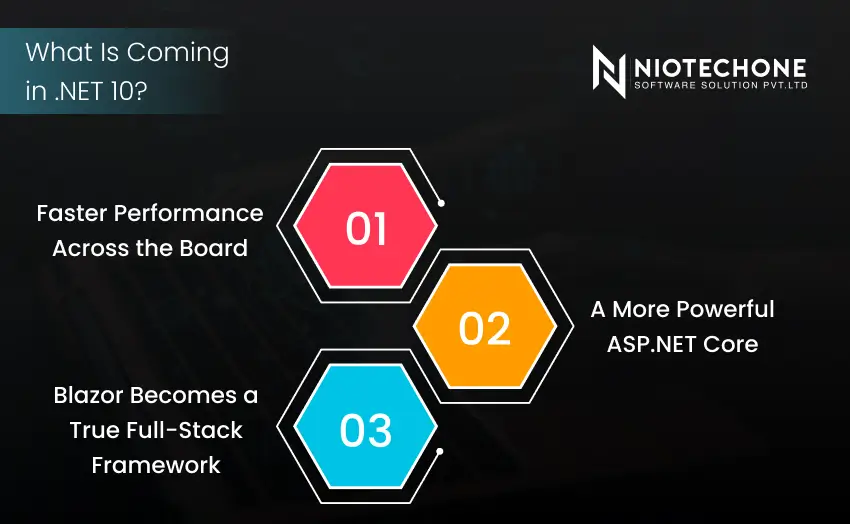
What Is Coming in .NET 10?

Faster Performance Across the Board

The .NET system has always focused on performance. .NET 10 is taking it to the next level. The team that works on the runtime is making the JIT compiler better, managing memory efficiently, and making applications start up faster. 

A More Powerful ASP.NET Core

The ASP.NET Core system is becoming more powerful and easier to use with .NET 10. The minimal APIs are now ready for use. Some of the additions include better documentation, limits on how often something can be used, and better security features. 

Blazor Becomes a True Full-Stack Framework

Blazor is almost ready to be used by companies. With .NET 10, Microsoft is making it render things faster, manage parts of the application better, and support streaming efficiently. An ASP.NET Core development company that looks to the future can now build websites using just C#. 

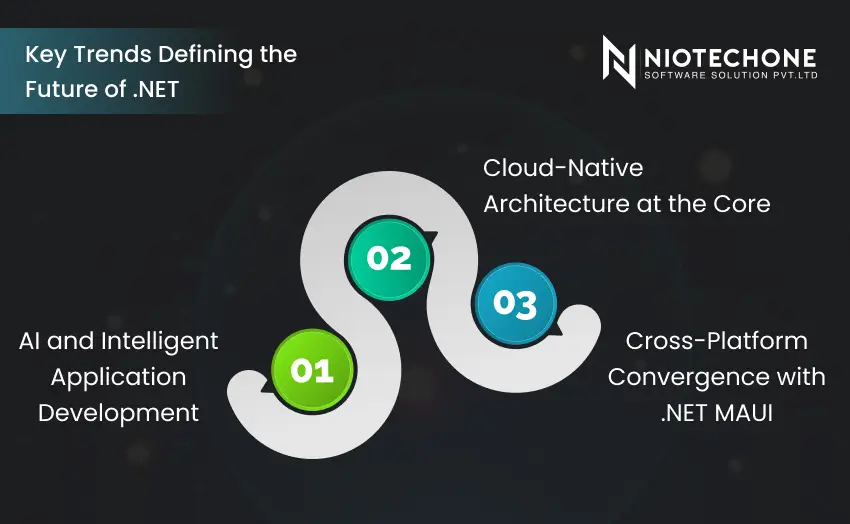
Infographic showing key trends shaping the future of .NET including AI, cloud-native architecture, and .NET MAUI.

Key Trends Defining the Future of .NET

AI and Intelligent Application Development

Artificial intelligence is not separate from everything else. It is becoming a main part of our systems. With things like ML .NET and Azure AI, .NET is becoming a powerful tool for making smart business applications. 

Cloud-Native Architecture at the Core

The way we make applications has changed a lot because of the native movement. Now we. Build applications in a different way. .NET works well with Azure, including Azure Functions and Azure Kubernetes Service, which makes it a great tool for building strong microservices. 

Cross-Platform Convergence with .NET MAUI

.NET MAUI is getting better and better as a way to make applications that work on different platforms. Microsoft is working on making .NET 10 better on iOS and Android. Also, making it work better on desktops. If a business works with a hire .NET developers company that’s reliable, they can make applications that work the same way on the web, on mobile devices, and on desktops. 

Real-World Business Impact

The .NET plan is really exciting, not only for developers but also for businesses in different industries. The .NET roadmap is really exciting for developers. It has an impact on businesses in many different industries. 

  • HealthcareThe new .NET roadmap gives us security and faster performance. This makes patient management platforms work better and follow all the rules. 
  • Financial ServicesThe .NET roadmap gives us ways to handle lots of things at the same time, and stronger cryptography. This is very important for processing transactions in time and catching fraud. 
  • Logistics & Supply ChainThe .NET roadmap helps make native .NET applications. These applications can do things like find the best routes, track fleets in real time, and manage warehouses automatically for big companies.

Why the Time to Act Is Now

Many businesses wait for the big release before they start a new project. The thing is, the architecture patterns and cloud integration strategies that will be great in .NET 10 are already available in .NET 8 LTS. So businesses that start building with modern .NET now will be able to use improvements without having to start all over again. 

If you are thinking about hiring .NET developers or working with an ASP.NET development services partner, this is a good time to do it. The .NET ecosystem is very mature, and the plan for the future is clear. Microsoft has been committed to .NET for a long time. 

  • Build on .NET 8 now. You will be able to use the new features in .NET 10 without having to spend a lot of money to redo everything.
  • Modern architecture patterns like microservices and cloud-native design are ready to use
  • If you start using .NET early, your team will have a head start on using the tools and getting performance and AI capabilities.

Conclusion

The future of .NET is looking good. It is what modern businesses need, like AI and cloud-native architecture. .NET 10 and other innovations like Blazor and ML .NET are made for the demands of businesses. If you work with a company that knows a lot about .NET development or a company that can build .NET applications, you can make solutions that will work well in the future. 

Frequently Asked Questions FAQs

.NET 10 is Microsoft’s next LTS release expected in November 2026 with three years of support, ideal for enterprise apps. 

.NET 10 offers better performance, advanced ASP .NET Core and Blazor features, and stronger AI integration.

Yes, migrating improves performance, security, and maintainability. 

Healthcare, finance, logistics, travel, and retail benefit most due to high security and scalability.  

Yes, Blazor is fully production-ready for building full-stack enterprise applications using C#.