Introduction
Today’s organizations use cloud-native architecture that enables them to scale easily, manage less infrastructure, and develop applications faster. Since organizations develop an increasing number of applications, APIs, automated processes, and event-based services, they may face the problem of server management that consumes time and money.
Azure Functions provides organizations with an opportunity to create applications without dealing with any servers. With the help of .NET technologies, organizations can build event-driven applications. Here comes into play Serverless .NET on Azure Functions.
What is Serverless .NET?
Serverless .NET means developing and executing .NET apps without having to provision servers or infrastructure explicitly. Within the serverless approach, developers concentrate solely on writing application code, while the cloud provider takes care of:
- Server management
- Scaling
- Resource allocation
- Availability
This modern cloud approach helps organizations build scalable applications faster while reducing operational complexity. One of the biggest advantages of serverless .NET application development is cost optimization because businesses only pay for actual execution time instead of maintaining continuously running servers.
What are Azure Functions?
Azure Functions is the serverless computing platform offered by Microsoft to enable the execution of functions upon receiving certain triggers. These triggers may include:
- Database changes
- File uploads
- Timers
- Queue messages
The ability of Azure Functions to scale depending on demand makes it the perfect choice for traffic-heavy and trigger-based applications. Therefore, developing applications for .NET developers using Azure Functions becomes one of the most effective methods to develop cloud-native apps.
Practical Use Cases of Serverless .NET on Azure Functions
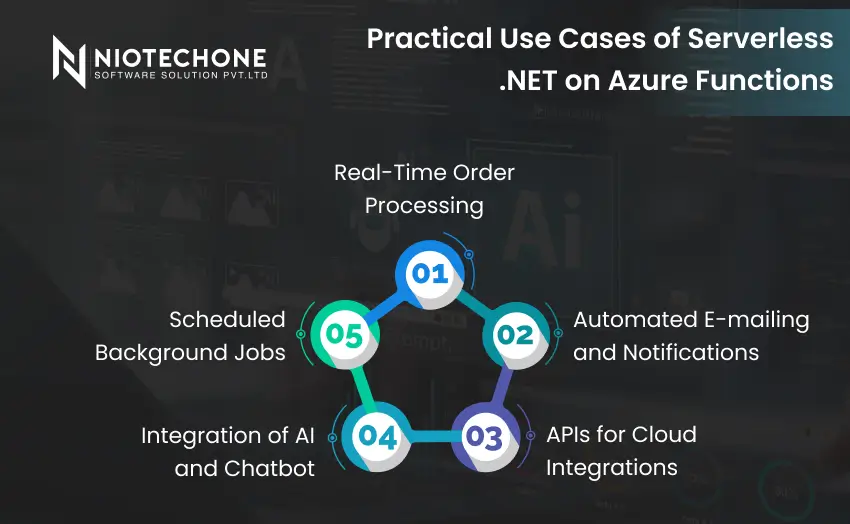
Real-Time Order Processing
Companies can leverage Serverless .NET using Azure Functions to process online orders, check payment details, and automatically send notifications. With this approach, applications can process huge numbers of transactions without having to maintain any server environment.
Benefits
- Improves application scalability during high traffic
- Reduces infrastructure and operational costs
Automated E-mailing and Notifications
Organizations have been employing Azure Functions with .NET for automatically sending e-mails, SMS, and other forms of notifications depending upon certain actions or scheduled time intervals.
Benefits
- Facilitates real-time customer interactions
- Simplifies background task automation
APIs for Cloud Integrations
Enterprise-level companies nowadays make use of Serverless Azure APIs for connecting their cloud services to third-party applications as well as their own business systems.
Benefits
- Improves API scalability and performance
- Supports faster cloud integration workflows
Integration of AI and Chatbot
Companies make use of Azure functions together with AI to enable the creation of chatbots, virtual assistants, and AI-enabled workflows in customer support and automation applications.
Benefits
- Automation of customer support processes
- Facilitates the development of AI-powered cloud applications
Scheduled Background Jobs
Azure Functions can be used for scheduling functions like reports, database maintenance, backups, and monitoring processes in enterprise-level applications.
Benefits
- Automates recurring business operations
- Improves system reliability and maintenance
Why Need to Use Serverless .NET on Azure Functions
Reduced Infrastructure Management
With Serverless .NET on Azure Functions, it makes it easy for software developers to concentrate only on the code rather than infrastructure management, like server management, OS management, and others.
Automatic Scaling
Applications running on Azure Functions are automatically scaled according to workload.
Improved Cloud Integration
Serverless .NET technologies work in harmony with various Azure services, such as Azure Storage, Azure SQL, Azure Service Bus, and Azure AI Services.
Fast Development and Deployment
Application creation, testing, and deployment can be accelerated by developing with .NET through Azure Functions.
When to Use Serverless .NET on Azure Functions
Event-Driven Applications: If your application demands automatic reaction to any particular event, such as file upload, API calls, database changes, or queue notifications, Serverless .NET technologies on Azure Functions would be a suitable choice.
Changing Workload: Applications with varying workloads can use Azure Functions because of their scalability feature without server management.
Real-Time Data Processing: Utilize Azure Functions for processing streaming real-time data, IoT triggers, analysis, and monitoring situations that demand instantaneous activation.
Rapid Cloud-Native Development: Use Azure Functions in cases where there is a need for fast development of cloud-native applications.
Background Processing Tasks: Use Azure Functions for background tasks such as scheduling tasks, sending emails, generating reports, data synchronization, and more.
Benefits of Using Serverless .NET on Azure Functions
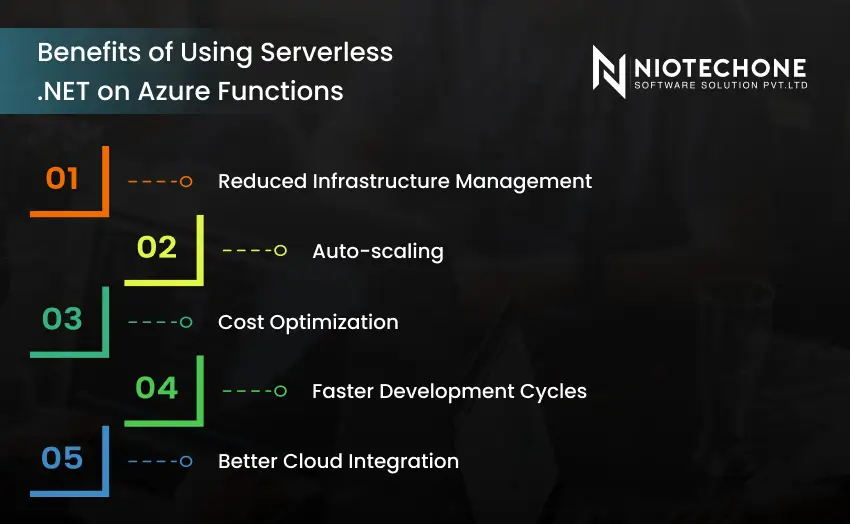
Reduced Infrastructure Management
Because serverless architecture uses .NET, software developers do not have to manage any virtual machines, OSs, or other server settings. This is because Azure will take care of all the infrastructure management tasks for you.
Auto-scaling
Azure Functions automatically scales applications based on incoming traffic and workload demand. This is especially useful for applications experiencing unpredictable usage spikes.
Cost Optimization
Some of the key benefits that organizations get from using Azure’s serverless computing technology include pay-per-use billing. The bill will only be issued once some processes have been executed on the cloud.
Faster Development Cycles
Developers can leverage Azure Functions with .NET 10 and create cloud native applications quickly.
Better Cloud Integration
This simplifies enterprise cloud application development. There is support for Azure Storage, Azure Service Bus, Azure SQL Database, and Azure Event Grid.
Challenges in Serverless Application Development
Despite the numerous benefits provided by serverless computing, developers could encounter certain difficulties.
Performance Issues During Cold Start: Serverless functions might encounter latency during cold start times.
Monitoring of Distributed Applications: It might become challenging to monitor various cloud-based functions.
Vendor Lock-In: Applications might become dependent on their respective cloud environment as a result of close integration.
Security Issues: Companies need to establish strict policies for authentication, API security, and identity management.
Conclusion
Serverless computing has brought a paradigm shift to the world of application development in the cloud due to its capacity to streamline infrastructural administration and scale effectively.
Using Serverless .NET via Azure Functions, businesses can create architectures that respond to events, provide scalable web services, enable process automation, and support other cloud-native applications without worrying about server administration.
Microsoft Azure will enable businesses to enhance efficiency, achieve cost savings, and accelerate application execution with Azure Functions. Real-time ordering, AI-enabled automations, and background operations are among the various uses of Azure Functions by modern enterprises.