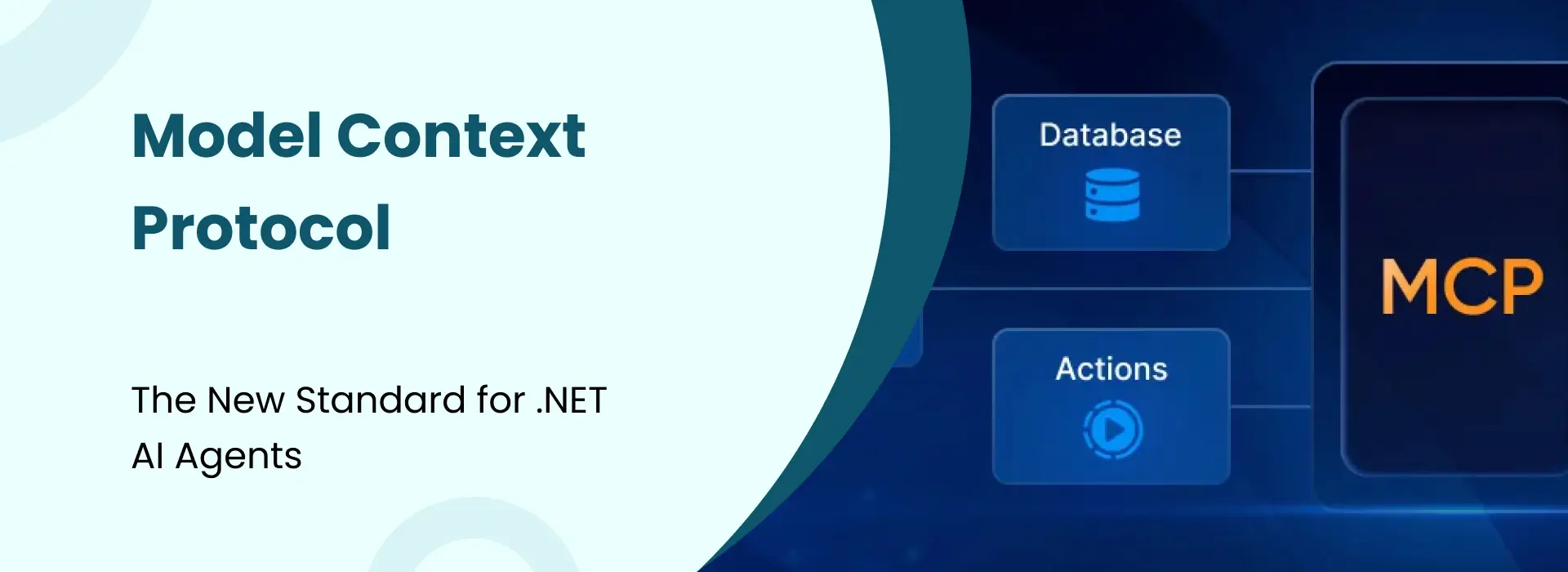
Model Context Protocol: The New Standard for .NET AI Agents

Introduction

AI isn’t really experimental anymore—it’s already part of what teams are building and shipping, especially in .NET applications. You’ll see it in chat features, internal tools, and automation. It’s kind of everywhere now.

The tricky part starts when you try to connect it with real systems. There are APIs, databases, third-party services—and somehow everything needs to work together without things getting weird or breaking. That’s usually where it starts to get messy, which is exactly where MCP begins to help.

What is Model Context Protocol MCP banner with futuristic MCP text and NiotechOne branding.

What is Model Context Protocol (MCP)?

MCP isn’t some complex concept once you strip it down. It’s really just a structured way to let AI models interact with the outside world—APIs, tools, services—without everything turning into one-off custom logic.

Instead of wiring things differently every time, MCP lets developers:

  • Define what goes in and what comes out
  • Make tool usage more consistent
  • Pass context between steps without losing track
  • Put limits on what the AI can and can’t do


It’s not flashy, but that’s kind of the point. It makes AI integrations feel more controlled and less unpredictable.

Why MCP Matters for .NET Developers

If you’ve worked with .NET for a while, you already know the focus has always been on structure and long-term maintainability. That doesn’t really change just because AI is involved.

For a .NET development company, it helps avoid the usual chaos that can come with AI integrations. Instead of building everything in slightly different ways, teams get a more consistent pattern to follow.

Key Benefits Of Model Context Protocol:

1) Standardization: Instead of juggling different formats and one-off integrations, MCP gives a more consistent way for AI to work with services

2) Better Maintainability: Developers can make changes to models or tools without stressing about breaking the whole system

3) Enhanced Security: MCP puts some control around what the AI can access, which helps avoid unwanted actions or risks

4) Faster Development: Teams offering .NET development services can move more quickly by reusing components instead of building everything from scratch

How MCP Works in .NET Applications

Let’s break it down into a simple flow:

1) User Input: A user interacts with your application (e.g., chatbot or API).

2) AI Model Processing: The AI model interprets the request.

3) MCP Layer: The protocol determines:

  • What tool to call
  • What data is required
  • How the response should be structured


4) Tool Execution:
External services or APIs are triggered.

5) Response Handling: The result is returned in a standardized format.

6) Final Output: The user receives a clean, meaningful response.

This structured approach is especially useful for teams working in an ASP.NET development company environment where consistency is critical.

MCP vs Traditional AI Integration

Before MCP, integrating AI into applications often meant:

  • Writing custom logic for each tool
  • Handling inconsistent data formats
  • Managing complex workflows manually


With MCP:

Traditional Approach

MCP Approach

Custom integrations

Standardized protocol

    Hard to scale

Easily scalable

    Error-prone

Reliable and predictable

  Limited reuse

Highly reusable

This shift is why many .NET Core development company teams are adopting MCP as a default approach.

Building AI Agents with MCP in .NET

AI agents are becoming more autonomous. They can:

  • Make decisions
  • Call tools
  • Execute workflows


MCP provides the structure needed to make these agents reliable.

Core Components:

  1. Tools: Defined actions the AI can perform (e.g., API calls, database queries).
  2. Context: Information is passed between interactions.
  3. Protocol Rules: Defines how communication happens.
  4. Execution Engine: Handles the flow between AI and tools.


A
.NET Development Company can use MCP to build advanced AI agents that integrate deeply with enterprise systems.

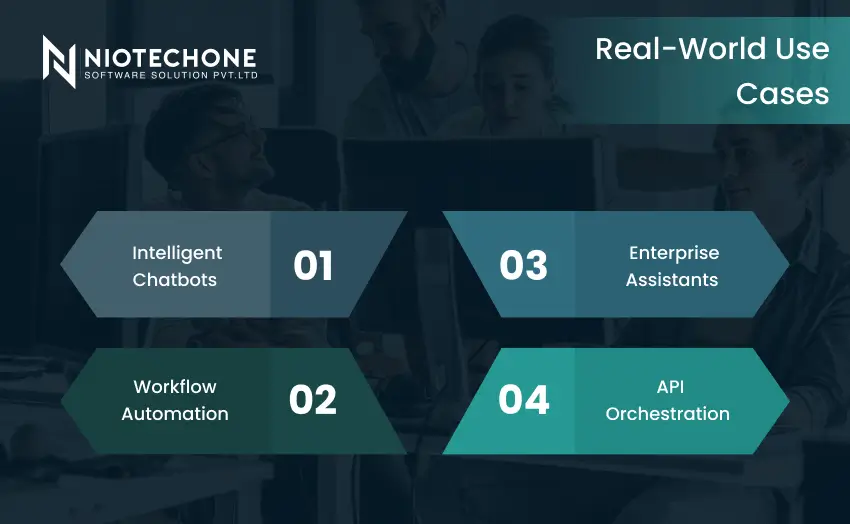
Real-world use cases of AI applications including intelligent chatbots, workflow automation, enterprise assistants, and API orchestration

Real-World Use Cases

1) Intelligent Chatbots: hook into databases, kick off workflows, and answer users in a more personal way

2) Workflow Automation: handle the usual grind—data entry, reports, notifications

3) Enterprise Assistants: plug into internal tools, surface insights, help teams get through daily work

4) API Orchestration: AI agents that coordinate how different services talk to each other

Companies offering ASP.NET development services can use MCP to build automation that fits real workflows instead of feeling overbuilt.

Challenges and Considerations

While MCP is powerful, it’s not without challenges:

1) Learning Curve: Developers need to understand protocol design and AI workflows.

2) Tool Design: Defining tools properly is crucial for success.

3) Performance Optimization: Handling multiple tool calls efficiently is important.

4) Security: Ensuring controlled access to sensitive data is critical.

However, these challenges are manageable, especially for experienced teams in a .NET development company.

Future of MCP in .NET

The future looks incredibly promising. As AI frameworks evolve, MCP is expected to:

  • Become a standard across platforms
  • Integrate deeply with .NET libraries
  • Support advanced agent capabilities
  • Enable fully autonomous systems


A forward-thinking .NET Core development company will likely adopt MCP early to stay competitive.

Conclusion

In simple terms, Model Context Protocol just makes life easier when you’re trying to add AI to .NET applications. Instead of dealing with messy integrations, it gives you a cleaner way to connect AI with tools and data. 

It also makes applications easier to scale as things grow. For teams working with a .NET development company or thinking about hiring .NET developers, using MCP feels less like a trend and more like a practical step in the right direction.

Frequently Asked Questions FAQs

MCP is a standardized framework that allows AI models to interact with tools, APIs, and data sources in a structured and consistent way.

It simplifies AI integration, improves scalability, and ensures consistent communication between AI agents and applications.

Yes, MCP works seamlessly with ASP.NET Core, making it ideal for building AI-powered APIs and applications.

Absolutely. MCP is designed to support scalable, secure, and maintainable AI systems, making it perfect for enterprise use.

A basic understanding of AI concepts helps, but experienced teams at an ASP.NET development company or a .NET development services provider can handle implementation efficiently.