ASP.NET Core has been a robust platform to develop modern web applications. Minimal APIs have provided developers with a cleaner, faster, and lighter method of creating APIs. Minimal APIs remove boilerplate code, simplifying and making development more enjoyable.
In this blog, we’ll explore what Minimal APIs are, why developers love them, and how they can be applied in real-world scenarios. Minimal APIs are becoming a game-changer for any ASP.NET Core development company or business that is seeking to modernize.
Minimal APIs are a simplified form of developing HTTP APIs in ASP.NET Core without controllers, attributes, or a lot of configuration. They enable developers to specify endpoints in the Program.cs file in a succinct syntax.
Example:
csharp
var builder = WebApplication.CreateBuilder(args);
var app = builder.Build();
app.MapGet("/hello", () => "Hello, World!");
app.Run();
This little snippet forms a complete API endpoint. No controllers, no additional files, only clean and minimal code. Many .NET application development companies use this approach to deliver lightweight solutions faster.
Minimal APIs are rapidly becoming popular due to their ease of development and enjoyment. The following are the key reasons:
These advantages are directly translated into quicker project delivery and satisfied clients by the Microsoft .NET development company.
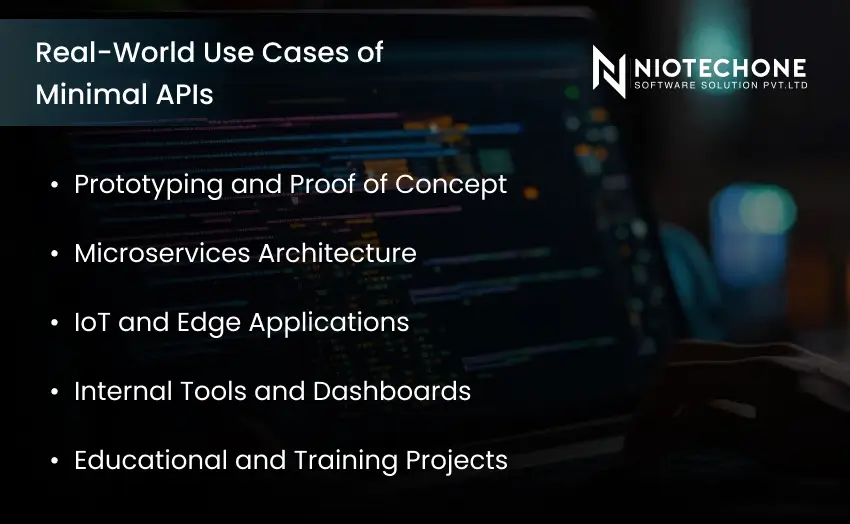
Minimal APIs are not merely a coding gimmick, but they address real-world issues in daily development. This is how they shine in various situations:
Prototyping and Proof of Concept
The pace is more important than the form in testing ideas. Minimal APIs enable developers to spin up endpoints in minutes without scaffolding controllers or models.
Example: A startup that is experimenting with a new payment gateway can easily build a simple API to model transactions without investing in a complete architecture.
Microservices Architecture
Microservices should be small, autonomous, and simple to deploy. Lightweight services with minimal APIs reduce dependencies, minimize dependencies, and can be easily integrated with containers such as Docker and orchestration tools such as Kubernetes.
Example: An ASP.NET development company that is developing e-commerce platforms can use Minimal APIs to provide product catalog, order processing, and user authentication services.
IoT and Edge Applications
IoT devices often need simple APIs to send sensor data or receive commands. Minimal APIs:
Example: Minimal APIs could be used in a home system to manage temperature sensors, lighting, or security alerts.
Internal Tools and Dashboards
Internal tools are more about speed and functionality, and not about complicated design. Small teams can develop endpoints quickly and maintain them easily with minimal APIs.
Example: A company that provides IT services may develop a simple HR dashboard to request leave or monitor attendance.
Educational and Training Projects
Minimal APIs are easy to learn and help students to understand development concepts without cumbersome frameworks. They provide easy syntax and routing; HTTP methods and responses are easy to comprehend.
Example: A coding bootcamp can learn about REST using Minimal APIs by creating a blog or task manager.
Here’s a practical example of how Minimal APIs can be used to build a small To-Do application:
csharp
var builder = WebApplication.CreateBuilder(args);
var app = builder.Build();
var todos = new List();
app.MapGet("/todos", () => todos);
app.MapPost("/todos", (string todo) =>
{
todos.Add(todo);
return Results.Ok(todos);
});
app.MapDelete("/todos/{index}", (int index) =>
{
if (index = todos.Count)
return Results.NotFound();
todos.RemoveAt(index);
return Results.Ok(todos);
});
app.Run();
This simple API allows you to:
All in less than 30 lines of code!
Minimal APIs not only make developers happy but also provide real benefits to teams and organizations. We can discuss the main advantages in detail:
Reduced Development Time
Minimal APIs reduce boilerplate code, enabling developers to work on business logic. This accelerates the project schedules and facilitates quicker delivery of features.
Example: A fintech company partnering with a .NET Core development company can deploy a prototype payment service in days rather than weeks.
Lower Maintenance Costs
Fewer lines of code imply fewer bugs and less complexity. Applications built with Minimal APIs are easier to maintain, saving time and costs in the long run.
Example: A home-grown HR application created by an ASP.NET development company with Minimal APIs will need fewer updates than a heavy MVC setup.
Scalability
Minimal APIs are lightweight and modular, and it is simpler to scale applications as business requirements increase. They fit perfectly with middleware and dependency injection, and thus, scaling does not need a complete rewrite.
Example: A shopping site supported by a Minimal APIs can be used to develop product listings and then grow to inventory management and customer support by a .NET application development company.
Developer Happiness
Minimal code is clean and enhances productivity and morale. Frameworks that minimize unnecessary complexity are preferred by developers, resulting in improved collaboration and creativity.
Example: Companies that hire .NET developers for microservices projects often find Minimal APIs boost collaboration and reduce frustration during sprints.
Minimal APIs in ASP.NET Core are a game-changer. They make development easier, enhance performance, and make the process of building APIs more fun. Whether you’re prototyping, building microservices, or creating internal tools, Minimal APIs provide the perfect balance of simplicity and power. For any ASP.NET development services provider or Microsoft .NET development company, Minimal APIs will result in quicker delivery, reduced costs, and happier developers.
Minimal APIs are a lightweight way to build HTTP APIs using simple syntax without controllers.
Yes, but they are best for small to medium services. For complex apps, you can mix Minimal APIs with traditional controllers.
Absolutely. You can use authentication, authorization, dependency injection, and middleware just like in traditional ASP.NET Core apps.
They avoid unnecessary overhead from controllers and attributes, making them lightweight and efficient.
Yes, Minimal APIs are flexible, and you can gradually move to MVC if your project grows in complexity.
3rd Floor, Aval Complex, University Road, above Balaji Super Market, Panchayat Nagar Chowk, Indira Circle, Rajkot, Gujarat 360005.
Abbotsford, BC
15th B Street 103, al Otaiba Dubai DU 00000, United Arab Emirates
3rd Floor, Aval Complex, University Road, above Balaji Super Market, Panchayat Nagar Chowk, Indira Circle, Rajkot, Gujarat 360005.
Abbotsford, BC
15th B Street 103, al Otaiba Dubai DU 00000, United Arab Emirates
Copyright © 2026 Niotechone Software Solution Pvt. Ltd. All Rights Reserved.