
Minimal APIs vs Controllers in .NET: Pros, Cons, and Benchmarks
- Niotechone Marketing Team
Table of Contents
- Introduction
- The Importance of this Decision in Real Projects
- Minimal APIs in Production Context
- Controllers: Why They Continue to Dominate Real Systems
- Pros and Cons: Minimal APIs
- Pros and Cons: Controllers
- Benchmarks: What the Numbers Really Mean
- Common Mistakes Teams Make
- Best Practices That Work
- Scalability, Cost, and Maintenance Impact
- Conclusion
Introduction
ASP.NET Core provides greater freedom than ever. That freedom is a strength and a risk in 2026. The question of whether to develop APIs with Minimal APIs or Controllers is one of the most controversial decisions in modern core software development.
Both methods are supported, performant, and production-ready on paper. In fact, the choice significantly influences the way a system develops, the way teams work, and the long-term cost of the software. This article is based on actual project experience with systems that have survived over the years, expanded across teams, and met evolving business needs.
The Importance of this Decision in Real Projects
Modern .NET APIs are seldom standalone. They usually:
- Power business-critical processes.
- Serve multiple clients.
- Connect with cloud services.
- Evolve continuously.
The API layer is situated at the center of the software development lifecycle, as described in practice. A bad choice here does not fail instantly. It adds friction gradually, via maintenance overhead, irregular patterns, and accumulating technical debt.
That is why the Minimal APIs vs Controllers option has a direct influence on the best practices of software architecture and sustainability in the long term.
Minimal APIs in Production Context
Minimal APIs were added to minimize ceremony. They eliminate controllers, attributes, and filters and use direct endpoint definitions.
Where Minimal APIs Work Well
In practice, Minimal APIs are most effective when:
- The service is small and specialized.
- The API surface is limited.
- The team is stable and experienced.
- A priority is performance tuning.
They are particularly useful in:
- Internal microservices
- Infrastructure-level endpoints
- Lightweight integrations
Minimal APIs in such cases minimize noise and accelerate delivery.
Controllers: Why They Continue to Dominate Real Systems
In 2026, controllers continue to be the foundation of most long-lived ASP.NET Core applications- and that will be the case.
What Controllers Do Well
Controllers provide:
- Distinct separation of concerns.
- In-built validation, filters, and authorization.
- Consistent team structure.
- Close correspondence to testing frameworks.
These features facilitate .NET application development best practices and minimize the dependency on the discipline.
Architecture is made visible by controllers. The fact that visibility is essential in large or changing systems.
Pros and Cons: Minimal APIs
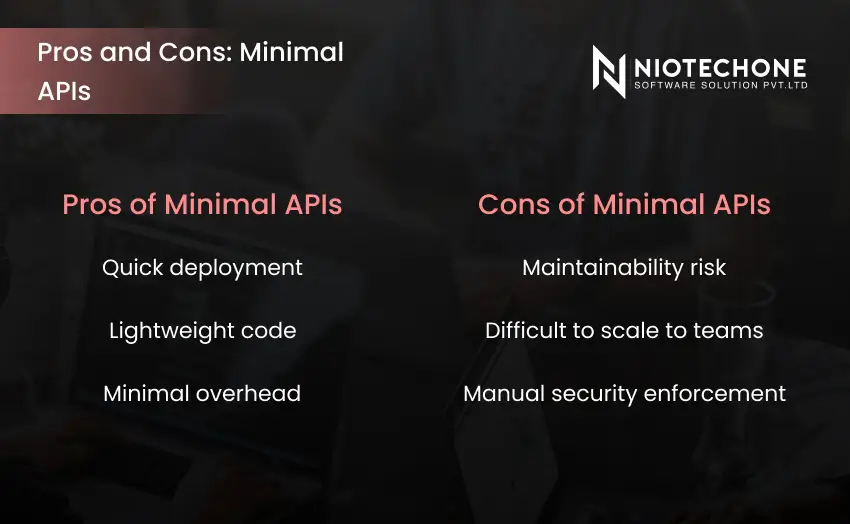
Pros of Minimal APIs
- Quick deployment – Spin up endpoints in seconds without additional boilerplate. Small services or microservices.
- Lightweight code – The code is small and simple to read initially because there are fewer classes and attributes.
- Minimal overhead – Slight performance improvement can be used in highly focused, high-performance endpoints.
Cons of Minimal APIs
- Maintainability risk – Files may become disorganized, and responsibilities may be mixed without strict conventions.
- Difficult to scale to teams – Large teams can have difficulty in keeping structure.
- Manual security enforcement – Filters, authorization, and validation have to be added manually.
Pros and Cons: Controllers
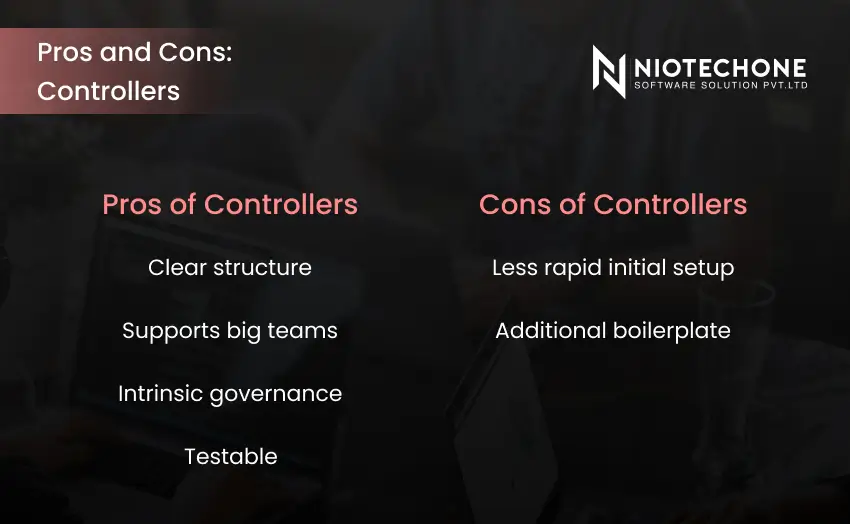
Pros of Controllers
- Clear structure – Isolates concerns and makes code readable and easier to maintain.
- Supports big teams – Patterns make onboarding less frictional and confusing.
- Intrinsic governance – Validation, filters, and authorization are simpler to administer uniformly.
- Testable – Unit and integration testing is easy because of the patterns that are established.
Cons of Controllers
- Less rapid initial setup – More classes and conventions imply a slightly longer startup.
- Additional boilerplate – May be cumbersome on small or prototype projects.
Benchmarks: What the Numbers Really Mean
Minimal APIs are said to be faster. This may be the case in isolated benchmarks. They add a little more overhead.
But in practice:
- Response time is dominated by network latency.
- Database calls are much more important.
- Larger bottlenecks are serialization and caching.
The best way to optimize ASP.NET Core performance is to work on architecture and data flow, rather than eliminating controllers. One of the more frequent software development errors is the selection of Minimal APIs based on performance.
Common Mistakes Teams Make
1. Minimal APIs as the Default
Minimal APIs appear easier on the surface. Endpoint files become dense and less reasonable as requirements increase.
2. Without Strategy Mixing Patterns
Integrating Minimal APIs and Controllers without boundaries brings about inconsistency and confusion.
3. Allowing Business Logic to Escape Endpoints
This is a common problem with Minimal APIs and a significant source of technical debt.
4. Disregarding Long-Term Ownership
What appears clean today might be expensive to maintain in year three.
Such errors tend to manifest themselves in the future as technical debt in software projects.
Best Practices That Work
1) Select Controllers as the Default Architecture
In the majority of business applications:
- Controllers should be the standard
- They enforce structure naturally
- They support large teams and long lifecycles
This is in line with ASP.NET Core application architecture in enterprise systems.
2) Minimize APIs Purposely
Minimal APIs must be restricted to:
- Small, isolated services
- Performance-critical endpoints
- Internal tools that are controlled in scope.
They are not to substitute Controllers in a whole business system.
3) Security and Compliance Considerations
In securing .NET applications:
- Controllers make policy enforcement easier.
- Filters reduce duplication
- Permission logic is the same.
Minimal APIs are secureable, but more manual discipline is needed. Controllers minimize the risk of missed checks in regulated or enterprise settings.
Scalability, Cost, and Maintenance Impact
Scalability
Both patterns are on a technical scale. Controllers are better organized. They assist teams in developing without disorganisation.
Cost
Minimal APIs may minimize short-term effort. The long-term cost is typically minimized by controllers through decreasing maintenance and refactoring effort.
Maintenance
Controller-based systems:
- Are easier to understand
- Support safer refactoring
- Reduce onboarding time
This directly favors scalable software application design.
Conclusion
By 2026, the Minimal APIs vs Controllers debate will not be about novelty or elegance. It is about risk management. Minimal APIs are effective tools when applied deliberately. Controllers are the surest default of systems that need to scale, evolve, and endure changes in teams.
In the development of core software, the architecture that has the least code is not the best, but the one that remains understandable years later, when the system has expanded, and the original developers are long gone.
Categories
Related Articles

Related Tags
Frequently Asked Questions FAQs
A little, but the distinction is seldom important in practice.
No. They are the safest option when dealing with complex and long-lived systems.
They are capable of it, but it is not often a good idea with enterprise applications.
Controllers, because of established testing patterns and tooling.
Yes, but with distinct architectural lines.