Artificial Intelligence (AI) is not only transforming apps, but it is transforming expectations. Think about APIs that not only provide information but also think: detecting fraud before it occurs, suggesting the appropriate product at the appropriate moment, or processing medical records in seconds. That is the strength of AI-based APIs.
ASP.NET Core 2026 has enabled developers and businesses to finally have a framework that is faster, more secure, and cloud-ready to develop these intelligent APIs. You will learn in this guide how to build AI-powered APIs step-by-step and how companies, both startups and enterprise-scale ASP.NET development companies, are utilizing them to be ahead of the pack.
AI-based APIs enable applications to provide intelligent functionality without the need to have complex client-side logic. They automate, enhance personalization, scale across platforms, and provide businesses with a competitive advantage. As an illustration, a FinTech application can immediately identify fraudulent activities, whereas a healthcare platform can process patient data to forecast risks.
In the case of companies that are in the process of digital transformation, collaborating with a .NET development company or an established ASP.NET Core development company is a sure way of ensuring that AI solutions are deployed in an effective and secure manner.
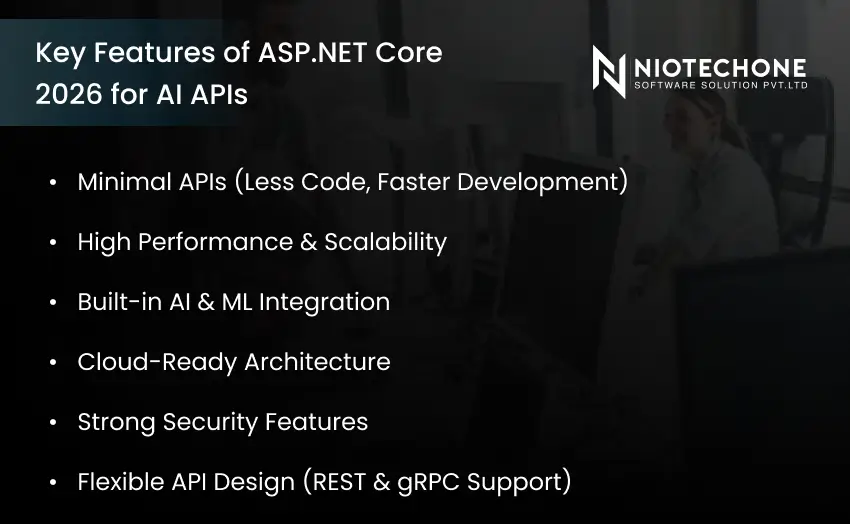
ASP.NET Core 2026 is designed to support modern, AI-based applications at high speed, security, and scale. The following are the main characteristics that make it a good option in the creation of AI-powered APIs:
1. Minimal APIs (Less Code, Faster Development)
Minimal APIs enable developers to write endpoints with minimal boilerplate code. This implies accelerated growth, a more organized structure, and faster implementation of AI capabilities.
2. High Performance & Scalability
ASP.NET Core is also designed to support heavy workloads, which is why it is suitable to use with AI APIs that can process a lot of data or receive a lot of requests without slowing down.
3. Built-in AI & ML Integration
Machine learning integration becomes simple with .NET. Developers can easily integrate ML models into APIs and add intelligent features such as predictions and recommendations.
4. Cloud-Ready Architecture
ASP. Whether you are deploying on Azure, Docker, or Kubernetes, .NET Core is designed for the cloud. This guarantees that your AI APIs will be able to scale with the increase in your user base.
5. Strong Security Features
AI APIs that deal with sensitive data require security. In-built authentication, authorization, and encryption support are useful in securing your applications against threats.
6. Flexible API Design (REST & gRPC Support)
Depending on their requirements, developers have the option of either REST or gRPC. This flexibility allows the development of APIs that are compatible with mobile applications, web applications, and enterprise systems.
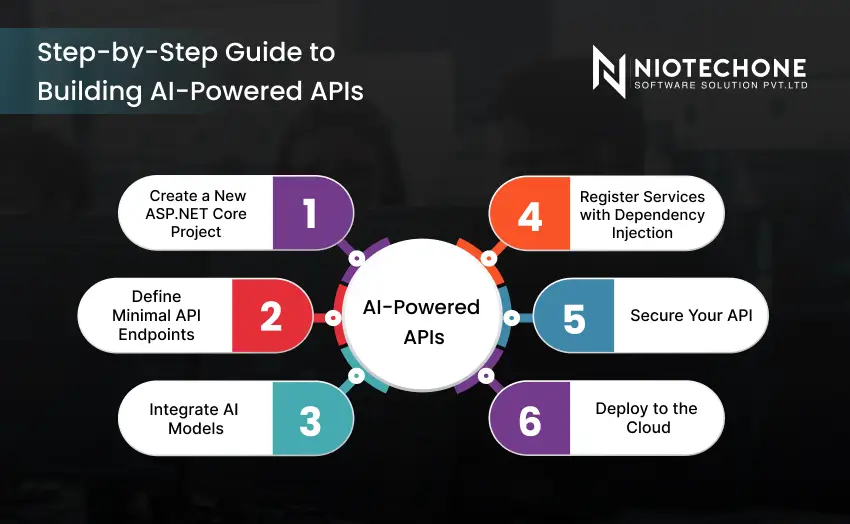
1. Create a New ASP.NET Core Project
bash
dotnet new webapi -n AIPoweredAPI
cd AIPoweredAPI
2. Define Minimal API Endpoints
csharp
var builder = WebApplication.CreateBuilder(args);
var app = builder.Build();
app. MapPost("/predict", async (PredictionInput input, PredictionService service) =>
{
var result = await service.PredictAsync(input);
return Results.Ok(result);
});
app.Run();
3. Integrate AI Models
csharp
public class PredictionService
{
private readonly PredictionEngine _engine;
public PredictionService(PredictionEngine engine)
{
_engine = engine;
}
public Task PredictAsync(ModelInput input)
{
return Task.FromResult(_engine.Predict(input));
}
}
4. Register Services with Dependency Injection
csharp
builder.Services.AddPredictionEnginePool()
.FromFile("MLModel.zip");
builder.Services.AddScoped();
5. Secure Your API
AI APIs tend to deal with sensitive information. Apply JWT authentication, rate limiting, and HTTPS. These measures can be implemented with the help of a professional Microsoft .NET development company.
6. Deploy to the Cloud
ASP.NET Core 2026 is cloud-ready. You may deploy to Azure App Service, deploy to Docker containers, or scale with Kubernetes. A lot of businesses depend on an IT services firm or a .NET application development company to handle deployments.
Industries are already being transformed by AI-powered APIs. ASP.NET Core 2026 allows businesses to create APIs that can be easily integrated with AI models to provide real value.
Healthcare IT
APIs can help hospitals predict patient risks based on medical history, identify anomalies in medical images, and propose individual treatment plans. As an example, an AI-based API can scan thousands of X-rays within minutes and indicate possible problems to doctors. Collaboration with a Microsoft .NET development company will guarantee adherence to healthcare standards such as HIPAA.
FinTech
AI APIs are used by banks and startups to detect fraud, offer precise credit scoring, and process market data to perform algorithmic trading. An AI-powered API developed using ASP.NET Core may help a FinTech startup cut fraud losses by 40%. An ASP.NET Core development company usually assists in the implementation of these solutions.
E-commerce
Retailers recommend products with APIs, chatbots with customer support, and dynamically adjust prices. As an example, an online shop can apply AI APIs to recommend clothes according to the browsing history of browsing, which will boost sales conversion. Most of them opt to hire .NET developers to incorporate these features into their systems so that they can be scaled during the high shopping periods.
Web Development and Enterprise IT
AI APIs facilitate natural language search, intelligent content tagging, and workflow automation. Businesses can automate routine processes such as document authorizations or customer registration, which saves time and minimizes mistakes. The IT services company or ASP.NET development services provider can be collaborated with to implement these solutions in various departments.
Some basic habits can help you create AI-powered APIs that are more reliable and useful when you are building them.
1. Keep Endpoints Focused
To begin with, maintain a focused endpoint. Every endpoint must have a purpose, e.g., a /predict endpoint must only make predictions. This makes your API clean and maintainable.
2. Optimize for Performance
When your API is frequently called with the same input, it will be more resource-efficient and faster to cache the result rather than to recalculate it each time. This is particularly significant in high-traffic situations such as e-commerce recommendations.
3. Monitor Model Performance
The accuracy of AI models may decrease with time as the data evolves. Monitoring the interaction of users with your API and the accuracy of the predictions will help you understand when it is time to improve it.
4. Retrain Models Regularly
Artificial intelligence requires new information to remain topical. Training regularly keeps your predictions relevant and correct.
5. Make Your API Developer-Friendly
Lastly, ensure your API is user-friendly. Proper documentation using tools such as Swagger/OpenAPI can assist other developers in learning how to interact with your endpoints in a short time.
To ensure that these practices are implemented uniformly, particularly when scaling APIs to enterprise use, many businesses prefer to engage an experienced ASP.NET development services provider.
Developing APIs with AI capabilities using ASP.NET Core 2026 requires taking the right steps: minimal defining of endpoints, connecting them to AI models, adding the appropriate levels of authorization/security, and deploying them in the cloud.
The end product is an API that not only provides data but also provides intelligent data to help organizations in many industries, like FinTech, e-commerce, and many others, in creating smarter, more user-friendly applications.
Whether you develop in-house or hire an ASP.NET Core development company to develop your application, ASP.NET Core provides developers with the speed, scalability, and security needed to remain competitive in today’s digital economy.
An AI-powered API integrates machine learning or AI models to provide intelligent services such as predictions, recommendations, or automated decision-making.
Yes, you can connect APIs from platforms like OpenAI, Hugging Face, or Azure AI alongside ML.NET to extend functionality.
Absolutely. It’s optimized for high performance and scales easily with Kubernetes and cloud platforms, making it ideal for enterprise-level projects.
Not necessarily. You can start with pre-trained models or external AI services without deep ML knowledge, and still deliver intelligent features.
You can secure APIs by using JWT authentication, HTTPS for encrypted communication, and rate limiting to prevent misuse or abuse.
3rd Floor, Aval Complex, University Road, above Balaji Super Market, Panchayat Nagar Chowk, Indira Circle, Rajkot, Gujarat 360005.
Abbotsford, BC
15th B Street 103, al Otaiba Dubai DU 00000, United Arab Emirates
3rd Floor, Aval Complex, University Road, above Balaji Super Market, Panchayat Nagar Chowk, Indira Circle, Rajkot, Gujarat 360005.
Abbotsford, BC
15th B Street 103, al Otaiba Dubai DU 00000, United Arab Emirates
Copyright © 2026 Niotechone Software Solution Pvt. Ltd. All Rights Reserved.