Microservices at Scale: Why Many Outsourced Projects Fail and How to Avoid It

Introduction:

The microservices architecture has emerged as the gold standard of the modern enterprise software systems. The ability to separate large monolithic applications into smaller independent services can enable businesses to be scaled, agile, and have shorter deployment cycles. No wonder, global business organizations, both startups and fortune 500 companies are embracing this architecture by outsourcing models.

We have seen at Niotechone Software Solution Pvt. Ltd. a top.NET development company in Rajkot how the poor architectural decisions or the immaturity of DevOps can transform an otherwise promising microservices project into a nightmare of maintenance. We have developed experience in the development of .NET core applications, Azure cloud application development, and custom software development, which has taught us what works and what does not when outsourcing microservices at scale.

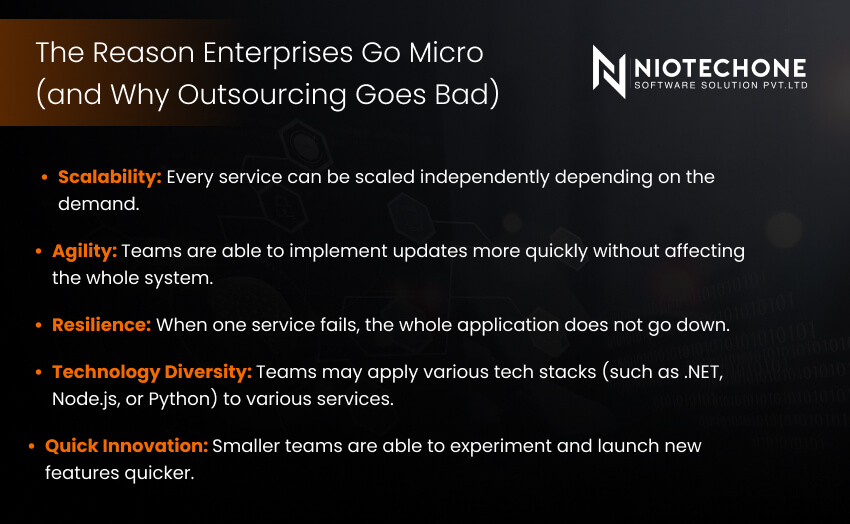
The Reason Enterprises Go Micro (and Why Outsourcing Goes Bad)

Businesses are shifting to microservices due to a number of reasons:

  • Scalability: Every service can be scaled independently depending on the demand.
  • Agility: Teams are able to implement updates more quickly without affecting the whole system.
  • Resilience: When one service fails, the whole application does not go down.
  • Technology Diversity: Teams may apply various tech stacks (such as .NET, Node.js, or Python) to various services.
  • Quick Innovation: Smaller teams are able to experiment and launch new features quicker.


However, in the case of outsourcing microservices projects, these benefits are usually lost. Why? Because:

  • The architecture is not aligned with the in-house and outsourced teams.
  • Service ownership does not have a single source of truth.
  • DevOps pipelines are incomplete or not well-constructed.
  • Testing and observability are considered as an afterthought.
  • The pressure of cost and delivery compels teams to focus on speed rather than stability.


The development of microservices requires serious technical governance and regular communication, which most projects do not take into account.

Successful Microservice Construction

This is how to design scalable, high-performance microservices that perform flawlessly even in complicated outsourced environments.

1. Domain-Driven Design (DDD)

Decompose the application into business-driven domains. Every microservice must be a distinct business capability (e.g., Payment, Inventory, Notifications).

2. Containerization and Orchestration

  • Containerize services using Docker.
  • Scale Kubernetes (Azure users use AKS).
  • Auto scale with HPA (Horizontal Pod Autoscaler).

3. Centralized Observability

  • It is necessary to have a single view of several services.
  • Install Azure Monitor, Prometheus, or Grafana to track performance.
  • Debug with distributed tracing tools, such as Jaeger or OpenTelemetry.

4. CI/CD Automation

  • Automated pipelines avoid manual errors and enhance the speed of release.
  • Incorporate CI/CD processes of each microservice.
  • Allow rollback deployments.

5. Security and Compliance

  • Microservices expand the attack surface.
  • Use zero-trust security policies.
  • Implement token-based authentication (JWT, OAuth2).
  • Secure data in transit and rest.

The success of Microservices at Niotechone

At Niotechone Software Solution Pvt. Ltd., we focus on the development of the .NET Core applications and the development of the Azure cloud applications, and we assist the enterprises of the world to deploy the microservices-based architecture that can scale safely and efficiently.

We leverage:

  • Container orchestration: Azure Service Fabric and AKS.
  • ASP.NET core development in Rajkot to develop microservice APIs.
  • AI Software development in India predictive monitoring and anomaly detection.
  • custom Enterprise mobility software solutions to combine microservices on mobile and web platforms.

We are a Software development company in Rajkot and a .NET development company in India and this experience allows us to provide high-performing systems to your business requirements.

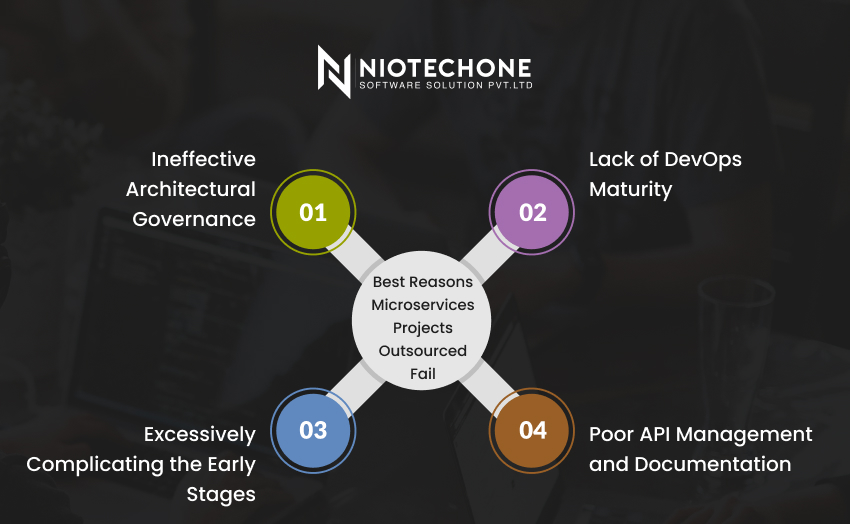
Best Reasons Microservices Projects Outsourced Fail

There are numerous reasons why outsourced microservices projects fail. We shall discuss the key failure patterns (anti-patterns) that we have observed in industries:

1. Ineffective Architectural Governance

In the case of several vendors or remote teams working on the various services, they may have their conventions. In the absence of good architectural governance:

  • APIs become inconsistent.
  • Data contracts are prone to breaking.
  • Service discovery and communication is no longer reliable.

Solution:

  • Establish explicit architecture blueprints, governance policies, and versioning policies at the outset. Create a Central Architecture Board that will review all services prior to deployment.

2. Lack of DevOps Maturity

DevOps-free microservices is anarchy. CI/CD pipelines are essential to provide fast updates and stable rollouts.

Solution:

  • Use powerful CI/CD pipelines (Azure DevOps, Jenkins, GitHub Actions).
  • Provisioning of environments with Infrastructure as Code (IaC).
  • Rollout with blue-green or canary deployments.

In Niotechone, DevOps pipelines are incorporated in all ASP.NET Core development projects in Rajkot and Azure cloud application development projects to ensure that downtime is minimal and the velocity is high.

3. Excessively Complicating the Early Stages

Most teams leap directly into using microservices on small projects that do not require them. This causes unwarranted complexity.

Solution:

  • Begin with small steps — first split high-value modules. The system is gradually scaled with containerization and orchestration with Docker or Kubernetes as the system grows.

4. Poor API Management and Documentation

In cases where two or more microservices interact, documentation issues may lead to API mismatch, which will lead to broken features.

Solution:

  • Standardize API formats (OpenAPI/Swagger).
  • Apply API gateways such as Azure API Management or Kong.
  • Keep appropriate API lifecycle records.

Outsourcing Microservices Projects: Best Practices

The following are the best practices to ensure success with outsourced microservices:

  • Select partners that have DevOps and Cloud-Native experience.
  • Establish architecture blueprints and governance structures.
  • Establish deployment, performance, and error-solving SLAs.
  • Ensure open communication between teams.
  • Scalable infrastructure Use Azure cloud application development.
  • Pay attention to predictive maintenance and observability.

Conclusion

Microservices are not a silver bullet, as they require proper design, constant monitoring, and cross-team cooperation. The majority of outsourced failures are caused by bad governance and technical immaturity, rather than the idea.

Enterprises can access professionals who know both architecture and implementation by collaborating with a reliable .NET development company in Rajkot such as Niotechone. Our teams combine custom software development, Azure cloud application development and ASP.NET core development expertise in India to provide scalable, secure and reliable systems.

To globalize companies, it is a winning formula of automation, observability, and AI-driven development coupled with high-quality technical leadership, which we have perfected in any industry at Niotechone.

Frequently Asked Questions FAQs

Due to the lack of consistent architecture, insufficient DevOps integration, and inter-team communication. The collaboration with a seasoned Software development company in Rajkot will reduce these risks.

Software Development AI in India makes it possible to predictive test, analyze the root cause, and identify anomalies, which minimize downtime and maintenance expenses.

Azure offers such tools as AKS, Service Fabric, and API Management - all the essentials of scalable, secure, and cost-effective microservices.

NiotechOne uses containerized architectures and automated CI/CD pipelines by using the .NET Core application development and Azure cloud application development.

Collaborate with a .NET development company in India that offers end to end visibility, good governance and established cloud expertise.