Cloud Migration Step-by-Step Guide for 2026
- Niotechone Marketing Team
Table of Contents
- Introduction
- What Is Cloud Migration?
- The importance of cloud migration in 2026
- Step 1: Establish Clear Business Objectives
- Step 2: Evaluate Current Infrastructure and Applications
- Step 3: Select the appropriate Cloud Migration Strategy
- Step 4: Choose the appropriate Cloud Platform
- Step 5: Early Plan Security and Compliance
- Step 6: Phase-by-phase Migration of Applications and Data
- Step 7: Post-Migration Performance and Cost Optimization
- Step 8: Empower AI and Automation
- Step 9: Train Teams and Update Processes
- Typical Cloud Migration Problems in 2026
- Conclusion
Introduction
Migration to the cloud has ceased to be a competitive advantage but a business requirement. The need to be flexible, secure, and cost-effective is on the increase as organizations go digital. In 2026, businesses will collaborate with experienced cloud and software development teams in India, who are increasingly focusing on cloud-first approaches to remain competitive.
A systematic cloud migration strategy is essential, whether you are planning to modernize your applications or move to the Azure cloud application development. This guide will take you through every step of cloud migration step-by-step- helping businesses to avoid expensive errors and maximize performance, scalability, and ROI.
What Is Cloud Migration?
Cloud migration refers to the process of transferring digital resources like applications, databases, workloads, and IT resources out of on-premise infrastructure and into cloud-based environments.
This includes:
- Moving old applications.
- Updating systems with cloud-native services.
- Implementing hybrid or multi-clouds.
In the case of companies that provide custom software development, cloud migration can be the basis of creating scalable and future-proof solutions.
The importance of cloud migration in 2026
In 2026, businesses are under increasing pressure to innovate more quickly and at lower costs of operation. This shift is made possible by cloud platforms.
Key drivers include:
- Blistering digital transformation in industries.
- Remote and mobile accessibility.
- Heightened attention to security and compliance.
- AI, analytics, and automation integration.
Businesses running modern .NET applications are increasingly moving to cloud-native architectures to support scalability, security, and continuous innovation.
Step 1: Establish Clear Business Objectives
Businesses need to establish the purpose of migrating to the cloud before they migrate anything.
Common objectives include:
- Cutting infrastructure expenses.
- Enhancing scalability and performance.
- Improving security and compliance.
- Enabling enterprise mobility and a remote workforce.
Defined objectives make cloud migration a part of long-term business strategy, rather than technical upgrades.
Step 2: Evaluate Current Infrastructure and Applications
A thorough evaluation assists in deciding what to migrate, modernize, or retire.
This step includes:
- Dependency mapping of applications.
- Performance benchmarking
- Security and compliance assessment.
- Infrastructure cost analysis.
In the case of companies that offer tailor-made Enterprise mobility software solutions, this test guarantees that mobile applications work best in cloud environments.
Step 3: Select the appropriate Cloud Migration Strategy
Migration approaches to different workloads vary. It is important to choose the appropriate strategy.
Strategy | Description | Best Use Case |
Rehosting | Lift-and-shift migration | Legacy apps with minimal changes |
Refactoring | Cloud-native optimization | High-performance applications |
Replatforming | Partial modernization | Cost and performance optimization |
Rebuilding | Complete redesign | Long-term scalability goals |
Replacing | SaaS adoption | Non-core business apps |
A software development company usually assists companies in choosing strategies that are fast, cost-effective, and growth-oriented.
Step 4: Choose the appropriate Cloud Platform
Cloud services vary in terms of services, pricing models, and ecosystem support.
Key evaluation criteria:
- Interoperability with the current technology stack.
- Security and compliance certifications.
- Scalability and worldwide accessibility.
- Connection with AI and analytics tools.
The reason why many organizations prefer Azure cloud application development is that it supports enterprise-grade solutions and integrates well with the .NET technologies.
Step 5: Early Plan Security and Compliance
Security is not something that should be considered after cloud migration.
Critical security considerations:
- Access and identity management.
- Key management and data encryption.
- Regulatory compliance (GDPR, ISO, HIPAA)
- Backup and disaster recovery plans.
This is particularly critical when migrating enterprise systems or customer-sensitive information.
Step 6: Phase-by-phase Migration of Applications and Data
A gradual migration strategy reduces risk and downtime.
Best practices include:
- Move low-risk workloads initially.
- Performance testing at the end of every phase.
- Maintaining data integrity in transfers.
- Maintaining rollback plans
Many India-based development teams using ASP.NET Core upgrade applications during cloud migration to unlock cloud-native performance benefits.
Step 7: Post-Migration Performance and Cost Optimization
Migration to the cloud is not completed when workloads are live.
Post-migration optimization is concerned with:
- Monitoring resource usage
- Right-sizing infrastructure
- Enhancing the response time of applications.
- Cutting down on unnecessary services.
Cost optimization guarantees that businesses achieve the full financial benefits of cloud adoption.
Step 8: Empower AI and Automation
Seamless AI integration is one of the largest benefits of cloud adoption in 2026.
Benefits include:
- Predictive analytics
- Scaling and monitoring are automated.
- Smart customer insights.
- Smart software testing and deployment.
Businesses across India adopting AI-driven software development are gaining a competitive edge through intelligent and adaptive applications.
Step 9: Train Teams and Update Processes
Migration to the cloud not only affects technology but also people and processes.
Key focus areas:
- Developer and IT team cloud training.
- Updating DevOps workflows
- Re-defining security and governance policies.
- Promoting cloud-first thinking.
This guarantees success in the long term after the technical migration.
Typical Cloud Migration Problems in 2026
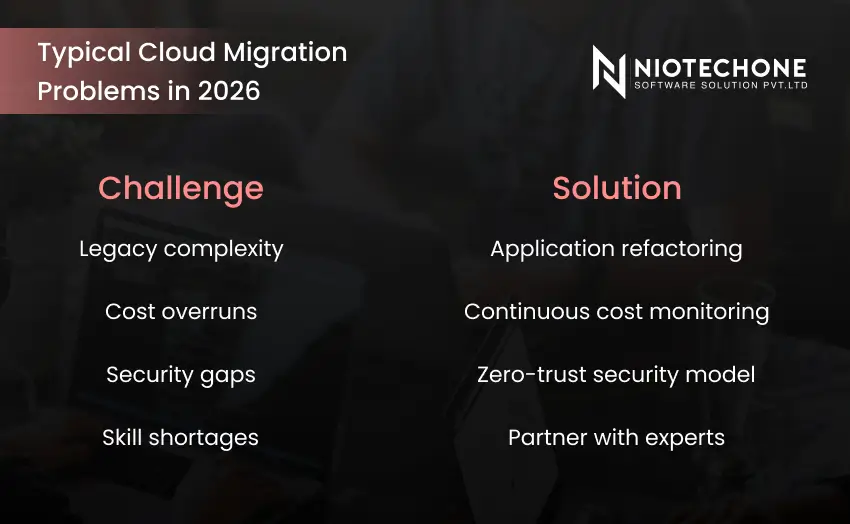
Cloud migration is associated with challenges despite its advantages.
Challenge | Impact | Solution |
Legacy complexity | Migration delays | Application refactoring |
Cost overruns | Budget strain | Continuous cost monitoring |
Security gaps | Data risks | Zero-trust security model |
Skill shortages | Project delays | Partner with experts |
The collaboration with a seasoned software development company assists companies in addressing these issues effectively.
Conclusion
In 2026, cloud migration is not merely a matter of system migration, but rather a matter of empowering smarter, faster, and more resilient businesses. A step-by-step process is structured to assist organizations in reducing risks and maximizing the value of cloud investments.
Businesses can create scalable, secure, and future-ready digital platforms by aligning migration objectives with business objectives and using the expertise of a trusted .NET development company or a software development company. Cloud migration is the key to innovation, efficiency, and long-term growth with the right strategy.
Categories
Related Articles

Frequently Asked Questions FAQs
It is based on the complexity of the application, and the majority of projects require 3-9 months.
There are initial costs, but long-term savings tend to be more than that.
Yes, by rehosting, refactoring, or rebuilding strategies.
Yes, Azure is popular with enterprise-grade and .NET-based solutions.
Cloud systems enable scaling on demand without infrastructure constraints.