7 Jobs AI Won’t Replace in 2026 (Future-Proof Careers)

Introduction

The world of work is rapidly changing due to advancements in technology. Massive advancements are being made in the automation of jobs through Artificial Intelligence (AI), from manufacturing automation using AI technologies to AI-powered chatbots providing customer service around the globe.

The truth is, there is a more balanced outlook regarding the use of AI in the workplace. Although AI will continue to automate many routine and repetitive tasks, or tasks that involve lots of data analysis.

The objective of this article is to look at 7 types of jobs that AI will not replace, why they are resistant to being replaced, and how businesses that are investing in custom software development or are looking to implement a solution utilizing AI should prepare themselves for what is coming.

Why AI Won’t Replace Every Job

While AI is powerful, it has limitations. The difference between AI strengths and human strengths explains why some careers remain safe.

AI Strengths

Human Strengths

Data analysis

Emotional intelligence

Pattern recognition

Ethical judgment

Task automation

Creative thinking

Predictive analytics

Relationship building

24/7 operation

Strategic long-term vision

Top jobs AI won’t replace such as software developers, healthcare professionals, entrepreneurs, and creative professionals.

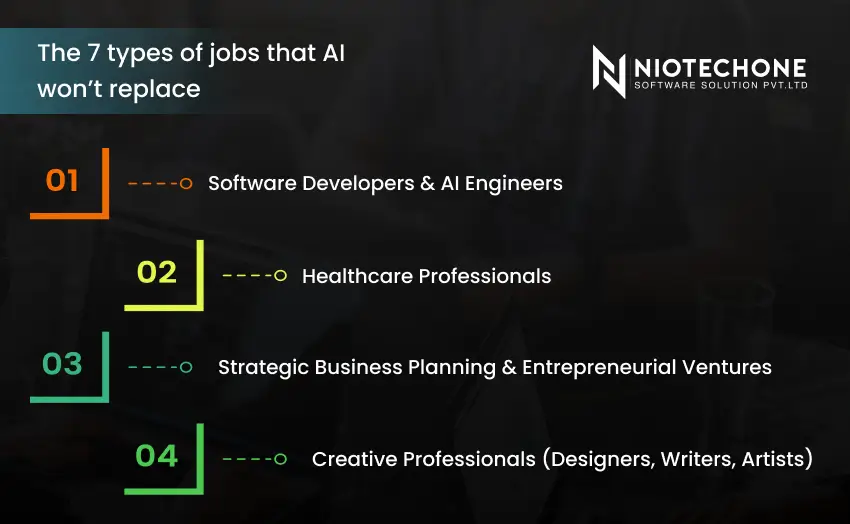
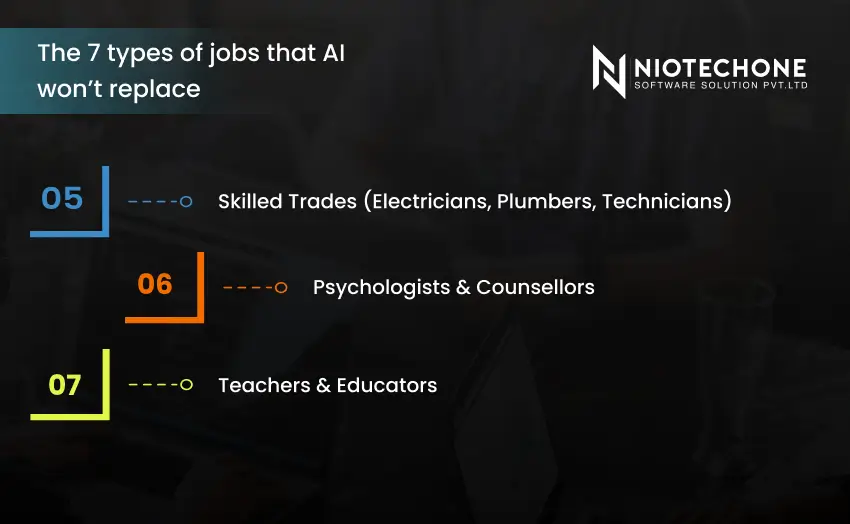
The 7 types of jobs that AI won’t replace

1. Software Developers & AI Engineers

Despite AI tools that generate code, skilled developers remain irreplaceable.

Why This Career Is Safe:

  • Businesses need custom software solutions.
  • AI systems require human supervision.
  • Cybersecurity and cloud infrastructure demand expertise.
  • Strategic system design can’t be automated fully.


Companies like a leading
.NET development company in India specialize in building scalable and AI-integrated business applications. The demand for skilled developers in areas like Azure cloud application development and enterprise mobility solutions continues to rise.

2. Healthcare Professionals

AI can assist healthcare professionals, but it cannot fully replace doctors, nurses, or therapists because human empathy and ethical judgment remain essential in patient care.

AI can help diagnose and help with medical images, but nothing is as important as having human compassion.

Reasons why this profession will continue to be around:

  • Compassion and trust in others are important to provide emotional support.
  • Judging who the patient is and how you treat them takes judgment.
  • Making legal and ethical decisions cannot be automated.

AI may be an additional tool, but it can NEVER fully take the place of humans with compassion in Healthcare.

3. Creative Professionals (Designers, Writers, Artists)

Creating creative work requires much more than just creating something new to compose or generate, like a video, image, or piece of content.

 Creative Workflow is made up of many components:

  • New Story
  • Brand Awareness
  • Social Awareness
  • Strategic Messaging


To create new creative material for a digital company in India, any business investing in digital transformation or creating custom applications must hire.

4. Strategic Business Planning & Entrepreneurial Ventures

While AI provides a great deal of analytical insight into market behavior, it does not take the place of innovative decision-making.

As entrepreneurs and business strategists, we are tasked with…

  • Identifying opportunities in a market.
  • Creating a vision for the long term.
  • Using risk management principles to make decisions.
  • Providing direction to the teams we lead.

For example, the technology leaders at Niotechone don’t simply create applications.

Jobs AI will not replace including skilled trades, psychologists, and teachers requiring human expertise and emotional intelligence.

5. Skilled Trades (Electricians, Plumbers, Technicians)

Although both factories may include AI and robots, skilled trades will have to be accomplished by humans due to the physical flexibility and ability to solve problems on the job, also known as hands-on troubleshooting, local/surrounding adaptability, and quick decision-making.

6. Psychologists & Counsellors

While AI chatbots can deliver advice, they do not give authentic emotion, they do not develop strong friendships, and they do not possess the ability to read between the lines of human interaction.

However, as we live more and more of our lives digitally, the need for mental health support is increasing exponentially.

7. Teachers & Educators

AI may help enhance online education; however, education itself is much more than people simply transmitting their knowledge.

Teachers:

  • Motivate students
  • Adjust their teaching styles
  • Give students emotional support
  • Teach students to think critically

Although AI will help create individualized learning pathways, it cannot take the place of a human mentor who will help to create a new generation.

What These Jobs Have in Common: The Four Pillars of AI-Resistance

Even though these professions are part of diverse sectors like technology, health care, education, business, and trades, there are compelling similarities among them.

Now, let’s examine the four pillars of AI resistance:

1. Emotional Intelligence (EQ)

While AI can analyze information and perform some calculations in a matter of milliseconds to represent how we behave.

Many careers rely heavily upon having a high level of empathy, including but not limited to:

  • Healthcare
  • Mental Health
  • Education

These professions are based on compassion, connection to others, and creating a trusting relationship with them.

2. Complex Problem-Solving & Critical Thinking

In known circumstances where there is a well-defined structure of input data, AI provides excellent results. The reality is that most of the time, our world is very unpredictable and chaotic.

People in the following professions: 

  • Software Development
  • Skilled Trades
  • Strategic Business Planning

must adapt quickly, evaluate their unique situations, respond appropriately to those situations, and make good choices.

3. Innovation and Creativity

While AI-generated content is based on its patterns, originality, storytelling, and innovation come from the human imagination.

Creative professionals and Entrepreneurs:

  • Build brand images
  • Create user experiences
  • Build cutting-edge ideas
  • Find new market opportunities

The Importance of Innovation: Through Innovation, businesses grow; without innovation, there is no digital transformation.

4. Strategic foresight and Ethical judgement

AI gives insight, but cannot specify long-term vision or assume ethical responsibility.

All leaders and experts must:

  •  Use a risk-based approach to make decisions
  •  Develop and maintain ethical practices
  •  Plan for sustainability and future growth
  • Accept full accountability for the actions and results of their organisation.

For example, Niotechone Software Solution Pvt.Ltd, through its innovative use of AI in its respective industries, has developed a responsible approach.

Skills for a Future-Proof Career - 2026 and Beyond

Skills that will help you remain employed in an AI environment include:

1. Skills in Emotional Intelligence – AI/ML lacks true emotional intelligence, making it difficult for humans to relate to it.

2. Skills in Complex Problem Solving – Human judgment is still extremely important

3. Skills in Cloud & AI Integration – There are a lot of opportunities for Azure Cloud Application Development & AI-powered Enterprise Solutions.

4. Skills in Creativity & Innovation – AI/ML replicates existing ideas; only humans create something that has never been done before.

5. Skills in Adapting to New Technology – Continuous learning around tools, frameworks, and platforms, such as ASP.NET Core Development.

Will Automation Replace Jobs in the Future?

The answer to this question is short and simple: AI will change job functions, not remove humanity as we know it.

Annual Changes That Have Occurred Historically

  • The Industrial Revolution changed job functions but created more industries.
  • The Internet allowed us to create the digital economy.
  • AI will allow us to develop entirely new job types that we cannot currently fathom.

The perspective should not be fear-mongering, but rather to be prepared.

Conclusion

AI will enhance productivity, but it will not replace careers built on expertise, creativity, and human judgment. Professionals designing enterprise systems, managing cloud application development, and leading innovation will remain essential in 2026 and beyond.

The key is simple: adapt, upgrade your skills, and position yourself where human intelligence adds the most value. Careers in software development, healthcare, education, skilled trades, and business leadership will be insulated from any job loss.

Frequently Asked Questions FAQs

Although automation of repetitive tasks by Artificial Intelligence will change many jobs, jobs requiring creativity and empathy will remain.

The future-proof career fields to pursue include: Software development, Healthcare, Education, Trades (skilled), and Business Strategy.

yes, Artificial Intelligence tools assist Developers, but skilled professionals will still be required for architectural design.

Prepare for the future workforce by acquiring emotional intelligence, problem-solving, cloud, and Artificial Intelligence knowledge.