AI-Augmented Delivery Models Explained
- Niotechone Marketing Team
Table of Contents
- Introduction
- What Are AI-Augmented Delivery Models?
- How AI Is Transforming Software Delivery
- Understanding the Challenge of Trust in AI-Augmented Delivery
- Key Trust Challenges in AI-Augmented Delivery Models
- Role of Custom Software Development in Building Trust
- AI-Enhanced Delivery in Enterprise Application Development
- Best Practices in Trust Building in AI-Augmented Delivery Models
- Conclusion: AI-Augmented Delivery Is Built on Trust
Introduction
Artificial Intelligence is no longer a hypothetical technology that exists in the innovation labs. It has become an essential component of the way modern software is designed, developed, tested, and deployed. AI has become an inseparable part of software delivery pipelines, with automated code reviews and intelligent project forecasting being only a few examples.
This development has led to AI-enhanced delivery models, in which AI tools are used in collaboration with human teams to enhance speed, quality, and decision-making. Companies that collaborate with a Software Development Company in Rajkot or a Software Development Company in India are more and more demanding AI-driven efficiencies as a delivery standard.
What Are AI-Augmented Delivery Models?
AI-augmented delivery models are software development models in which AI tools are used to augment human capabilities instead of substituting them. These models combine machine learning, data analytics, and automation throughout the software lifecycle without losing human expertise in the decision-making process.
In the conventional delivery models, teams use a lot of manual effort in planning, coding, testing, and monitoring. AI-enhanced models add intelligence to these processes by examining patterns, forecasting risks, and automating repetitive tasks.
In contrast to fully autonomous systems, AI-enhanced delivery focuses on human-machine cooperation. Strategy and validation are still the responsibility of developers, architects, testers, and project managers, and AI assists in execution and optimization.
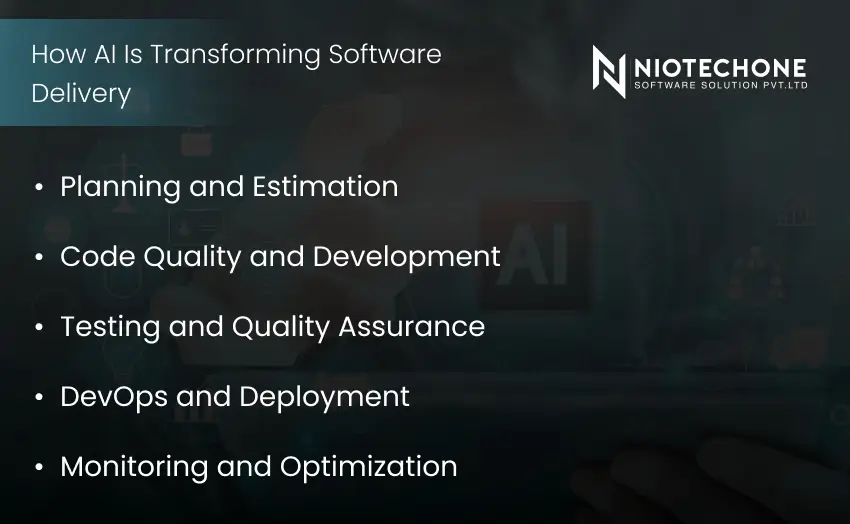
How AI Is Transforming Software Delivery
AI has greatly transformed the way software projects are implemented. It influences all levels of the development lifecycle.
Planning and Estimation
AI uses past project data to create more precise timelines, cost estimates, and risk assessments. This minimizes guesswork and enhances stakeholder confidence.
Code Quality and Development
AI-based tools help in code generation, early bug detection, and code standards. It is especially useful in large-scale enterprise and .NET development projects.
Testing and Quality Assurance
Automated test generation, regression testing, and anomaly detection enhance release stability and minimize manual QA effort.
DevOps and Deployment
AI streamlines CI/CD pipelines by forecasting deployment failures, system health, and performance improvements.
Monitoring and Optimization
After deployment, AI constantly monitors the behavior of applications to detect performance bottlenecks and security threats.
In the case of companies that deal with web and mobile application development, these features greatly reduce the release cycles and enhance user experience.
Understanding the Challenge of Trust in AI-Augmented Delivery
Although it has its benefits, the adoption of AI is usually received with scepticism. The greatest obstacle is trust.
Confidence in AI-enhanced delivery implies that AI-generated insights are:
- Accurate
- Explainable
- Secure
- Aligned with business goals
Most organizations find it hard to comprehend how AI comes up with some of the recommendations. This is not very transparent, and this is uncomfortable, particularly when decisions are made that impact budgets, timelines or systems that are customer-facing.
The problem of trust is aggravated in the enterprise setting where regulatory compliance, data privacy, and accountability are paramount.

Key Trust Challenges in AI-Augmented Delivery Models
Lack of Transparency
AI systems tend to be black boxes. Recommendations are given to teams without clear explanations, and thus, validation becomes hard.
Fear of Incorrect Outputs
AI relies on training data. When the data is not complete or biased, the results can be misleading, which affects the project outcomes.
Over-Automation Risks
The unquestioning use of AI may decrease human control, which may lead to the possibility of making mistakes or making incorrect decisions.
Data Security and Privacy
AI tools need to have access to sensitive codebases and business data. Weak governance is a security issue.
Cultural Resistance
AI can be perceived as a threat to expertise instead of a support tool by developers and managers, which slows down adoption.
Validation Complexity
Another complexity is that AI-generated insights may need specialised knowledge to be interpreted properly.
The lack of attention to these issues may lead to unsuccessful implementations, loss of investments, and lack of trust in AI-based projects.
Role of Custom Software Development in Building Trust
Generic AI tools are not sufficient to build trust. This is where the development of custom software is essential.
Businesses can use custom AI-enabled systems to:
- Regulate the training of AI models.
- Define validation rules
- Adopt explainable AI systems.
- Implement security and compliance requirements.
Ready-made solutions are not always flexible, and it is hard to adjust AI behavior to the needs of the business. An effective Software Development Company in India can create AI systems that fit the organizational processes, minimizing risk and enhancing trust.
AI-Enhanced Delivery in Enterprise Application Development
Enterprise application development is associated with complicated architectures, large volumes of data, and rigid compliance criteria. In such settings, AI-enhanced delivery models offer quantifiable benefits.
AI improves:
- Requirement traceability
- Dependency mapping
- Performance forecasting
- Security monitoring
Meanwhile, enterprise systems require transparency and control. To gain the trust of stakeholders, AI should be explainable and auditable. This balance is essential to the industries of finance, healthcare, logistics, and SaaS platforms.
Best Practices in Trust Building in AI-Augmented Delivery Models
Businesses ought to adhere to best practices to achieve long-term success:
- Have human validation points.
- Apply explainable AI methods.
- Continuous monitoring of AI performance.
- Develop effective data governance policies.
- Train personnel to read AI outputs.
- Do not go all the way with automation.
When AI systems are predictable, auditable, and aligned with business goals, trust increases.
Conclusion: AI-Augmented Delivery Is Built on Trust
The future of software development is AI-enhanced delivery models. They facilitate quicker releases, quality, and smarter decision-making.
But technology is not sufficient. Trust determines success. Companies that strike a balance between AI innovation and human judgment will have a competitive advantage. Individuals who do not trust will find it hard to scale AI responsibly.
Through collaboration with a reputable Custom Software Development Company in India, companies can embrace AI-enhanced delivery models that are effective, transparent, and dependable.
Categories
Related Articles


Frequently Asked Questions FAQs
AI-enhanced delivery models are models that integrate AI with human knowledge to enhance software planning, development, testing, and deployment.
AI automates repetitive work, forecasts risks, enhances code quality, and assists in making decisions faster throughout the development lifecycle.
The lack of transparency, data security concerns, and uncertainty about AI-generated recommendations lead to trust issues.
No, AI improves productivity, yet human skills are still needed in strategy, validation, and business alignment.
Through tailor-made software solutions, human control, and collaboration with established development companies.