How UX & AI Together Can Improve Software Adoption

Introduction:

In today’s digital world, developing software that users love is no longer about functionality but about experience. Even the most potent custom software development or .NET Core applications fail when users become frustrated in adopting them. This is where User Experience (UX) and Artificial Intelligence (AI) come together for the purpose of building great software.

UX personalization informed by AI allows software to anticipate user needs, adapt workflows, and provide context-aware solutions. When applied strategically, this approach improves not only usability but also adoption of software solutions so that users do not just use your applications but also embrace them.

Whether your company is a software development company based in Rajkot, building custom enterprise mobility software solutions, or developing ASP.NET Core applications.

User Experience (UX) design improving software adoption by enhancing usability, engagement, and user satisfaction.

The Importance of UX in Software Adoption

User Experience (UX) is more than just a nice interface— UX is the experience that users have when interacting with your software. Well-executed UX design provides:

Ease of Use: Users can accomplish their tasks easily and efficiently without confusion.

Emotional Connection: Users begin to trust and rely on software that provides a pleasant, satisfying experience.

Intuitive Navigation: Users can find what they need without needing extensive training.

Research suggests that poor UX is among the top reasons software gets rejected, even when full-functioning. Developers engaged in web development or custom software development must prioritize UX in order to adapt at a high rate.

How Artificial Intelligence Improves User Experience

Artificial intelligence (AI) is transforming the interaction between software and its users. Some examples of how AI improves UX include the following:

Personalization: AI can analyze user activity and tailor experiences based on preferences. For example, enterprise mobility software solutions can modify notifications and dashboards for each employee.

Predictive Assistance: AI algorithms can reduce user friction by anticipating their needs. For instance, a .NET Core application development project may use AI to recommend the next steps in a specific workflow or relevant features of the software.

Automated Support: AI-based chatbots and virtual assistants automate the manual management of tasks, minimizing interruptions while adopting software, and increasing the seamless effort and reducing frustration.

Behavioral Insights: By analyzing user interactions, AI can identify friction points in the UX design, allowing software development companies in Rajkot to develop software that gets continued usage and improves user engagement.

Real-World Specifics

Healthcare Use

In the context of managing patients, a user interface powered by AI would be able to personalize its dashboard for the doctor, nurse, and physician, ultimately improving the adoption of particular workflows.

Enterprise Mobility Applications

We have seen custom enterprise mobility software solutions take advantage of AI-powered task prioritization and AI-powered reminders to free employees to focus on higher-value tasks, positively impacting productivity, satisfaction, and engagement.

Web Portals

We have also seen organizations integrate AI analytics into their .NET Core web applications, allowing the system to automatically recommend content or features based on how a user interacts with a particular action or feature within the application.

These scenarios illustrate how user experience (UX) enhanced by AI improved efficiencies and increased adoption and satisfaction.

Wider Organization Benefits

Bringing together UX and AI also provides specific benefits to an organization:

Increased Software Use and Adoption

UX will allow for personalization of the user experience, predictive assistance, and reduced onboarding time.

Reduced Costs for Training Staff on Software Efficiencies

An AI-powered guide reduces the need for a prolonged and costly training program.

Enhanced Productivity

Users will be able to complete tasks with greater speed and, thus, with decreased potential for errors.

Data-Driven Decision Making

Through behavioral insights on usage, an organization may improve its UX and overall strategy.

For a software development company in Rajkot or any global enterprise, the key benefits to their organization will be increased ROI and an ever-growing level of satisfied end-users.

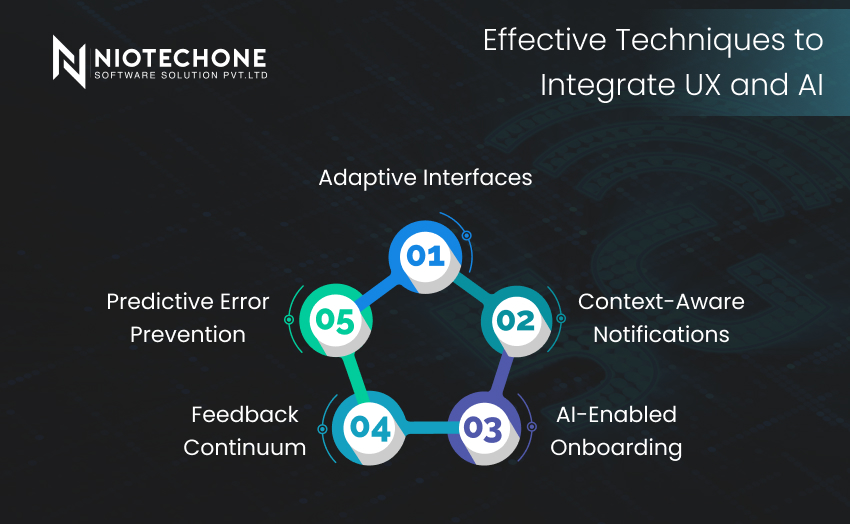
Effective Techniques to Integrate UX and AI

Getting your software used depends largely on combining UX principles with the capabilities of AI. Here are some ways that businesses can accomplish this:

1. Adaptive Interfaces

Utilizing AI to adapt the interface based on users’ preferences and behaviors is crucial in providing person-centered applications, whether they are ASP.NET Core development projects, mobile apps, or any other type of application.

2. Context-Aware Notifications

AI can also assess workflows to provide alerts that are timely, relevant, and more efficiently utilized. If there is a custom enterprise mobility software solution built for interacting with clients, the software could notify sales reps to touch base with a lead on follow-up. If the lead isn’t ready, another time could be determined, which is better than just distracting the sales rep.

3. AI-Enabled Onboarding

If you onboard users in a personalized experience utilizing AI- suggestions to guide users through complex modules would reduce training time and cost, and facilitate adoption for new tools like Azure cloud application development or any internal development dashboard.

4. Feedback Continuum

AI can provide feedback for how the users are interacting with the software on an ongoing basis, so UX designers can iterate on improvements without direct user input. The convergence of UX and AI allows a dependence on how software elevates, or declines to meet the demands of the user.

5. Predictive Error Prevention

AI can identify issues and/or bottlenecks before they happen, eliminating reliability issues. In software development and .NET Core applications, this is a huge deal in getting users to trust using it; long-term users or adoption is dependent on this.

Considerations Regarding Challenges

While the potential of merging AI and UX is extensive, there is a significant number of considerations to think about, which include:

Data privacy concerns: AI is reliant on user data, which requires very strict compliance with legislation.

Complex Implementation – Getting the right combination of AI algorithm use at the same time as having AI with an intuitive UX will require an association of qualified .NET Core application development skills and expertise in  Azure cloud application development.

User Trust – Users and participants in any scenario are unlikely to use AI-driven features if they feel as if they are managing their data or workflow with the same level of access as before.

With that said, to attain the most opportunity out of a better UX, a realistic depression of the issues of AI integration must be conducted.

Conclusion

UX and AI integration is a powerful enabler to improve software adoption. When AI enables software to prepare personalized experiences while predicting workflows and acting accordingly through an intuitive design delivering so-called predictive software, organizations will have not only software services being adopted, but an experience that users embrace.

Whether we are speaking about custom software development, .NET Core application development, or ASP.NET Core development, Rajkot – with respect to development or deliverable software solutions or enterprise-grade .NET Core applications, AI being an addition to the UX design process is no longer recommended, but essentially required to have a software experience that truly resonates with their users or participants.

Frequently Asked Questions FAQs

A solid UX design means the software will be easy to learn, efficient, and provide a straightforward interface. Software with outstanding core functionality built in .NET Core or ASP.NET Core development in Rajkot or anywhere risks failure upon adoption if usability is poor. In contrast, good UX can drive user engagement and sustained use of the software.

The use of AI-powered tools and technologies can enhance UX in software development to personalize experiences for users, anticipate their needs, and automate processes — particularly important for enterprise mobility software solutions. This makes the software easier to use and manages new user expectations.

Yes, an AI-enabled onboarding experience is capable of adjusting to the individual user experience, improving transition for complex technologies, reducing training costs, and improving user adoption of the full software capabilities in systems like Azure cloud application development. 

For software development companies in Rajkot, in tandem, AI methodology with good UX design develops user-centered, adaptive, efficient, custom software development and web development experiences. 

Of course! Building on well-designed UX UX along with having built them using enterprise standards like .NET Core application development and Azure cloud frameworks means that customer-facing AI-powered apps can be expected to be secure software solutions compliant with data privacy regulations and standard encryption technology.