How .NET Applications Can Support Green Cloud Computing

Introduction

With the growth in the use of cloud technology in organizations, sustainability has become another crucial factor besides efficiency and scalability. Considering the growing trend towards green technologies that will contribute to saving energy, the development of green cloud computing has been seen, which combines both cloud and sustainability technologies. Through the use of new-age technologies like ASP.NET Core, .NET Core, and Microsoft Azure, businesses can create cloud-based applications while saving energy, too.

What is Cloud Computing?

The provision of cloud computing services such as servers, storage, networking, software, databases, analytics, intelligence, and more through the Internet is known as cloud computing. Enterprises have the opportunity to leverage the cloud computing systems using various infrastructures such as Microsoft Azure, AWS, Google Cloud, etc.

Cloud computing has proven to be vital in today’s digital transformation and enterprise application development due to its ability to help in:

  • Scalability
  • Faster implementation
  • Remote accessibility
  • Improved security
  • Flexible infrastructure 
Green cloud computing concept image featuring a digital cloud with binary data and the text “What is Green Cloud Computing?”.

What is Green Cloud Computing?

Green Cloud Computing refers to the application of cloud computing using green methods. Some of its characteristics include efficient use of energy, management of the servers, and reducing carbon dioxide emissions from cloud computing operations.

The main aim of it is to develop sustainable digital ecosystems without affecting the efficiency of application programs and business processes.

It includes:

  • Energy-efficient cloud servers
  • Performance optimization of applications
  • Environmentally sustainable software development
  • Cloud resource optimization


Leading cloud service providers, including Microsoft Azure, AWS, and Google Cloud, are working on creating carbon-neutral and energy-sourced cloud services.

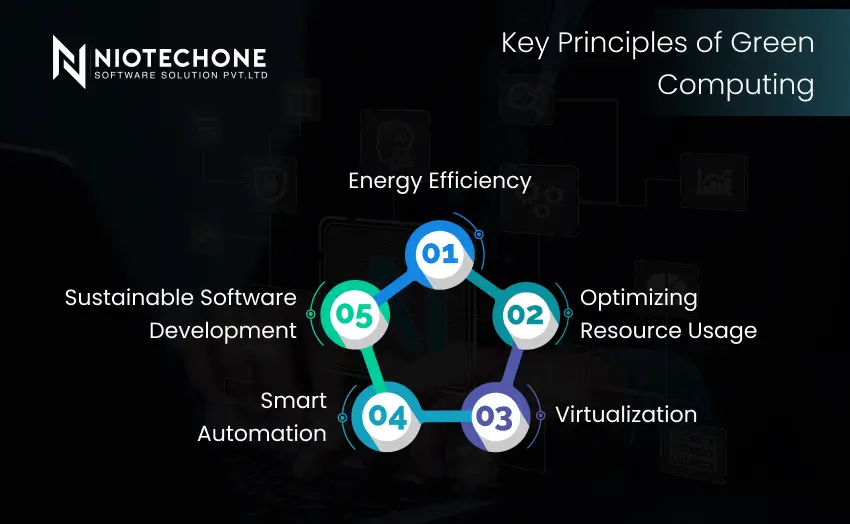
Infographic showing key principles of green computing including energy efficiency, resource optimization, virtualization, smart automation, and sustainable software development.

Key Principles of Green Computing

Energy Efficiency 

Energy-efficient applications utilize minimal computing power, such as CPU, RAM, and disk space. Technologies such as ASP.NET Core and .NET Core allow for fast applications using minimal energy.

Optimizing Resource Usage 

Optimization of resource usage involves using resources only when required. Tools such as auto-scaling on Microsoft Azure minimize energy usage and increase cloud performance without incurring extra costs.

Virtualization 

In virtualization, several virtual machines as well as containers can operate on a single server without being reliant on too much hardware and consuming less power. Tools such as Docker and Kubernetes facilitate the easy creation of cloud-native applications. 

Smart Automation 

Automated technologies help track and manage workloads and shut down unnecessary cloud services by themselves.

Sustainable Software Development 

Programmers need to produce efficient code and develop lightweight programs that lessen server workloads. The practice of writing clean code in a .NET development company increases the efficiency of the application.

How .NET Can Support Green Cloud Computing

The .NET ecosystem by Microsoft offers robust solutions to develop sustainable and efficient software applications. 

Fast Performance Using ASP.NET Core 

ASP.NET Core performs operations very quickly and efficiently, consuming less power than the previous frameworks. It results in enhanced performance, reducing power consumption.

Cross-Platform Development with .NET Core 

The .NET Core framework can run on Windows, Linux, and macOS. Cloud platforms that run on Linux might consume fewer resources and have energy-efficient infrastructure.

Cloud-Native Design 

Modern .NET frameworks have microservice, container, and Kubernetes capabilities. This makes it easier to scale and use resources efficiently.

Optimized Memory Management 

The .NET Framework has an efficient garbage collector and memory management mechanism that ensures efficient utilization of resources.

Integrating with Microsoft Azure for a Greener Cloud Environment

There are multiple green cloud services available within Microsoft Azure. .NET applications can easily connect with Azure-based services like Azure App Services, Azure Kubernetes Services, and Azure Functions.

Impact of Green Cloud Computing on .NET Application Development

It is revolutionizing the approach to developing and deploying .NET applications in the modern world.

Reduced Infrastructure Costs 

Green cloud computing, the .NET applications require fewer resources from the servers, thus lowering the cost associated with cloud computing and operation.

Improved Application Performance 

Energy-efficient programming contributes to faster and improved system performance, as well as better application performance. .NET applications consume fewer CPU and memory resources.

Better Scalability 

Cloud-based .NET applications scale automatically according to user needs without using any unnecessary server resources.

Enhanced ESG Compliance 

Organizations implementing sustainable cloud technology will be able to comply with the ESG standards and have a lower carbon footprint.

Stronger Brand Reputation 

Adopting green IT by organizations improves their reputation among consumers and business partners.

Future of Green Cloud Computing with .NET Core

The emergence of sustainable technology depends greatly on AI, automation, and cloud computing.

Energy-Efficient AI Applications 

Today’s engineers are developing energy-efficient AI applications that use minimal computational resources to achieve great results.

Resource Optimization Using AI 

AI-driven cloud computing solutions can optimize workloads and cut back on energy waste. This boosts the efficiency of cloud computing, saves on expenses, and enables green computing. 

Serverless Computing Growth 

With the evolution of technology like Azure Functions, an application runs only when needed, making it more efficient and scalable.

Carbon-Conscious Cloud Computing

The upcoming cloud computing platforms will enable the automatic movement of applications to renewable energy sources. This helps companies lower carbon emissions.

Cloud Computing vs Green Cloud Computing

Feature

Cloud Computing

Green Cloud Computing

Primary Focus

Scalability and performance

Sustainability and efficiency

Energy Consumption

Higher

Optimized and reduced

Resource Usage

General usage

Smart resource optimization

Environmental Impact

Moderate to high

Lower carbon footprint

Infrastructure Goal

Business growth

Sustainable digital operations

Server Utilization

Standard scaling

Energy-efficient scaling

Real World Use Cases

1. Sustainable E-Commerce Platforms 

E-commerce sites built using the ASP.NET Core framework and hosted on Microsoft Azure take advantage of auto-scaling functionality to meet requirements for traffic. During peak sales hours, the system scales up, whereas during off-peak hours, the system scales down.

Impact of Green Cloud Computing:

This will help conserve power by eliminating unnecessary server activity and reducing cloud hosting fees.

2. Serverless Applications for Businesses 

Several businesses today employ Azure Functions together with the .NET programming language to create serverless applications. These applications run only when needed, without the continuous presence of servers.

Impact of Green Cloud Computing:

Businesses save on power and expenses since there will be no requirement for servers to operate all the time. 

Conclusion

The concept of green cloud computing is revolutionizing application development. Using the .NET family technologies, including ASP.NET Core, .NET Core, and Azure services, businesses can develop their applications in a way that is highly efficient yet consumes less energy. This will not only help businesses save money but also make sure that they do not harm the environment.

Frequently Asked Questions FAQs

It is a cloud approach focused on reducing energy usage and environmental impact while maintaining performance and scalability. 

.NET enables lightweight, optimized, and scalable applications that consume fewer resources and improve efficiency. 

Azure offers auto-scaling, serverless computing, and renewable-energy data centers for greener cloud solutions. 

It runs applications only when needed, reducing idle resource usage and saving energy.

Yes, it reduces infrastructure usage, lowers energy consumption, and helps decrease overall operational costs.