
E-learning Platform Development: Features and Technologies
- Niotechone Marketing Team
Table of Contents
- Introduction
- What Is E-Learning Platform Development?
- Why Businesses and Institutions are investing in E-Learning Platforms
- Technologies in E-Learning Platform Development
- Advanced Features That Improve Learning Experience
- Security, Scalability, and Performance Considerations
- Why should we select a software development company in India
- Conclusion
Introduction
E-learning systems have transformed the way individuals learn, train, and upskill in the world. Digital learning has become an inseparable part of the contemporary education system, starting with schools and universities and extending to enterprises and training providers. Simply put, an E-learning platform is a software that assists in the delivery of courses, training content, assessments, and tracking of progress using web and mobile applications.
The online learning demand is on the rise in 2026. This shift is being driven by remote education, hybrid classrooms, corporate training, and global workforce development. The old classroom-based models are no longer fast, flexible, and scalable as needed by the modern learners and organizations. This is the reason why companies and organizations are investing in the development of custom E-learning platforms.
Collaboration with a seasoned custom software development company in Rajkot helps organizations develop secure, scalable, and future-proof learning solutions. E-learning platforms have the potential to serve millions of learners with the right features and technologies, providing them with consistent, engaging experiences.
What Is E-Learning Platform Development?
E-learning platform development can be defined as the process of creating and developing software systems that facilitate online learning and training. These platforms enable learners to view courses, videos, assignments, and assessments through web browsers or mobile applications. Meanwhile, administrators and instructors will be able to control content, monitor performance, and engagement.
A full-scale E-learning platform or LMS is not a simple learning app, but it is created to support complex needs. These are various user roles, scale content delivery, reporting, security, and integrations with other enterprise systems. This is where custom software development comes in.
A tailor-made E-learning system is developed based on particular learning objectives and business requirements. Organizations can create features that align with their teaching models, business rules, and growth plans instead of adapting workflows to an existing tool. This will guarantee enhanced usability, performance, and value.
Why Businesses and Institutions are investing in E-Learning Platforms
Companies in all sectors are embracing E-learning systems in education and training. They are used by schools to access students outside physical classrooms. Businesses use them to onboard, train on compliance, and develop skills. They are used by startups and content creators to monetize knowledge around the world. Scalability is one of the reasons behind this change.
It also enables organizations to update content fast, monitor learning results, and enhance training performance with data insights. Flexibility is another significant factor. Students are able to study at any time and place. Through collaborating with a software development company in India, organizations can access competent teams that are aware of the global education requirements and current technology stacks.
Technologies in E-Learning Platform Development
Frontend Technologies
Used to create user-friendly interfaces for learners, instructors, and admins.
- HTML5 and CSS3- Web platform structure and responsive layouts.
- JavaScript – Interactive and dynamic content processing.
- React / Angular / Vue – Fast and scalable web applications.
- Reactive UI systems – Provide a seamless experience across devices.
Backend Technologies
Manage business logic, user management, and system performance.
- ASP.NET / ASP.NET Core – Scalable and secure backend development.
- Java / Node.js – API and service backend alternatives.
- RESTful APIs & GraphQL – Allow frontend and backend communication.
- Microservices architecture -Enhances scalability and flexibility of the system.
Database Technologies
Store user information, course material, and learning analytics.
- SQL Server / MySQL / PostgreSQL – Structured data management.
- MongoDB – Scalable unstructured learning data storage.
- Cloud databases – Auto scaling and high availability.
Security Technologies
Secure sensitive learner and enterprise data.
- SSL/TLS encryption – Secure data transmission.
- OAuth/JWT authentication – Secure user access control.
- Role-based access control (RBAC) – User role-based data protection.
- Cloud security tools – Threat detection and monitoring.
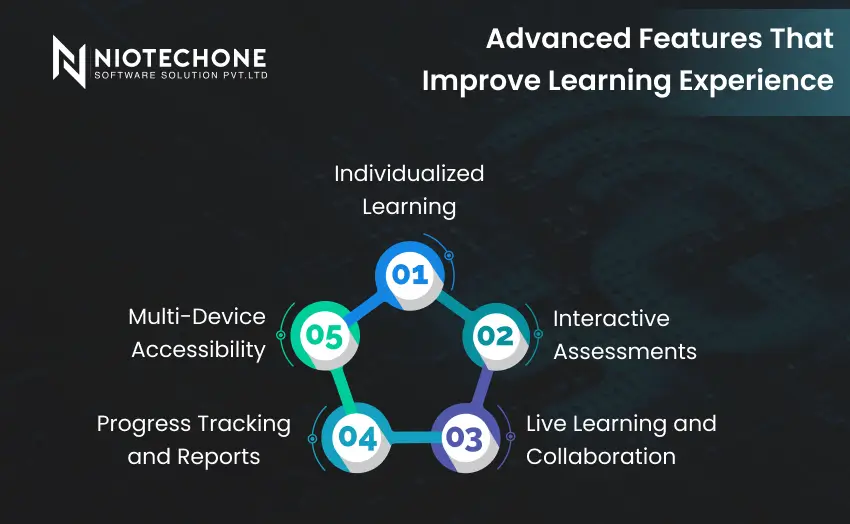
Advanced Features That Improve Learning Experience
- Individualized Learning: Course recommendations and content are given to learners depending on their progress, skills, and learning behavior.
- Interactive Assessments: Quizzes, assignments, and instant feedback can assist learners in comprehending concepts more and keep them engaged.
- Live Learning and Collaboration: Online classes, discussions, and doubt-clearing sessions are real-time and provide a classroom-like experience.
- Progress Tracking and Reports: Students and teachers can monitor the performance, completion rates, and skill development with ease.
- Multi-Device Accessibility: Users are able to learn continuously on mobile, tablet, and desktop devices.
Security, Scalability, and Performance Considerations
E-learning systems deal with sensitive information, such as personal data and learning history. There should be strong security measures like encrypted data, secure authentication, and access controls. Security systems based on the cloud are usually more secure than traditional systems.
Scalability is also a factor. Platforms should be able to sustain increasing user bases without performance problems. Optimized architecture guarantees seamless video streaming, quick load times, and stable accessibility during peak usage.
Why should we select a software development company in India
India is a software development center in the world. Companies enjoy economical solutions, a talented workforce, and established delivery models. Indian teams are well-experienced in enterprise application development, cloud platforms, and scalable learning systems.
A software development company in India provides end-to-end solutions, including planning and development, deployment, and long-term support. This renders them dependable collaborators in international E-learning initiatives.
Conclusion
The development of E-learning platforms is no longer a choice. It is a strategic investment for education providers, enterprises, and training organizations across the globe. E-learning platforms provide scalable, flexible, and interactive learning experiences with the right features and technologies.
Custom development guarantees a greater alignment with business objectives, enhanced security, and scalability. Collaboration with a reputable software development company assists organizations in developing future-proof E-learning solutions that facilitate growth and innovation.
Categories
Related Articles

Frequently Asked Questions FAQs
An E-learning platform refers to software that provides online courses, training, and educational content using web or mobile applications.
The main characteristics are user management, course delivery, assessments, progress tracking, and communication tools.
Prices are based on features, complexity, and technology stack. Tailor-made solutions are more valuable in the long run.
Yes, custom platforms are more scalable, flexible, and integrated with business systems.
Indian companies offer experienced developers, cost effectiveness, and international delivery experience.


