Design Patterns Every Senior .NET Developer Should Know

Introduction

With the increasing complexity of applications, functional code is no longer sufficient. In the modern world of software development, scalable architecture, reusability, and maintainability are essential. Design patterns are very important here.

If you are an experienced developer working in a Microsoft .NET development company, design patterns are solutions to common software problems that are based on tried and tested development strategies. At Niotechone, we use contemporary architectural concepts and cutting-edge technologies in .NET development services to create dependable, future-proof solutions.

Why Design Patterns Matter in .NET Development

Design patterns are solutions to common software design problems that can be reused. Developers can use proven methods that make the code easier to maintain and scale for each project instead of reinventing the wheel.

In large enterprise systems created by an ASP.NET development company, poor architecture can easily result in technical debt. Design patterns are used to structure code in a more effective way, making it easier to manage and extend applications.

For teams in an ASP.NET Core Development company, design patterns also enhance collaboration, as developers adhere to a consistent coding structure and architectural approach.

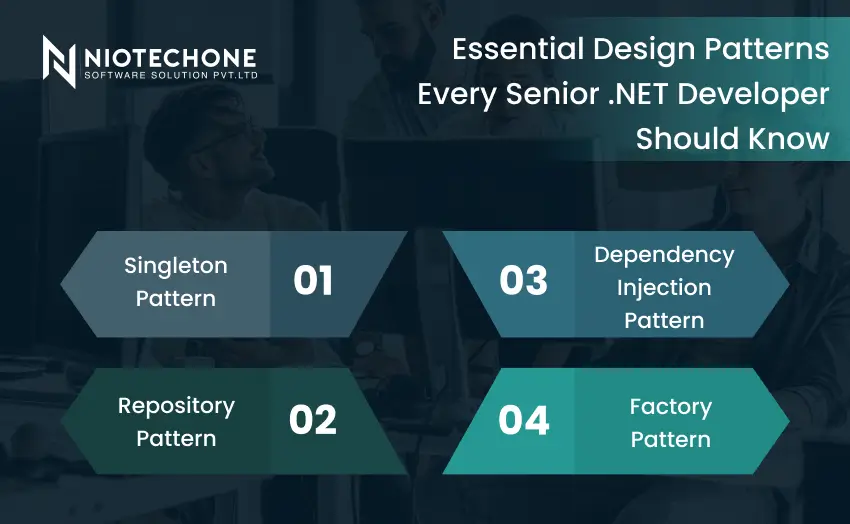
Infographic showcasing essential .NET design patterns including Singleton, Repository, Dependency Injection, and Factory patterns for senior developers.

Essential Design Patterns Every Senior .NET Developer Should Know

Singleton Pattern

The Singleton pattern is a design pattern that guarantees that a class has exactly one instance for the duration of the application’s existence.

This pattern is frequently applied in logging systems, caching services, and configuration management. In applications created by a .NET Core development company, Singleton helps to manage shared resources efficiently without creating unnecessary objects.

But senior developers also know when not to use it. Singleton can lead to systems that are hard to test and maintain if it is overused.

Repository Pattern

The Repository pattern separates database logic from business logic, resulting in cleaner and easier-to-maintain applications.

In enterprise applications handled by a Microsoft .NET development company, direct database access scattered across the codebase can create major maintenance challenges. The Repository pattern solves this by centralizing data access operations.

Dependency Injection Pattern

One of the most popular patterns in today’s world is Dependency Injection in .NET applications. It enables objects to be dependent on something other than themselves.

The sentence should clearly explain how the pattern is used in ASP.NET Core frameworks. It enhances flexibility, decreases tight coupling, and makes unit testing easier.

Factory Pattern

The Factory pattern is used to create objects without revealing the actual instantiation mechanism to the client.

In complex systems developed by a .NET Core development company, object creation can become complicated when multiple conditions or configurations are involved. Factory patterns make this easier and make the code.

Senior developers often use factory patterns, which are frequently employed in payment systems, notification services, and API integrations where object logic is subject to dynamic changes.


Benefits of Using Design Patterns in .NET Applications

Design patterns enable developers to create applications that are easier to manage, scale, and maintain over time. For companies that use a Microsoft .NET development company, Proper architecture is a key factor in the success of software in the long-term.

Improved Code Reusability

Design patterns promote the use of reusable components, minimizing code duplication and enhancing the efficiency of development in enterprise applications.

Better Application Scalability

Properly designed applications can better accommodate the expansion of features and the increasing demands of users.

Cleaner Project Architecture

Structured coding practices make applications easier to understand, maintain, and upgrade for future development needs.

Enhanced Team Collaboration

Standard architecture facilitates collaboration among developers in large projects and enterprise environments.

How Design Patterns Improve Enterprise Applications

Design patterns are not just theoretical concepts—they directly impact software quality and business performance.

Improved Scalability

Applications that are designed to grow in a proper way can grow more efficiently. For a .NET application development company, scalability is critical when building enterprise-level platforms.

Better Maintainability

Clean architecture simplifies the process of adding new features, bug fixes, and new developers. This is crucial for long-term projects that are handled by an ASP.NET Core development company.

Enhanced Code Reusability

Reusables save development time and ensure consistency between projects. This aids teams to provide quicker and more dependable .NET development services.

Common Mistakes Developers Make with Design Patterns

Using design patterns where they are not needed

Too many patterns can lead to overly complex and hard-to-maintain simple applications.

Selecting an inappropriate pattern for the problem

Using inappropriate patterns can lead to performance problems and to unnecessary development and maintenance costs.

Ignoring scalability requirements

Some developers use patterns without taking into account the growth and flexibility requirements of the application in the long-term.

Developing tightly coupled components

If patterns are not implemented well, they can lead to high coupling and low maintainability of the application.

Lack of understanding of core concepts

If design patterns are used without knowledge, they can result in confusing architecture and code organization.

Focusing more on theory than practicality

Developers sometimes prioritize textbook implementations instead of solving actual business and application development challenges.

Not following SOLID principles

Ignoring SOLID principles while implementing patterns can result in rigid and difficult-to-test applications.

Conclusion

Design patterns are still one of the most valuable skills for senior .NET developers. They assist in developing scalable, maintainable, and evolvable applications.

If CQRS is mentioned in the conclusion as an important design pattern, the blog should include a dedicated section explaining the CQRS pattern. Companies that work with a trusted .NET Core development company, such as Niotechone, can ensure their applications are developed according to best practices and modern development standards.

Frequently Asked Questions FAQs

Design patterns are proven software design solutions that help developers solve common coding and architectural problems efficiently. They improve code structure, scalability, and maintainability in modern applications.

Senior developers often work on complex enterprise applications where clean architecture is essential. Understanding design patterns helps them build scalable systems, reduce technical debt, and improve long-term application performance.

Dependency Injection is one of the most widely used patterns in modern .NET applications because it improves flexibility, testability, and maintainability. It is heavily used by every modern ASP.NET Core development company.

Yes, design patterns are extremely important for enterprise applications developed by a Microsoft .NET development company because they help manage complexity, improve scalability, and ensure cleaner code architecture.

An experienced .NET development company understands when and where to apply specific design patterns without overcomplicating the application. This ensures better performance, maintainability, and long-term scalability for business applications.