Choosing Between .NET and Spring Boot for Business Growth

Introduction

Today’s highly competitive environment demands that the choice of backend framework plays an important role in determining your future success. Regardless of what kind of project you are developing – enterprise software, Saas applications, or websites that require high performance, the question may come down to choosing between .NET and Spring Boot.

To be able to make an informed decision depending on your business goals, budget considerations, the skills of your staff, and other factors, read this article.

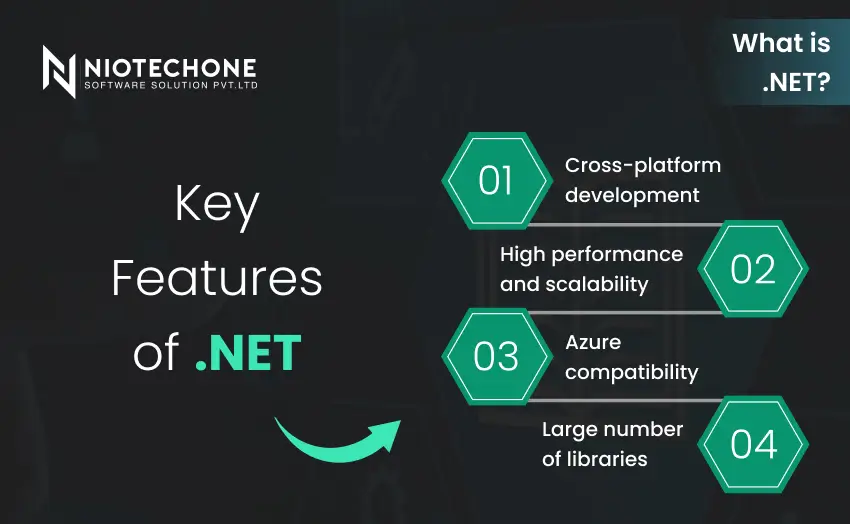
Dark-themed infographic showing the key features of .NET including cross-platform development, high performance, Azure compatibility, and a large library ecosystem.

What is .NET?

.NET is an open-source software development framework from Microsoft. It’s truly innovative. The .NET Framework supports many programming languages: C#, VB.NET, F#, etc.

A .NET Development Company usually develops its applications using the .NET Core framework.

Key Features of .NET 

  • Cross-platform development: The application should run on Windows, Linux, and macOS. 
  • High performance and scalability: A fast development, low-code-based application. 
  • Azure compatibility: Offers good compatibility with Microsoft Azure.
  • Large number of libraries: Includes a large number of pre-developed tools and libraries.
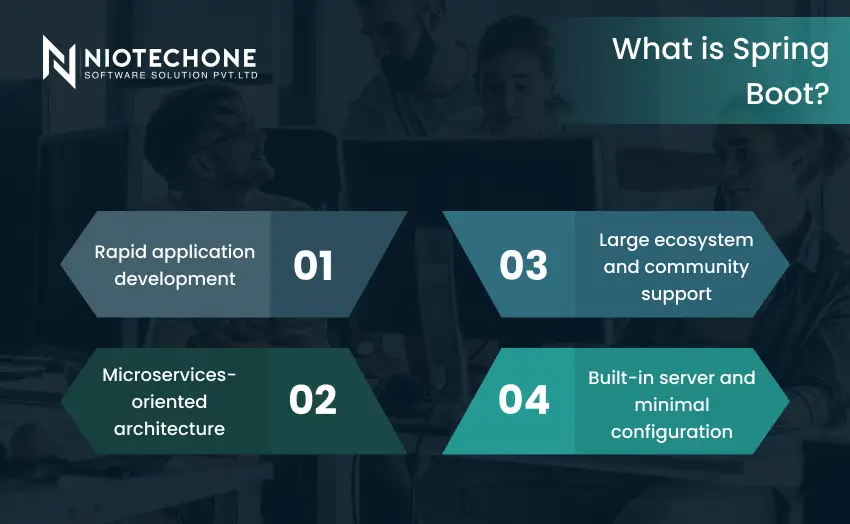
Infographic explaining Spring Boot features including rapid application development, microservices-oriented architecture, large ecosystem support, and built-in server configuration.

What is Spring Boot?

Spring Boot is a Java framework constructed upon the foundation of the Spring framework. Its development aims to create robust applications that can be quickly deployed into production.

Spring Boot is popularly used by businesses that use Java for their services based on microservices.

Key Features of Spring Boot

  • Rapid application development:  Microservices design has never been simpler.
  • Microservices-oriented architecture: Build performant applications that can scale easily when user traffic grows. 
  • Large ecosystem and community support: A very large community providing an enormous variety of libraries.
  • Built-in server and minimal configuration: Contains a built-in server with minimal configurations.

.NET vs Spring Boot: Detailed Comparison

Feature

.NET

Spring Boot

Winner

Performance & Speed

High performance with the Kestrel server and optimized runtime

Slightly heavier due to JVM overhead

.NET

Scalability

Strong Azure integration for cloud scaling

Popular for microservices with Kubernetes

Tie

Cost Efficiency

Lower hosting costs and faster development

May need more infrastructure resources

.NET

Security

Built-in authentication and data protection

Strong security via Spring Security

Tie

When to Choose .NET for Your Business

.NET will be the best option when your organization requires reliability, speed, and scalability. Here are some of the scenarios in which .NET is the best solution:

1) When You Need High-Performance Applications 

The .NET is a fast and performance-focused framework. It uses state-of-the-art features such as JIT compilation to speed up execution and to maximize resource utilization, therefore suitable for high-traffic applications with real-time requirements.

2) When Your Business Uses Microsoft Technologies 

If you’ve been working with any of the products like Microsoft Azure, Windows Server, SQL Server, and even Office 365. Then, in your setup, .NET will seem to blend in perfectly. It can fit into your environment smoothly without any problems of incompatibility.

3) When Security Is a Top Priority 

Robust security functionality, including authentication, authorization, protection of data, and secure programming interfaces, is available with the .NET Framework. Because of this, it would appear to be an ideal platform for critical industries like the finance and healthcare sectors.

Use Cases of .NET

1) SaaS Platforms

In case of building cloud services, .NET gives an option for multi-tenant architecture and provides high performance, making it possible to implement highly reliable software for software-as-a-service products. 

2) Enterprise Applications 

It’s a widely used technology for enterprise applications such as ERP and CRM. It offers robust performance, security, and scalability to the .NET Framework, making it suitable for handling workflow and supporting many users.

3) Financial Systems 

High security and performance requirements are essential when creating financial systems, payment systems, and trading software. .NET can help meet these criteria due to the high level of its security and performance.

Use Cases of Spring Boot

1) Microservices Architectures 

The Spring Boot framework ranks among the top frameworks used in building microservices due to the fact that individual services are independently created, deployed, and scaled.

2) Large-Scale Enterprise Systems 

Due to its efficient architecture and integration, the Spring Boot framework is very much recommended for the development of enterprise-scale applications. The framework is capable of handling complicated logic, large volumes of data, and large numbers of users.

3) Cloud-Native Applications 

The Spring Boot framework can easily integrate with cloud environments such as AWS and other similar clouds. The Spring Boot framework supports Docker and Kubernetes.

How to Make the Right Decision

Before choosing between .NET and Spring Boot, consider these phases:

Project requirements: You need to take into consideration the requirements of your software project.

Cost constraints: Choose a framework by taking into account the cost constraints that are associated with your project.

Development time: Keep in consideration the time you have for developing and implementing the software application.

Team expertise: Choose a framework that best suits the expertise of the team that will be implementing it.

Long-term scalability: Ensure the framework supports the scalability requirement.

Expertise: It is always wise to opt for help from experts, for instance, from a Microsoft .NET development company, to make sure the correct technology has been chosen.

Conclusion

Which one will be chosen: .NET or Spring Boot? It comes down to requirements, knowledge of the developers, and how the future of the company is planned. It is fair to say they are both great and have many comparable qualities with regards to today’s application requirements, but if performance, cost-efficiency, security, and Microsoft product integration are paramount, .NET has to be considered.

.NET is better overall for performance, cost-efficiency, and enterprise-level solutions.

Frequently Asked Questions FAQs

For startups, .NET is often preferred due to lower development costs and faster performance, especially when working with a .NET application development company.

Both frameworks offer strong security features. The difference depends more on implementation than the framework itself. 

Yes, .NET supports microservices using ASP.NET Core and integrates well with Docker and Kubernetes. 

India offers cost-effective development services with highly skilled developers, making it a popular choice for outsourcing .NET projects. 

No, Spring Boot is still widely used and actively maintained. It remains a strong choice for Java-based enterprise applications.