Building Microservices with .NET Aspire and Dapr

Introduction

The foundation of modern application development is microservices, which allow achieving scalability, resilience, and accelerated innovation. In 2026, .NET Aspire and Dapr (Distributed Application Runtime) are two potent tools to develop cloud-native microservices. 

This guide will show you how to use them step by step, with examples, best practices, and real-world applications – useful to any .NET application development company or businesses planning to hire .NET developers.

Dark-themed microservices concept image with API and distributed system visuals alongside the text “What Are Microservices?”.

What Are Microservices?

Microservices are small, autonomous services that collaborate to create a bigger application. Each service is dedicated to one business capability and interacts with other services via APIs or messaging.

Key Benefits:

  • Scalability – Scale services individually.
  • Flexibility – Utilize various technologies in various services.
  • Resilience – The failure of a single service does not cause the whole system to fail.
  • Quick Deployment – Update services without having to redeploy the entire app.

Introduction to .NET Aspire

.NET Aspire is a Microsoft cloud-native development stack that is used to create distributed applications. It simplifies:

  • Service discovery
  • Configuration management
  • Observability (logs, metrics, tracing)
  • Kubernetes and cloud deployment


For a Microsoft .NET development company, Aspire provides a strong foundation to manage microservices efficiently.

Introduction to Dapr

Dapr (Distributed Application Runtime) is an open-source runtime that offers microservice building blocks. It assists developers in not reinventing the wheel by providing ready-to-use features such as:

  • Service-to-service communication
  • State management
  • Pub/Sub messaging
  • Secrets management
  • Observability


Dapr is a sidecar to your application, and it is a powerful tool for any .NET application development company.

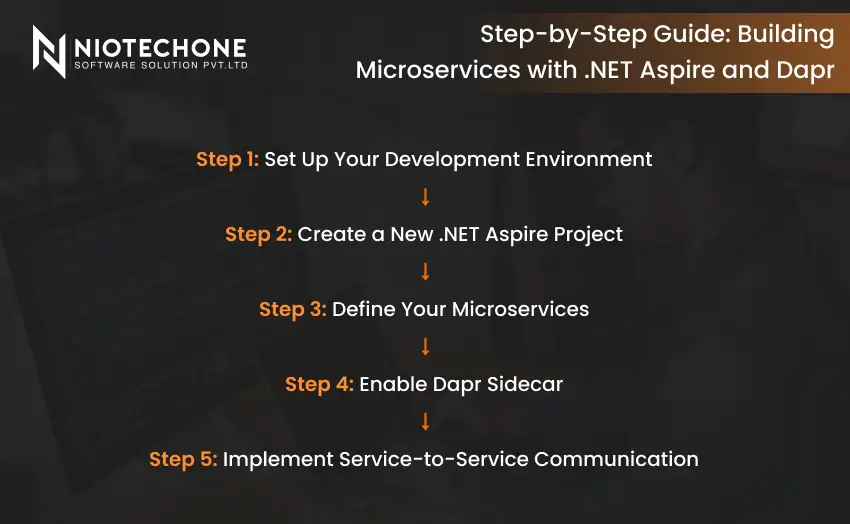
Step-by-step infographic showing how to build microservices with .NET Aspire and Dapr, including environment setup, project creation, service definition, Dapr sidecar configuration, and service communication.

Step-by-Step Guide: Building Microservices with .NET Aspire and Dapr

Step 1: Set Up Your Development Environment

  • Install .NET 10 SDK (latest version).
  • Install Dapr CLI:
💻
npm install -g dapr-cli
  • Initialize Dapr locally:
💻
dapr init
  • Install Docker and optionally Kubernetes for containerized deployments.


Step 2: Create a New .NET Aspire Project

Run:

💻
dotnet new aspire-app -n MicroservicesDemo

This creates a structured project with Aspire’s templates for microservices.

Step 3: Define Your Microservices

Example: A Shopping Application with:

  • Product Service – Manages product catalog.
  • Order Service – Handles customer orders.
  • Payment Service – Processes payments.
  • Notification Service – Sends updates.


Step 4: Enable Dapr Sidecar

Add Dapr support:

💻
dapr run --app-id product-service --app-port 5000 dotnet run

This starts the Product Service with Dapr sidecar, which allows such features as service discovery and state management.

Step 5: Implement Service-to-Service Communication

Invoke the service of Dapr:

🔷
var client = new DaprClientBuilder().Build();
var product = await client.InvokeMethodAsync(
    "product-service", "GetProduct", productId);

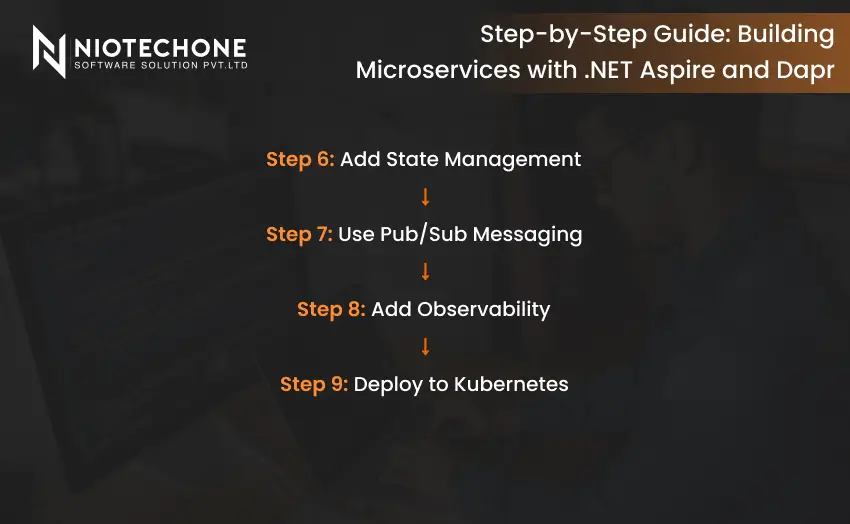
Infographic showing advanced steps for building microservices with .NET Aspire and Dapr, including state management, pub/sub messaging, observability, and Kubernetes deployment.

Step 6: Add State Management

Store order details:

🔷
await client.SaveStateAsync("order-store", orderId, orderData);

Step 7: Use Pub/Sub Messaging

Enable event-driven communication:

🔷
await client.PublishEventAsync("pubsub", "order-created", order);

Step 8: Add Observability

Aspire is compatible with Dapr to offer:

  • Distributed tracing – Trace requests between services to identify bottlenecks.
  • Metrics – Track performance statistics such as response times and errors.
  • Logs – Centralized logging for easier debugging.

As an example, in a healthcare system, tracing can be used to identify delays in patient record retrieval, and metrics can be used to identify problems in appointment scheduling. This helps developers move quickly before users experience inconvenience.

Step 9: Deploy to Kubernetes

Aspire ensures a smooth deployment:

💻
kubectl apply -f aspire-deployment.yaml.

Real-World Use Case: E-Commerce Platform

Product Service  

Maintains the product catalogue with details such as names, prices, and stock. The information is stored in Redis or Cosmos DB through Dapr to retrieve it quickly, even during flash sales. Aspire makes it easy to discover services.

Order Service  

Checks out, shopping carts, and order tracking. Accesses the state store of Dapr to store data securely and communicates with the Payment Service by invoking a service. Aspire provides observability to track order flows.

Payment Service  

Makes payments safely using third-party gateways. Dapr secrets management secures API keys, whereas Aspire provides secure communication and monitoring. Unsuccessful payments may be automatically retried.

Notification Service  

Sends instant email or SMS updates when orders are confirmed, shipped or delivered. Communicates using Dapr Pub/Sub to communicate events without tight coupling.

How Aspire + Dapr Work Together

  • Services communicate via Dapr service invocation.
  • Orders stored in Redis with Dapr state management.
  • Public/Sub notifications.
  • Aspire provides observability, tracing, and deployment pipelines.


This architecture guarantees scalability, fault tolerance, and quicker development – perfect for an ASP.NET development company or a
.NET Core development company building e-commerce solutions.

Best Practices for Microservices with Aspire + Dapr

Keep Services Small and Focused  

One responsibility should be assigned to each service. As an example, payments should not be handled by the Product Service. This isolation simplifies services to maintain, test, and scale separately.

Use Dapr Building Blocks  

Instead of writing custom code for communication, state storage, or messaging, leverage Dapr’s built-in features. This saves time in development and provides consistency between services.

Enable Observability Early  

Monitoring is critical in microservices. Aspire integrates with Application Insights, Prometheus, and Grafana to provide logs, metrics, and tracing. Enabling observability early on assists in identifying problems early and enhances system reliability.

Automate Deployments with Aspire and Kubernetes  

Manual deployments are prone to errors. Use Aspire’s deployment pipelines and Kubernetes manifests to automate builds, testing, and releases. This guarantees quicker delivery and less downtime.

Secure Communication with Dapr’s mTLS  

Security must not be an afterthought. Dapr offers mutual TLS (mTLS) for service-to-service communication, which encrypts and authenticates data. Add this to the Aspire configuration management to have a strong security configuration.

Conclusion

Building microservices with .NET Aspire and Dapr provides a modern, scalable, and resilient application development approach. Aspire makes management and deployment simpler, whereas Dapr offers ready-to-use building blocks of communication, state, and observability. For a .NET development company, ASP.NET development services, or businesses planning to hire .NET developers, this combination ensures future-ready applications that can scale with confidence.

Frequently Asked Questions FAQs

.NET Aspire is a cloud-native development stack that simplifies building and managing distributed applications with microservices.

Dapr provides building blocks like service invocation, state management, and pub/sub messaging, making microservice development faster and easier.

Yes, Dapr can be used independently, but Aspire enhances deployment, observability, and service management.

No, you can run them locally with Docker. Kubernetes is recommended for production scalability.

Together, they provide a complete ecosystem for building scalable, resilient, and cloud-native microservices.