Blazor in 2026: Is It Ready to Replace React and Angular?

Introduction

Modern front-end technologies have developed at a rapid pace in the last decade, mostly focused on JavaScript frameworks such as React and Angular. However, with the rise of the power of . NET-based technologies, Blazor emerged as a potential competitor to the established ones.

In 2026, many developers and businesses are asking a critical question: Is Blazor mature enough to replace React and Angular?

Introduction to Blazor framework for building interactive web applications using C#

What is Blazor?

Blazor is a relatively new web framework developed by Microsoft that lets developers build web applications using C# instead of JavaScript. This framework belongs to the .NET ecosystem and is widely used in modern .NET development companies to develop fast, scalable, and secure applications.

One significant advantage of Blazor is that developers don’t have to use JavaScript anymore – C# will work for both frontend and backend. That helps significantly when developing applications in a .NET development service company or a .NET development company. Blazor uses Razor components that allow combining HTML and C# code to create a dynamic user interface.

Blazor offers two main hosting models – Blazor Server and Blazor WebAssembly. It provides developers with flexibility depending on the requirements of a particular project. In such conditions, it will be great for a .NET Core development company. Moreover, it allows code sharing between client and server, thereby decreasing the development time and effort.

How Blazor Works

  • Blazor is a framework developed by Microsoft and part of the .NET ecosystem. It allows developers to create web apps using the C# language instead of JavaScript.
  • Widely used by Microsoft .NET development companies and modern .NET development teams to create scalable applications. 


Blazor has two working models:

1) Blazor Server

  • Works on the server
  • Makes use of SignalR for updating real-time UIs
  • Is great for the fast load and security of apps
  • Preferred by an ASP.NET development company and an ASP.NET Core development company


2) Blazor WebAssembly

  • Works directly in the browser
  • Doesn’t require a continuous server connection
  • Great for creating rich UI apps
  • Used by a .NET Core development company
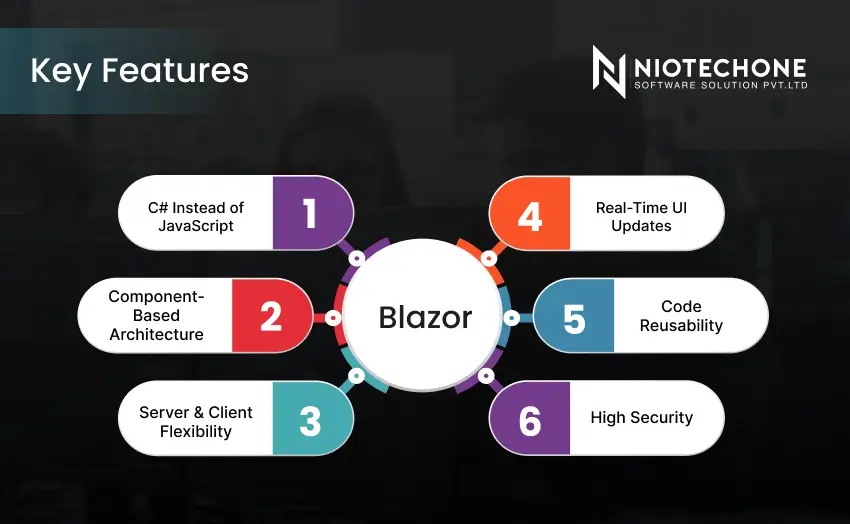
Key features of Blazor including component-based architecture, real-time UI updates, and code reusability

Key Features of Blazor

1) C# Instead of JavaScript

Blazor lets developers write code in C# for the client and server side without being overly dependent on JavaScript, which makes it extremely effective for a Microsoft .NET development company and teams offering .NET development services.

2) Component-Based Architecture

Blazor provides reusable UI components that are popular in modern .NET development. They make development easier and improve code maintainability.

3) Server & Client Flexibility

The developers can choose between Blazor Server or WebAssembly, depending on requirements. This flexibility is useful for an ASP.NET Core development company and a .NET Core development company.

4) Real-Time UI Updates

Blazor enables real-time changes in user interfaces to SignalR. This technology is usually used in ASP.NET development services.

5) Code Reusability

Blazor allows sharing the same code on both sides of development and reduces the time spent on it. The code reuse functionality can benefit a .NET application development company greatly.

6) High Security

As the application works at the server level, all data is protected. This is another significant advantage of the .NET framework for any ASP.NET development company.


Why Developers Use Blazor

1) Single Language Development
Using Blazor, developers don’t need to switch from one language to another; they can leverage C# in the backend and frontend environments. It significantly improves the work efficiency and productivity for a Microsoft .NET development company.

2) Faster Development Process
Due to the shared tools and libraries, Blazor makes development quicker and easier. Therefore, it’s an advantage for an ASP.NET development company.

3) Code Reusability
Blazor makes it possible for developers to reuse code on the client and server sides and save time. This is very advantageous for a .NET application development company.

4) Strong .NET Integration
Blazor easily integrates with other .NET frameworks and libraries. Hence, it would be perfect for an ASP.NET Core development company and a .NET Core development company.

5) Flexibility (Server & WebAssembly)
Blazor allows developers to choose between server-side and client-side execution depending on the project’s requirements. This is an advantage for teams working on modern .NET development services.

6) Growing Industry Demand
More and more enterprises adopt Blazor technology, which drives the rising need for Blazor specialists. In general, many businesses nowadays hire .NET developers for Blazor applications.

Can Blazor Replace React and Angular in 2026?

Today, these technologies still rule the market because of their strong communities, well-developed ecosystems, and high level of adoption. Nevertheless, Blazor becomes quite a valid option when it comes to building a product in enterprise conditions; in this case, one should consider Blazor to be perfect for an ASP.NET Core development company or a .NET application development company.

Key Points to Consider

  • Not a Full Replacement Yet
    Although Blazor is developing rapidly, its ecosystem is not as big as React or Angular’s ecosystems.
  • Best for .NET Projects
    Works best for a .NET Core development company and an ASP.NET Core development company building internal tools or enterprise apps.
  • Faster Development with C#
    Assists in reducing context switching, particularly in companies that provide ASP.NET application development.
  • Limited Frontend Ecosystem
    Fewer third-party modules than JavaScript-based frameworks.
  • Rising Demand
    More organizations seek .NET developers who know Blazor for contemporary app development.

Conclusion

The Blazor framework in 2026 is not just an innovative concept but an industrial-level tool, particularly suited for .NET developers. Although Blazor may not completely replace React or Angular at this point, it has certainly made its mark within the realm of enterprise software development. If you’re building startups or applications with highly interactive interfaces, React or Angular could be your best bets for now.

Frequently Asked Questions FAQs

Blazor is not necessarily better, but it offers a different approach by using C# instead of JavaScript. It is a great choice for a Microsoft .NET development company or teams already working with .NET development services.

Yes, Blazor is suitable for enterprise-level and large-scale applications. Many companies, including an ASP.NET development company and a .NET application development company, use it for complex projects.

Blazor reduces the need for JavaScript, but it can still be used when required. This flexibility helps teams offering ASP.NET development services build advanced features when needed.

Blazor Server runs on the server and updates the UI via real-time connections, while Blazor WebAssembly runs directly in the browser. Both are commonly used by an ASP.NET Core development company and a .NET Core development company.

Yes, many businesses prefer to hire .NET developers with Blazor expertise to build modern and scalable web applications efficiently.