Security plays an important role in modern web development. By 2026, ASP.NET Core powers enterprise software, SaaS platforms, APIs, and cloud-based applications.
As the number of applications grows, threats like data theft, unauthorized access, and API exploitation also increase. To build secure applications, developers must apply security from the very beginning of development.
These applications handle highly confidential information, including customer data, financial details, and critical business logic. Even a small loophole can cause a breach and lead to financial loss and reputational damage.
Today, cybercriminals use automated tools to find vulnerabilities in software. That is why developers must integrate security into software development from the start, especially when building scalable applications. Companies that hire .NET developers for secure application development can reduce future costs and risks.
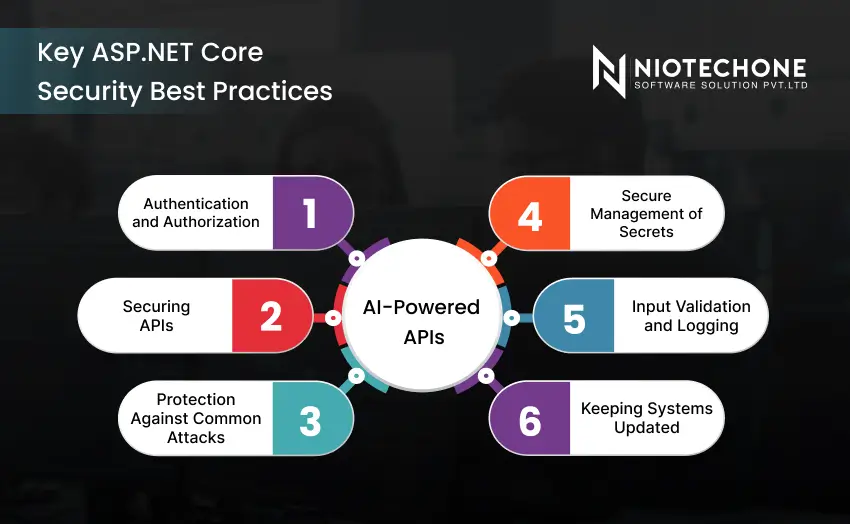
Authentication and authorization are very important in application security. It verifies a user’s identity, and authorization determines what they can or cannot do or access.
In modern API-based applications, ASP.NET Core allows secure and scalable access control using advanced access control mechanisms such as JWT (JSON Web Tokens) and OAuth 2.0.
To implement this effectively:
Attackers can easily bypass client-side checks, so developers must implement all security logic safely on the back end.
The API is one of the most vulnerable parts of an application because it stays exposed and often faces attacks from malicious parties. Therefore, developers must ensure the security to protect the integrity and reliability of the application.
It is important to encrypt all client-server communication through HTTPS. Developers must also control access through tokens.
Important practices include:
Limiting the number of exposed endpoints and protecting internal APIs also reduces security risks.
Among the commonest problems that developers encounter is that API keys, database credentials, and authentication tokens might be exposed in the codebase.
This can be highly dangerous to security, especially in the event that the code is leaked or shared. Rather, containers should always keep sensitive information in a secure place.
Developers should ensure protection against:
These measures reduce the security risks, and frequent testing with security tools helps detect and fix any vulnerabilities at an early stage.
It should be noted that one of the most frequent errors that could be committed by developers is the storage of sensitive data within the source code, including API keys, database credentials, and authentication tokens. This could result in major security threats, particularly when the source code is accessed by another person.
Best practices include:
Proper secret management will make sure that important data will not be lost even in the case of a security breach.
Attacks usually start from user inputs, so developers should treat all user data as suspicious until verification. Server-side validation is always necessary because attackers can bypass client-side validation.
ASP.NET Core Services provides validation features for models that ensure data consistency. Log files are equally important for detecting and tracking suspicious activities.
Key practices include:
Â
Validation and logging help prevent and detect security threats.
Unsecured software comes about because of outdated infrastructure and dependencies of the software. Attacks on older software are the most prevalent as they form the main targets of the attacker.
For one to be protected against attacks, you should always ensure that your software is up-to-date. You should have your ASP.NET Core software upgraded, have his third-party software updated, and uninstall any unnecessary software.
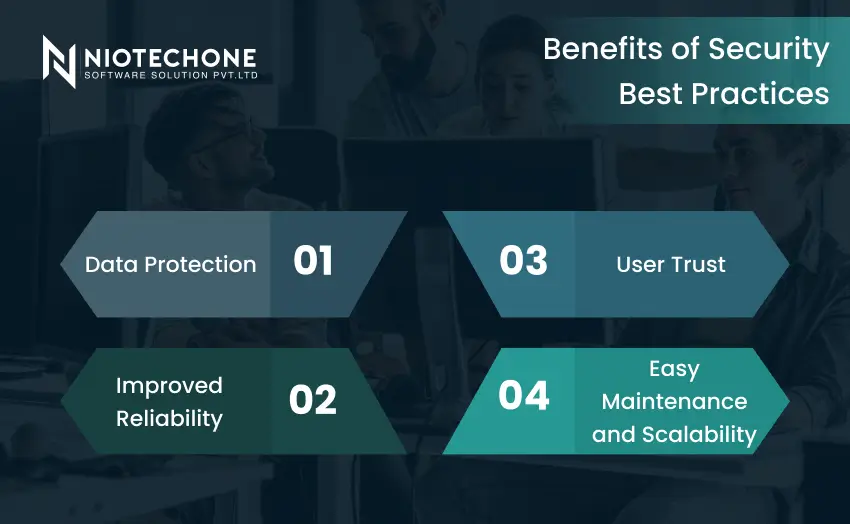
1. Data Protection: Ensures sensitive user and business data is secure from breaches and unauthorized access.
2. Improved Reliability: Reduces application downtime by preventing security attacks and system failures.
3. User Trust: Builds strong user confidence by ensuring safe and secure application usage.
4. Easy Maintenance and Scalability: Makes applications easier to maintain and scale without introducing security risks.
The future of security in ASP.NET Core is moving toward automation and intelligence. By 2026 and beyond, AI-based tools will play a major role in vulnerability detection, threat monitoring, and real-time response to attacks.
Some expected innovations include automated security testing, smarter authentication systems, and zero-trust architectures. These advancements will help developers and ASP.NET Core development companies build more secure and resilient applications.
Building a secure application depends on the proper implementation of security practices like authentication, API protection, input validation, and regular updates. A reliable .NET Development company ensures these are followed. In 2026, security remains essential for protecting data, maintaining reliability, and building customer trust for every business and Microsoft .NET enterprise.
ASP.NET Core includes built-in security features, but developers must configure them properly to achieve full protection.
JWT and OAuth 2.0 are widely used because they provide secure and scalable authentication for modern applications.
APIs can be secured by enforcing HTTPS, using authentication tokens, and applying rate limiting to prevent misuse.
Input validation prevents malicious or incorrect data from entering the system, reducing the risk of attacks such as SQL injection and XSS.
Security updates should be applied regularly to protect applications from newly discovered vulnerabilities.
3rd Floor, Aval Complex, University Road, above Balaji Super Market, Panchayat Nagar Chowk, Indira Circle, Rajkot, Gujarat 360005.
Abbotsford, BC
15th B Street 103, al Otaiba Dubai DU 00000, United Arab Emirates
3rd Floor, Aval Complex, University Road, above Balaji Super Market, Panchayat Nagar Chowk, Indira Circle, Rajkot, Gujarat 360005.
Abbotsford, BC
15th B Street 103, al Otaiba Dubai DU 00000, United Arab Emirates
Copyright © 2026 Niotechone Software Solution Pvt. Ltd. All Rights Reserved.