Amazon Q: The Intelligent AI Assistant by AWS
- Niotechone Marketing Team
Introduction
Cloud infrastructure management, code writing, data analysis, and workflow automation are activities that consume hours daily among developers and business teams. Amazon Q by AWS was constructed to manage all of it. It is an AI-powered assistant that works within the AWS environment, offering teams faster answers and intelligent automation without switching tools.
What is Amazon Q?
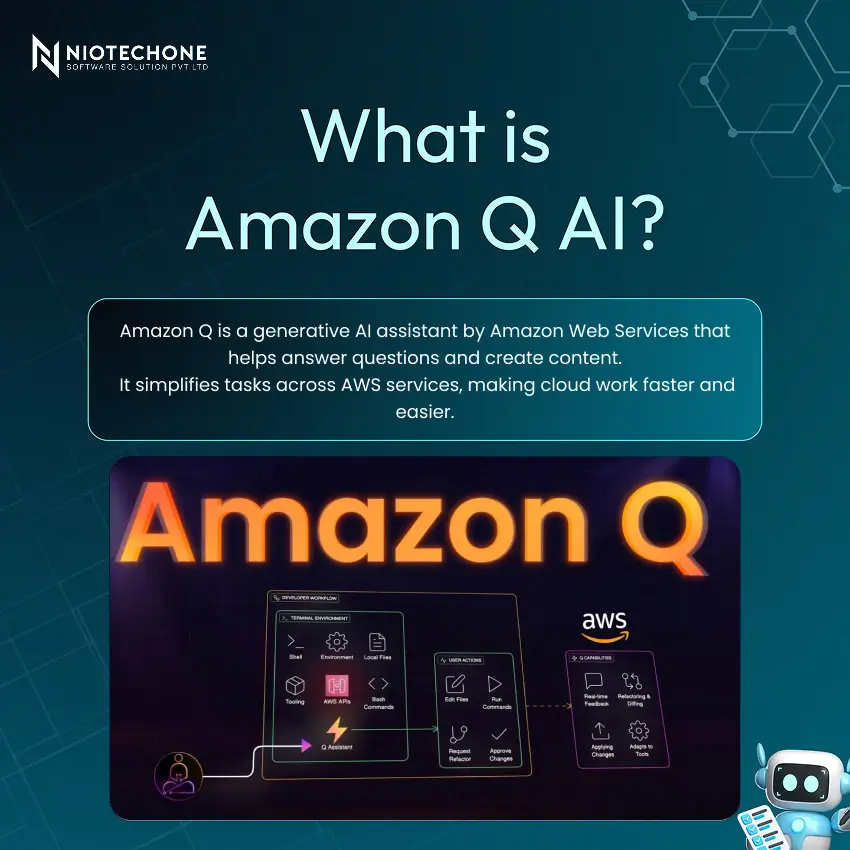
Amazon Q is a question-answering, generative AI assistant built on top of AWS and made specifically to help with answering questions, creating content, and assisting users with tasks within the AWS platform. This technology is based on large language models and uses over 200 AWS services, which helps teams work with cloud-based solutions differently, improving their efficiency and productivity.
Key Features
- Natural Language – Knows and answers conversational questions without technical instructions.
- Code Generation – Writes, reviews, and describes code in various programming languages.
- Data Analysis – Analyzes complex information sets and derives actionable insights.
- AWS Integration – Works seamlessly with more than 200 AWS services for an absolutely native cloud experience.
- Secure – Built on the principles of enterprise security and compliance.
- Enterprise-Ready – Can scale to small and large enterprises alike.
How Amazon Q Works
Amazon Q is a 3-step process:
Step:1 — User Query: You pose a question or provide a task in natural language.
Step:2 — AI Processing: The LLM processes the context and retrieves the corresponding data of related AWS services.
Step:3 — Response: Amazon Q produces a correct, practical response that can be put into practice.
Use Cases
- Software Development: Improve programming, debugging, and documentation without hampering your team’s efficiency.
- Business Automation: Optimize work processes and reduce human intervention.
- Customer Support: Technical support answers based on a scale of real-time precision.
- Data Analysis: Identify useful patterns in massive data sets and reports within seconds.
- Decision Making: Offer recommendations that are based on data analysis for better decision-making.
Advantages and Limitations
Advantages | Limitations |
Saves time by reducing task completion time significantly | Requires constant internet connectivity |
Boosts productivity with faster development cycles | May occasionally generate incorrect responses |
Easy to use — intuitive interface with minimal training needed | All outputs require human validation before use |
Provides smart, relevant suggestions automatically | Needs proper data handling protocols for privacy compliance |
Future Scope
- Better Accuracy — Better response reliability and more contextual insight are in the pipeline.
- Industry Growth — The adoption is likely to increase in the IT, business, healthcare, and education industries.
- Advanced Capabilities — Future releases will include more AWS service integration and more automation capabilities.
Conclusion
Amazon Q is an intelligent automation, enterprise-level security, and smooth AWS integration in a single, powerful assistant. It is designed to be secure, created to support smarter workflows, and can support modern teams at scale. Amazon Q is a logical and effective follow-up to any organization already invested in AWS, as it will enable them to make their cloud operations smarter and faster.
Categories
Related Articles

Related Tags
Frequently Asked Questions FAQs
Amazon Q is an AI assistant generated by AWS that helps in answering questions, writing code, analyzing data, and automating tasks in the AWS ecosystem.
Amazon Q has several pricing levels. Amazon Q Business and Amazon Q Developer have different plans, and thus, the prices are based on usage and features.
It is best suited to developers, cloud engineers, and business teams operating in the AWS ecosystem that require an AI assistant to be part of their tools.
ChatGPT is a general-purpose AI tool, whereas Amazon Q is AWS-specific with extensive integrations, enterprise security, and cloud-oriented capabilities.
Yes, it is constructed using enterprise-grade security and compliance controls, and it can be used in organizations with stringent data needs.