Why API Backwards Compatibility Is Harder Than It Looks

Introduction

APIs bridge the gap between SaaS platforms and mobile apps, enterprise systems and AI-driven platforms. Regardless of whether you are working with a .NET development company, an ASP.NET Core API development company, or a global software development company, your application is probably relying heavily on APIs.

To startup founders, CTOs, and enterprise decision-makers, this misconception can result in failed integrations, dissatisfied customers, and costly rework. This guide describes why API backward compatibility is complicated, how it affects scalable software applications, and what your development partner needs to do to get it right in 2026.

API backward compatibility concept with icons representing integration, connectivity, and system stability

What Is API Backwards Compatibility?

API backward compatibility means that when you update your API, existing clients can continue using it without breaking.

In simple terms:

Older apps, integrations, and systems that use your API should not be broken by a new version of your API.

For example:

  • An app on a mobile platform with version 1 of your API.
  • A partner integration that pulls certain fields.
  • A third-party SaaS tool that relies on your endpoint structure.

When your update deletes fields, changes response formats, or changes validation rules, you can break these systems accidentally. Backward compatibility safeguards your ecosystem.

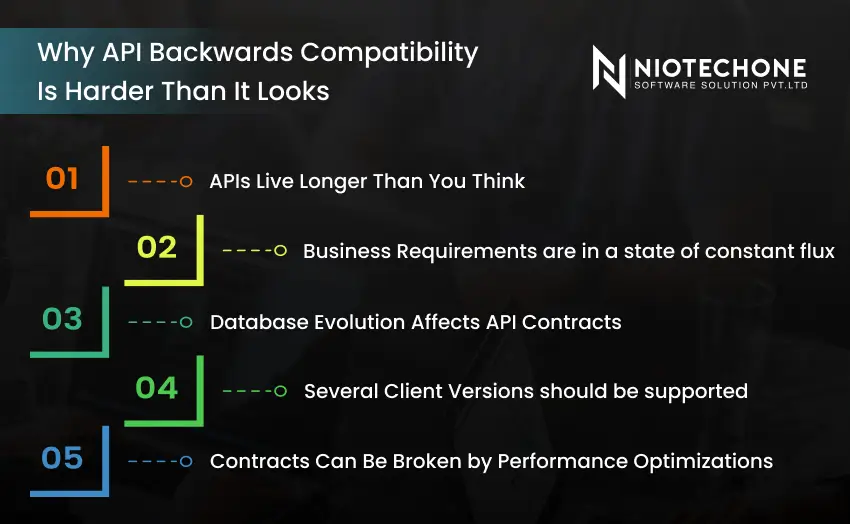
API backward compatibility challenges including evolving business requirements, database changes, and multiple client versions

Why API Backwards Compatibility Is Harder Than It Looks

1. APIs Live Longer Than You Think

The majority of APIs live longer than the applications they were created to support.

Enterprise clients may:

  • Use older app versions
  • Integrate via custom middleware.
  • Write automation scripts on your API.
  • Relied on particular data structures.

Minor modifications can interfere with the workflow of large enterprises.

An established ASP.NET Core development company develops APIs with the assumption that they will last 5-10 years.

2. Business Requirements are in a state of constant flux

  • New fields are needed to support new features.
  • Validation updates are required in compliance changes.
  • Response structures are changed by performance improvements.

Change is unavoidable in a developing SaaS product.

But here’s the problem:

The introduction of logic to accommodate new customers and safeguard current behavior adds complexity to the architecture.

3. Database Evolution Affects API Contracts

Database models are frequently reflected in APIs.

When database schemas change:

  • Columns get renamed
  • Relationships change
  • Data types are modified
  • Tables are split or merged

When your API is closely bound to the database structure, any schema change threatens to break external clients.

Professional custom .NET development services apply abstraction layers and DTO mapping to shield API contracts against database modifications.

4. Several Client Versions should be supported

In 2026, applications run across:

  • Mobile apps
  • Web apps
  • Partner integrations
  • IoT systems
  • AI services

They may both use various API versions.

Supporting them requires:

  • Versioning strategy
  • Conditional logic
  • Backward-compatible serialization
  • Maintenance planning in the long term.

This adds infrastructure and development expense.

5. Contracts Can Be Broken by Performance Optimizations

To maximize speed, it may be necessary to:

  • Removing unused fields
  • Changing nested structures
  • Flattening response models
  • Introducing pagination

A powerful, scalable software application should be able to balance performance and compatibility.

Real-World Case: API Compatibility Failure

A SaaS company has revised its payment API to enhance security.

Changes included:

  • Stricter validation rules
  • Modified error responses
  • Renamed JSON properties

They failed to version the API appropriately.

Result:

  • One-third of partner integrations were unsuccessful.
  • Mobile app transactions failed.
  • Enterprise customers have increased complaints.
  • Rollback needed.
  • The technical fix took two days.
  • The damage to trust took months.

This is the reason why backward compatibility is not only a technical problem but also a business problem.

Common API Changes That Break Compatibility

Below is a comparison table showing safe vs risky changes:

Change Type

Safe?

Risk Level

Adding an optional field

Usually safe

Low

Adding required field

Risky

Medium

Renaming field

Breaking

High

Removing field

Breaking

High

Changing data type

Breaking

High

Changing response structure

Breaking

High

Adding a new endpoint

Safe

Low

Even “small” changes can have large ripple effects.

Architectural Mistakes That Make Compatibility Harder

A lot of issues are based on poor architectural principles.

Poor practices include:

  • Close integration of API and database
  • No API versioning strategy
  • Lack of contract testing
  • No documentation governance
  • Monolithic API design

These are avoided by a professional ASP.NET development company at the very beginning.

Best Practices to ensure API Backwards Compatibility

1. Use API Versioning

The strategies are several:

  • URL versioning (/api/v1/)
  • Header versioning
  • Query parameter versioning

URL versioning is the most popular in enterprise-grade development of .NET applications.

Versioning eliminates forced migrations.

2. Apply Contract-First Development

Specify API contracts before implementation.

Swagger tools such as OpenAPI guarantee:

  • Consistent structure
  • Clear documentation
  • Automated validation

A professional ASP.NET Core development company considers contracts as formal agreements.

3. Implement Depreciation Policies

Backward compatibility is not eternal support.

Instead:

  • Mark depreciates endpoints
  • Communicate timelines
  • Provide migration guides
  • Provide parallel support windows

Trust is developed through professional governance.

4. Separate API and Database Models

Do not expose internal models.

Use:

  • DTO mapping
  • Service layers
  • Patterns of clean architecture.

This safeguards API contracts despite changes in internal data structures.

5. Invest in Automated Contract Testing

By 2026, AI-based testing tools will be able to identify:

  • Schema changes
  • Response inconsistencies
  • Field mismatches

Software development AI is now a significant contributor to API stability.

The Role of Cloud and Infrastructure

APIs are used in distributed environments in modern cloud application development.

In Azure cloud architecture, backward compatibility is:

  • API Gateway management
  • Inter-version routing
  • Load balancing
  • Monitoring usage by version
  • Gradual rollout strategies

In the absence of an appropriate cloud strategy, version management is anarchy.

1. AI-Powered API Monitoring

Breaking behavior is now detected in real time by AI tools.

2. Contract Governance Platforms

Centralized API governance tools are used by enterprises.

3. API-First Product Strategy

APIs, rather than UI, are used to design products.

4. Zero-Downtime Version Deployment

Canary releases and blue-green deployments minimize risk.

Any custom software developer must meet these standards to be a forward-thinking company.

Conclusion

The concept of API backward compatibility appears easy, until it is not. Small changes in growing SaaS platforms and enterprise systems can cause significant disruptions. The API evolution is risky and costly without structured versioning, contract governance, and scalable architecture.

In 2026, the companies that perform well consider API design as a strategic asset in the long term. When you are developing a scalable platform and require an established ASP.NET Core development company, make sure that the knowledge of backward compatibility is included in your base.

Frequently Asked Questions FAQs

Client trust loss, unsuccessful integrations, and emergency rollbacks that harm brand reputation.

Yes, Formal versioning should be adopted in any scalable SaaS or enterprise platform.

Not if designed correctly. Innovation can be done without breaking existing clients through proper versioning.

It relies on business policy, although most businesses endorse 6-24 months before sunset versions.

Yes, Services such as Azure enable the routing of traffic between different versions of APIs.