Vision AI India's Emerging Tech Conference: Shaping the Future of Technology

Introduction:

In the month of October in 2025, IIT Campus in Delhi transformed into an ecosystem of innovation and discovery as Vision AI India hosted its Emerging Tech Conference 2025 — a large event of thought leaders, technologists, policymakers, entrepreneurs, and researchers discussing the center of technology. 

This conference represented more than a demonstration of emerging tech. It was a bold articulation that India has moved into the global technology conversation and the next chapter of evolution is coming from artificial intelligence (AI) and quantum computing, as well as blockchain and cyber security.

For organizations like Niotechone, a leading .NET development company based in Rajkot, and teams working in web development or custom software development or azure cloud application development or asp .NET core development  technology insights have implications on their roadmaps, partnerships, and decisions about the future of technology.

Why the Conference Matters

Thought leadership & direction — The first contribution is to scope the narrative on what technologies will be central themes for this community in India, and the world. 

Ecosystem connection — Participating stakeholders — startups, researchers, investors, and social sector leads, all meet in one place, generating opportunities for collaboration.

Policy & ethics concerns — As the impact of technology increases, the conference provided notable emphasis on regulation, ethics, and governance, and connectors to government.

Signals to industry — For software development companies and engineering or technology companies, the themes and directives of such a conference suggest influence on investment, R&D priorities, hiring, and positioning.

As the Indian tech ecosystem is maturing, conferences are no longer exclusively signaling interest — they are also signaling what is possible and priorities.

Implications for Software and Tech Companies – AI Governance, Blockchain, Security, and Hybrid Architectures

Implications for Software & Tech Companies

What do these themes mean in execution, especially for firms like yours in Rajkot? Let’s look at implications and strategies.

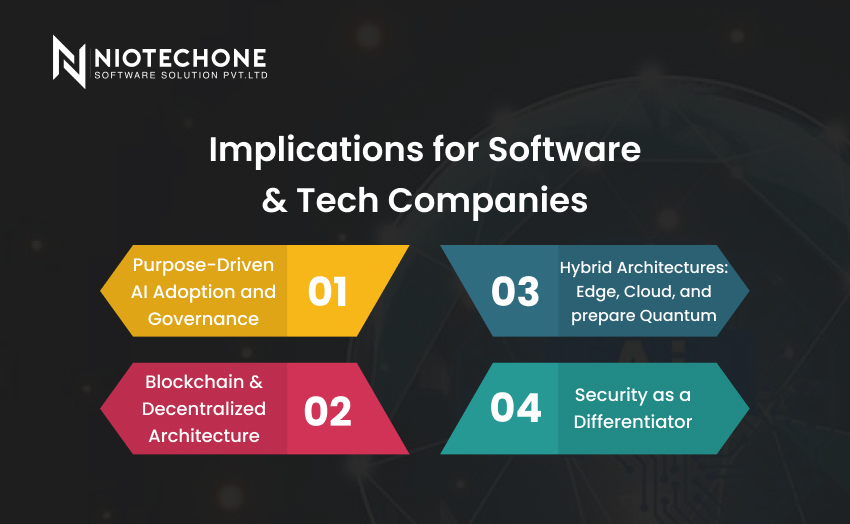
1. Purpose-Driven AI Adoption and Governance

If your company is already exploring AI in software development in Rajkot, Insight from Vision AI makes no mistake: responsible AI is optional. Tech firms must build the infrastructure to audit models, log decisions, make explainable to the user, monitor bias, and maintain data lineage.

2. Blockchain & Decentralized Architecture

Not every system requires blockchain, but in circumstances where trust, audit, and user-controlled information are essential, which may include consent logs, data portability, or a decentralized workflow, blockchains (also known as a “trust fabric”) should be evaluated.

3. Hybrid Architectures: Edge, Cloud, and prepare Quantum

A single operational layer won’t be the future: it will be a hybrid. Edge inference (mobile/offline usage), cloud intelligence, and eventually quantum-secure-operating will all coexist. Systems built today should be modular, pluggable, and reconfigurable to future compute paradigms, e.g., artificial intelligence (AI) ultimately quantum computing on-line, surface, and visual modes.

4. Security as a Differentiator

As concerns related to data breaches continue to receive media attention, businesses that can offer secure systems as a part of their application will gain trust. Whether working on custom enterprise mobility software applications or web applications, it will be advantageous to include advanced security measures.

How Niotechone and Rajkot Tech Can Respond

As a software development company based out of Rajkot, here are some ways you could use this content from the Emerging Tech Conference, presented by Vision AI India.

1. Embed Responsible AI into Your Product

If you are providing .NET Core application development or ASP.NET Core development in Rajkot, take advantage of your existing framework and attach AI audit logs, explainability modules, bias alerts, and governance scaffolding to your brand of AI-enabled development.

2. Cloud-Edge-Aware Solutions

Using your Azure cloud application development talent, develop flexible back end(s) that can off load inference to edge (GPU if available), manage updates, aggregate metrics, and orchestrate loads intelligently.

3. Selective Blockchain / Trust Ledger Integration

For clients who can connect to be transparent, you can integrate the blockchain/trust ledger module to your custom solutions in places that could be helpful, especially for data-sensitive use cases or in regulated spaces.

4. Security Posture

Make sure you incorporate threat modeling, security reviews, ongoing monitoring, and adherence to compliance in your software development lifecycle. Leverage learnings from external cybersecurity speaking engagements taking place at Vision AI to guide your internal policies.

Key Takeaways: Trends to Monitor

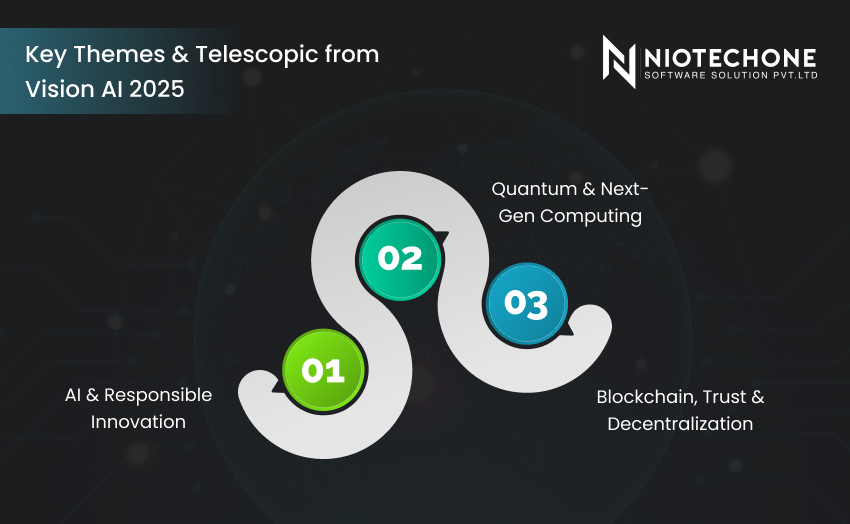
On behalf of Vision AI’s Emerging Tech Conference, below are key takeaways that should shape how technology companies conduct their business in 2025 and beyond:

  • Ethical & Explainable AI will transition from being a separate discussion or optional feature to it being expected as a baseline feature. 
  • Quantum-safe systems will mature from proof of concepts to implementations, and early adopters may have an advantage here.
  • Trust & decentralization will influence the emergence of new architectures—especially related to identity, consent, and data sharing.
  • Security & resilience need to be built in— not bolted on.
  • High-performance, reliability, and privacy will require a hybrid compute (cloud + edge + local) architecture.
  • Talent & capabilities need to evolve faster than business demand. 

Challenges & Critiques

No conference or technology vision is perfect. Here are some of the challenges and critiques to consider: 

  • Hype vs Reality: Quantum, blockchain, and AI have been touted as solutions. Often in the conference, examples of truth may have been aspirational, or too soon for production.

  • Access & Inclusion: Many parts of the globe do not have the infrastructure or talent. And equitable access to various dimensions of technology remains a big gap.

  • Regulation lag: Technology will evolve faster than laws, policy, and regulation. This has the risk of being under protected from misuse, misuse of privacy, and additional ethical lapses.

  • Talent gaps and brain drain: Retaining talent from larger cities and keeping them in mid-sized cities—such as Rajkot—will take time.

  • Sustainability and energy cost: More capable technologies such as AI and quantum may use a lot of energy — sustainability concerns should be addressed.

However, acknowledgment of problems is critical — to build accountable and resilient systems.

Conclusion

The Vision AI India Emerging Tech Conference 2025 presented evidence that India is not simply surfing the current technology wave — it is related to shaping the future direction of that wave. The collision between AI, quantum, blockchain, and secure systems are creating the next frontier of emergent technologies.

For companies like Niotechone  a .NET development company in Rajkot developing websites, writing custom software, developing Azure cloud applications, doing ASP.NET Core development in Rajkot, building .NET Core applications, and custom enterprise mobility software solutions — the conference was more than inspiration, it was a call to action.

We need to integrate ethics into AI and build hybrid systems that combine edge computing and cloud computing, prepare for protections relevant to the quantum age, design for trust, and invest significantly in our talent and culture. Those that accept this challenge will not just thrive in the coming decade, but they will lead it.

Frequently Asked Questions FAQs

It is an annual gathering of those working in AI, quantum computing, blockchain, and cybersecurity to discuss trends, ethics, policies, and technology roadmaps. 

The conference direction tends to provide an early signal of emerging technology areas, policy direction, and industry priorities that software companies can leverage to more efficiently align their investments and strategy. 

By aligning with these trends, you'll be able to position your services (AI-enabled software, secure architectures, blockchain modules, quantum-ready systems) ahead of your competition, while also being acceptable to high-end projects, thereby future-proofing your business.

Some of them are, indeed, exploratory; however, many aspects will be pieces of information that we will be able to put into practice (quantum-safe cryptography, decentralized identity, trust layers). It will be useful to begin thinking about your early approach, even if full adoption of quantum is 5-10 years down the road.

Ensure your architectures consider modularity and factor security and governance into your architectures, plan for edge support, stay apprised of developing AI ethics standards, and consider investing in upskilling your team.