Top 5 Security Features of Microsoft .NET Framework

Introduction

In the modern digital age, security has become a priority for all businesses and developers. Cyber threats are on the increase and organizations require structures that not only enhance productivity but also protect applications. Enterprises and all major companies have long trusted the Microsoft .NET Framework and .NET development company because of its strong, built‑in security features. 

If you plan to hire .NET developers or work with an ASP.NET Core development company, understanding these features will help you build secure, reliable, and scalable applications.

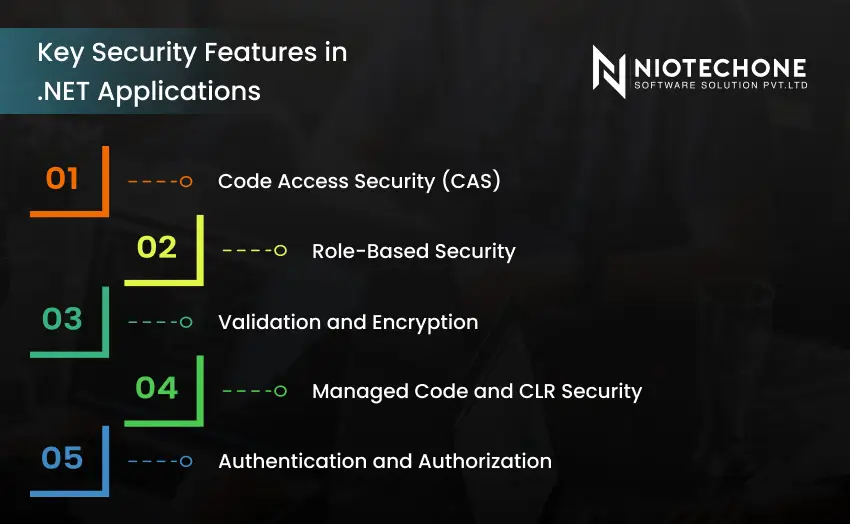
Key security features in .NET applications such as code access security, encryption, and authentication authorization

Key Security Features in .NET Applications

Before diving into individual features, it’s important to understand that these mechanisms form the backbone of secure .NET applications, which assist developers in creating systems that are resilient and trustworthy. 

1. Code Access Security (CAS)

What it is:  

Code Access Security (CAS) is a system that determines what code is allowed to do depending on its origin. It does not allow unauthorized or malicious code to carry out harmful activities.

How it works:

  • CAS grants permissions based on the source of the code (local machine, intranet, or internet).
  • When code attempts to perform on its permitted permissions, the framework prevents it.


Example:  

Imagine that you have downloaded a library online. CAS will make sure that this library will not be able to access sensitive files on your computer unless it is explicitly allowed.

Real‑world use case:  

CAS is often used by enterprises to limit external plugins or modules, so that they do not affect internal systems. A Microsoft .NET development company usually uses CAS in the process of incorporating third-party elements into enterprise solutions.

2. Role-Based Security

What it is:  

Role-based security is a security system that allows only authorized users to access certain sections of an application. It operates by assigning roles (such as Admin, Manager, or User) and granting permissions based on them.

How it works:

  • Roles in the application are defined by developers.
  • Users are authenticated and given roles.
  • The system checks the role before allowing access to features.


Example:  

In a banking application, only the users with the role of Admin can approve large transactions, while regular users can only see their account balance.

Real‑world use case:  

Role-based security is used in healthcare applications to make sure that only doctors can access patient records, while receptionists can only schedule appointments. Role-based security is commonly used in healthcare and finance projects by a trusted .NET application development company.

3. Validation and Encryption

What it is:  

.NET offers built-in data validation and encryption libraries to assist developers in safeguarding sensitive information such as passwords, financial data, and personal details.

How it works:

  • Validation is used to ensure that user input is safe (e.g., preventing SQL injection or cross-site scripting).
  • Encryption is the process of converting sensitive data into unreadable formats, which can only be decrypted using the correct key.


Example:  

Upon a user logging in, the password is encrypted and then stored in the database. Although hackers may gain access to the database, they will not be able to read the actual password.

Real‑world use case:  

Encryption is employed by e-commerce sites to ensure that payment information is secured and that the customer is not defrauded. These features are used by Many ASP.NET development companies to develop secure online shopping platforms.

4. Managed Code and CLR Security

What it is:  

The Common Language Runtime (CLR) is the runtime of the .NET Framework. It provides a safe execution of applications by controlling memory, exception handling, and type safety.

How it works:

  • CLR eliminates unsafe code such as direct memory access.
  • It also takes care of garbage collection automatically, minimizing the chances of memory leakage.
  • It implements type safety, which means that data is utilized in the right way.


Example:  

In case a developer accidentally writes code that may lead to a buffer overflow, the CLR will detect and block it before it can damage the system.

Real‑world use case:  

Enterprise applications are based on CLR security to ensure stability and avoid vulnerabilities due to unsafe code. A .NET Core development company often highlights CLR’s role in building scalable and secure enterprise solutions.

5. Authentication and Authorization

What it is:  

Authentication is used to verify the identity of the user, and authorization is used to determine what the user is allowed to do. .NET Framework has a variety of authentication schemes, such as Windows authentication, forms authentication, and token-based authentication.

How it works:

  • Authentication checks user credentials (such as username and password).
  • Authentication is used to make sure that users can only access resources that they are authorized to access.


Example:  

Within a corporate intranet, employees are able to log in using their Windows credentials. The system then permits them to access only the files relevant to their department.

Real‑world use case:  

Cloud-based applications are authenticated by using tokens to enable secure access by multiple devices. This is a general practice among ASP.NET Core development companies delivering enterprise-grade web applications.

Why These Features Matter

It has security features. .NET Framework is not merely a technical add-on, but rather fundamental safeguards that secure applications, businesses, and users. The following is why they are important:

Protecting Sensitive Data

Contemporary applications deal with sensitive data – customer data, financial transactions, and medical records. Such characteristics as validation, encryption, and authentication ensure that this data is not subject to unauthorized access and cyberattacks.

Example: An e-commerce site will encrypt payment information such that even when hackers access the database, they will not be able to misuse the information.

Impact: Garners customer trust and adherence to laws such as GDPR and HIPAA.

Preventing Unauthorized Access

Role-based security and authorization can be used to ensure that only the right people can access the right resources, minimizing insider threats.

Example: In a hospital system, doctors can access patient records, whereas receptionists can only handle appointments.

Impact: Reduces the risk of leaks and holds people accountable.

Blocking Malicious Code

CAS and CLR safeguards stop harmful code from executing, especially when using third‑party libraries.

Example: A downloaded internet plugin cannot access system files unless it is allowed.

Impact: Protects enterprise systems from malware and unauthorized changes.

Ensuring Application Stability

The code environment that CLR manages prevents unsafe operations, memory leaks, and crashes.

Example: CLR will identify and prevent a buffer overflow in case unsafe code might cause a buffer overflow.

Impact: Applications are not lost, and downtime and costs are minimized.

Conclusion

The Microsoft .NET Framework offers a powerful set of built‑in security features that protect data, control access, block malicious code, and ensure compliance. Through collaboration with a trusted .NET development company or .NET Core development company, businesses can develop secure, reliable, and scalable applications that users trust in today’s cyber‑driven world.

Frequently Asked Questions FAQs

Yes, While Microsoft encourages migration to .NET Core and .NET 6/7/8, the .NET Framework continues to receive security updates, making it safe for enterprise use.

Authentication checks the identity of the user, while authorization determines what actions the user is allowed to perform.

Yes, With built‑in validation libraries and parameterized queries, .NET helps developers prevent SQL injection.

It ensures that sensitive operations are only performed by authorized personnel, reducing risks of data breaches.

No. Developers must implement encryption using .NET libraries, but the framework makes it easy to secure sensitive data.