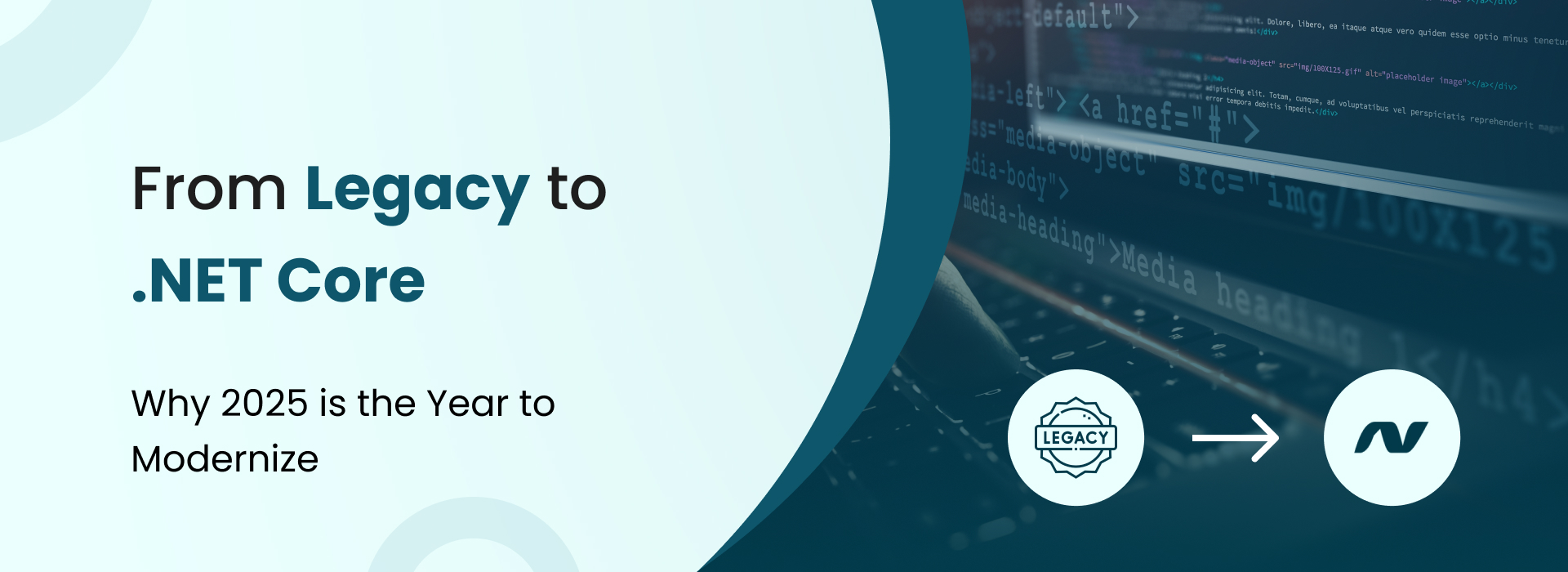
From Legacy to .NET Core: Why 2025 is the Year to Modernize

Introduction:

Today’s organizations are in a constant state of change, just like their software needs continue to change. Legacy systems, with their capabilities, often fail to deliver the speed, scalability, and performance necessary for the modern enterprise. As we reach 2025, businesses in Rajkot and around the world have begun leveraging .NET Core application development to modernize their digital capabilities. This is not only timely to stay relevant, but it is also an opportunity for improved performance, security, and enhanced cloud features. 

This guide will discuss why there is an increase in ASP.NET Core development in Rajkot, the benefits of transitioning from legacy systems, and how specialized enterprise mobility software development can improve the overall capabilities of your business.

Understanding Legacy Systems and Their Limitations

Legacy software refers to older applications built on outdated technologies that may no longer receive support or updates. While these systems often underpin critical operations, they come with several limitations:

High Maintenance Costs 

Maintaining legacy systems requires a very limited skill set, which is constantly decreasing. Many organizations waste a lot of their IT budget maintaining these systems. 

Limited Flexibility 

Legacy platforms may be incapable of handling modern traffic spikes, mobile usage, or cloud deployments, which can stifle business growth. 

Security Vulnerabilities 

Older systems may not receive regular security patches and, in addition, do not provide sufficient security against cyberattacks. Our modern solutions, such as Azure cloud application development, provide a more robust and secure framework to protect sensitive data. 

Integration Challenges 

Integrating legacy software products with modern applications or third-party service offerings is often challenging, resulting in inefficiencies and data silos.

Why 2025 is the Year to Modernize

At a time when digital experiences are constantly evolving, it is becoming increasingly important for enterprises to review their software solutions. Here are several reasons moving from .NET to .NET Core in 2025 is a good idea for your enterprise.

Performance and Cross-Platform Capabilities

Not only does .NET Core performance exceed its older .NET Framework counterparts, it has even greater advantages when it comes to cross-platform solutions. .NET Core can be run and deployed on usually all systems, including Windows, Linux, and macOS. The bottom line is that .NET Core development will enable the product to reach a much larger target audience in the market, and in the end, that goal will aid in your long-term success.

Cloud Friendly Workloads

As enterprises push applications and workloads to the cloud, cloud application development on Azure will provide very different concepts and abstractions for business owners to consider. Enterprises will be able to manage scalability, automate deployments, and view new advanced monitoring tools developed natively for .NET Core on Azure in Rajkot software development.

Better Architecture for the Future

By modernizing to custom software development, it will ultimately allow your applications to work well with future technologies to come, including Artificial Intelligence, Internet of Things and Next Generation Analytics applications. This will ultimately reduce the risk of costly re-writes in the coming years.

Cost Effective

Although a migration will require an investment upfront, the benefits will outweigh the costs quickly from reduced investment as repeated workloads to maintain, improve performance and increase productivity across your applications. Working with a software development company located in Rajkot will be able to assist you in building cost effective strategies.

The Significance of .NET Core in Contemporary Enterprise Applications

.NET Core is an open-source, cross-platform development framework developed by Microsoft for creating scalable and high-performance applications.

Key Features of .NET Core

  • Cross-platform: Build applications on Windows, Linux, and macOS platforms.
  • High-performance: Offers high-performance processing and indirect latency, ideal for enterprise-grade applications.
  • Modular architecture: Provides developers with the option to include only the components needed, promoting a lean application build.
  • Open-source: Libraries, tools, and updates are provided by the open-source community of developers worldwide.


Usage in Enterprise Mobility

Forward-thinking enterprises are making the investment in custom enterprise mobility software solutions to enable improved remote work, mobile sales, and operational efficiency among employees. The application development done using .NET Core allows for the development of applications supporting mobile-friendly web apps and backend systems.

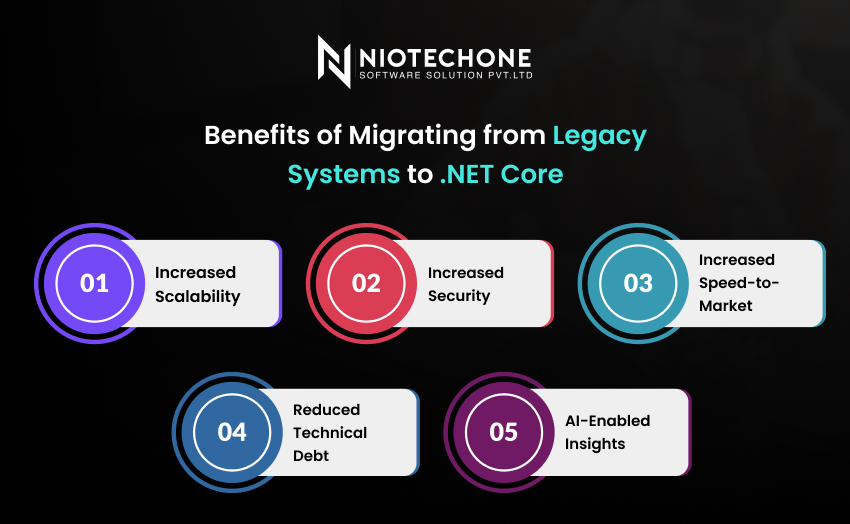
Benefits of migrating from legacy systems to .NET Core including scalability, security, speed-to-market, reduced technical debt, and AI-enabled insights.

Benefits of Migrating from Legacy Systems to .NET Core

Moving legacy systems to .NET core brings identifiable advantages to your business.

1. Increased Scalability

Custom software development ensures the application can scale horizontally and vertically in order to support users and load without performance degradation.

2. Increased Security

Built-in security protocols within ASP.NET Core development in Rajkot are able to safeguard against SQL injection, cross-site scripting, and other vulnerabilities. Cloud-based deployments through Azure cloud application development strengthen the data security and compliance.

3. Increased Speed-to-Market

New architectures, containerization, and microservices allow the development team to deploy updates and new features faster.

4. Reduced Technical Debt

Replacing legacy components using custom enterprise mobility software solutions reduces the outdated dependency, thereby reducing maintenance complexity for the future.

5. AI-Enabled Insights

Integrating AI within software development in Rajkot enables more predictive analytics, reduces repetitive tasks through automation, and yields a richer decision-making capability for enterprises.

How a Software Development Company in Rajkot Can Assist

The right software development company in Rajkot can help you migrate smoothly and upgrade a legacy system:

Evaluation and Strategy

Professionals review the legacy system, identify issues, and generate a phased plan for system modernization.

Migration Services

Transition quickly to .NET Core application development and cloud settings (like Azure cloud application development) without impacting day-to-day operations.

Custom Development

Design and develop custom software development products which fit your business needs, for web, mobile, and cloud applications.

Ongoing Support and Optimization

Following transition, the company will provide ongoing monitoring, updates, and optimization to maximize your performance and ROI.

Real-World Examples of .NET Core Modernization

Transition to Enterprise Mobility

A retail organization in Rajkot transitioned its sales and inventory management systems to a .NET Core Application Development from the legacy .NET Framework type which provided mobile access to the field agents and provided AI analytics.

Cloud-Enabled Banking Solutions

Banks leveraging Azure cloud application development with .NET Core Development in Rajkot have seen improved time and transaction timings, reduced downtime, and more possible cybersecurity.

AI-Powered Operations

A logistics organization developed a software application in Rajkot using AI algorithms on a .NET Core platform which has improved optimal delivery routes in addition to automated inventory management and providing demand forecasts.

Top Strategies for .NET Core Modernization

Begin with a Pilot Project

Start with a pilot project on a system that is not critical to evaluate the performance, security, and integration capabilities of your approached migration strategy.

Use  Microservices Architecture

Moving applications to small services which provide independence will increase scalability and flexibility.

Use Cloud-Native Capabilities

Begin utilizing Azure cloud application development capabilities, which include serverless computing, AI services, and containerized applications.

Monitoring & Review Continual Process

You will then want to begin monitoring performance, security, and user experience using monitoring tools after migration is complete.

The Future of Enterprise Applications with .NET Core

In 2025 and beyond, contemporary enterprises will focus on:

  • AI-driven workflows for analytic and automation promise.
  • Mobile-first strategies, driven by custom enterprise mobilization software.
  • Cloud-native applications designed to spring up in countries across the world.
  • Continuous integration and delivery (CI/CD) pipelines to speed up motion.

The businesses that build their .NET core applications today will be the ones that are front-runners in terms of the innovation, efficiencies and customer satisfaction.

Conclusion

Moving your legacy software to .NET Core is no longer just a choice, it is now a strategic need if businesses want to stay competitive in 2025. Modernising your software stack provides increased performance, security, cloud capability, and AI support, enabling the ability to tap into new business potential. Choosing to work with a reliable software development business in Rajkot will support a seamless migration, enable a scalable architecture, and provide custom software development to suit bespoke business needs. 

If your business has lagged behind, embark on ASP.NET Core development in Rajkot, use Azure cloud application development, and bring AI into your software development in Rajkot to safeguard the future of your enterprise today.

Frequently Asked Questions FAQs

.NET Core is cross-platform, faster, cloud-enabled, and easier to maintain than legacy .NET Framework applications.

Azure gives businesses the ability to run scalable, secure, and cost-effective cloud applications integrated with AI, analytics, and DevOps tools.

Migration requires an investment, but the long-term attributes such as a decrease in maintenance costs, enhanced scalability, and integration of AI outweigh the investment costs.

Yes, legacy applications can interact with modernized ones through APIs, middleware, and incremental migration plans.

AI includes functionality such as predictive analytics, workflow automation, and data driven decision making to enhance operational efficiencies and customer service experience.