How AI is Transforming .NET Development in 2026

Introduction

Artificial Intelligence (AI) is no longer hype; instead, it continues to mature as an important resource when creating innovative solutions across many industries. By 2026, AI will completely transform how you create, test, and distribute applications using the Microsoft .NET platform. 

By leveraging AI capabilities, you can eliminate inefficient coding practices for developers, delivering more enhanced experiences to end users of applications created via .NET. Ultimately, the combination of AI with .NET application development provides overall faster, smarter, and more attractive applications for the final consumer use.

The Rise of AI in .NET Development

Artificial Intelligence has changed from being used as an experimental technology to being a core component of how we build software. This includes building intelligent code editor(s) that respond faster, automatically testing code written by developers, using AI to monitor performance of their applications, and providing developers with natural language ways to describe features of their applications in plain English and generate working code from this.

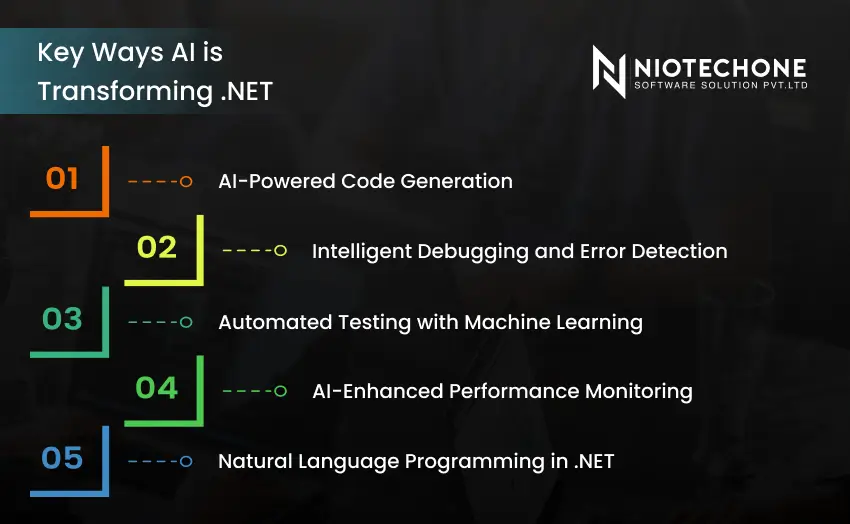
Key ways AI is transforming .NET including code generation, debugging, automated testing, performance monitoring, and natural language programming

Key Ways AI is Transforming .NET

AI-Powered Code Generation

Current AI systems are capable of creating complete modules in C# or F# at the request of the developer. Rather than creating boilerplate code, developers just tell AI what they require, and it creates clean, efficient code.

Example: A developer writes: “Develop a REST API to handle student records and authenticate.” AI immediately produces a .NET Minimal API, endpoints, authentication logic, and database integration.

Intelligent Debugging and Error Detection

It has always been time-consuming to debug. AI can now anticipate possible bugs prior to their happening by examining the coding patterns. It shows dangerous code blocks, describes mistakes in plain English, and even proposes solutions automatically.

Automated Testing with Machine Learning

Testing is a must, but writing test cases can be a bore. This is automated by AI, which creates unit tests and integration tests according to code behavior. These tools learn over time, becoming more accurate and less manual.

AI-Enhanced Performance Monitoring

Monitoring tools based on AI analyze the performance of applications in real time. They predict bottlenecks before they affect users, provide intelligent alerts with actionable insights, and even automatically allocate resources based on traffic.

Natural Language Programming in .NET

Now developers are able to define features in a natural language, and AI translates them into functional .NET code. For example, a simple request like “Build a login page with email and password validation” results in a fully functional Razor Pages login form with validation logic.

Real-World Use Cases of AI in .NET Development

FinTech Applications

Fintech companies are dependent on .NET to secure and scalable platforms. AI integration helps:

  • Identify fraud instantly
  • Give individualized investment recommendations
  • Chatbots, Customer support, Automation


A Microsoft .NET development company can create banking applications that can identify suspicious logins and notify users in real-time with the help of AI.

Healthcare IT Solutions

AI-powered .NET applications assist hospitals and doctors in handling huge amounts of data effectively. Key uses include:

  • Patient risk predictive analytics
  • Medical imaging assistance for radiologists
  • Scheduling and billing workflow automation


A
.NET Core development company will be able to provide hospital systems that track patient vital signs and alert doctors about any anomalies.

E-Commerce Platforms

Online shopping is being revolutionized by AI. With .NET, developers can:

  • Suggest products according to the browsing history
  • Adjust prices dynamically
  • Communicate with customers using AI chatbots


An ASP.NET development services provider might create an online store that recommends clothes based on previous purchases.

Education Technology

Based on EdTech platforms, .NET leverages AI to make learning interactive. Applications include:

  • Adaptive learning systems that modify lesson difficulty
  • Automated marking to save the time of teachers
  • On-the-fly virtual tutors responding to student queries


A
.NET application development company can incorporate AI into learning systems to develop individual study plans.

Smart Enterprise Solutions

Businesses use AI-powered .NET applications to simplify operations. Benefits include:

  • Anticipatory maintenance to minimize downtime
  • Data-driven insights for better decisions
  • Automated payroll and HR


Enterprises often hire .NET developers to develop solutions to track equipment health and plan maintenance before it breaks down.

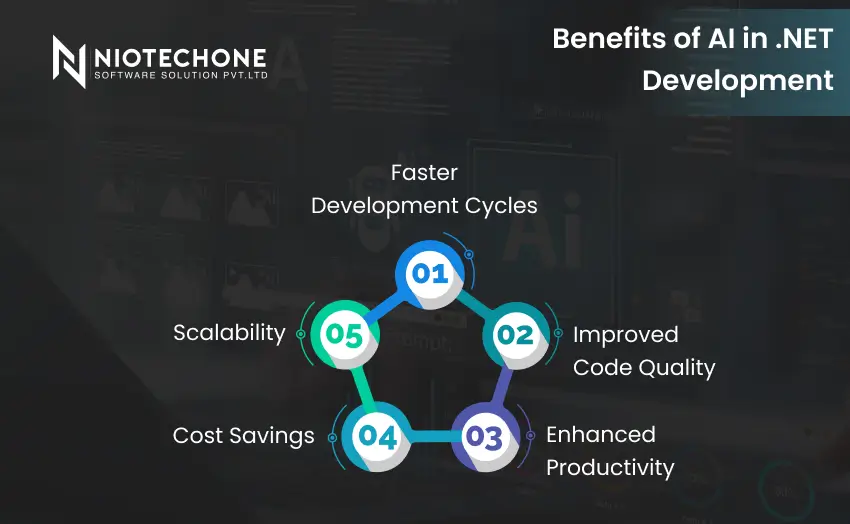
Benefits of AI in .NET development including faster development cycles, improved code quality, enhanced productivity, cost savings, and scalability.

Benefits of AI in .NET Development

Faster Development Cycles  

  • AI minimizes repetitive coding and testing, enabling teams to deliver applications faster and reduce time-to-market.


Improved Code Quality
  

  • AI will guarantee cleaner and more reliable code by implementing best practices and identifying mistakes at an early stage in .NET applications.


Enhanced Productivity
  

  • The developers are less engaged in routine work and more in creative problem-solving, which increases efficiency.


Cost Savings
  

  • Automated testing and debugging reduce the cost of development by decreasing the amount of manual work and errors.


Scalability
 

  • AI allows applications to dynamically respond to user demand, allowing them to perform smoothly even when under heavy load.

Challenges and Considerations

AI is transforming .NET development, but organizations must also manage the challenges that come with this shift.

Data Privacy and Security

The AI systems require huge amounts of data, which can be sensitive. To safeguard user information, developers need to adhere to such laws as GDPR and HIPAA and apply encryption, secure APIs, and tight access controls to user data.

Risk of Over-Reliance on AI

Even though AI has the ability to automate most tasks, it cannot substitute human expertise. Over-dependence can decrease problem-solving skills, and manual review and critical thinking are still necessary to ensure accuracy and control.

Integration with Legacy Systems

Older models are still in use by many businesses. Integrating AI into .NET applications is complicated. The compatibility issues that tend to arise are also to be considered, and migration strategies or hybrid solutions should be adopted to create a balance between innovation and stability.

Ethical and Transparency Concerns

The choices of AI must be fair and open. Black-box models may be more difficult to interpret, and developers need to focus more on transparency through explainable AI methods and process documentation.

Cost and Resource Management

The implementation of AI may be resource-consuming, requiring a lot of computing resources and investment. Smaller companies might not be able to meet the financial demands of sophisticated AI infrastructure, and it should be planned.

Conclusion

AI is reshaping, by making it faster, smarter, and more intuitive, to develop .NET in 2026. It minimizes repetition and enables developers to concentrate on creativity and innovation.

Whether you work with an ASP.NET development company, a .NET Core development company, or prefer to hire .NET developers. The future of scalable, secure, and future-ready applications lies in the adoption of AI-driven solutions by .NET developers.

Frequently Asked Questions FAQs

AI is embedded in IDEs like Visual Studio, offering code suggestions, automated testing, and performance monitoring.

No. AI assists developers by automating repetitive tasks, but human creativity and problem-solving remain essential.

FinTech, healthcare, e-commerce, and education are leading adopters due to their need for scalability and personalization.

Yes, but developers must implement strong data privacy measures and ethical guidelines to ensure safe AI usage.

The biggest advantage is speed—AI reduces development time while improving code quality and scalability.