By 2025, the global talent market has changed radically. The use of AI tools, specialized cloud platforms, and new software paradigms is transforming the expectations of organizations on the part of developers. In the case of outsourcing companies that market engineering capacity, particularly those that have positioned themselves as a larger .NET development company in India, these trends are not something to be learned. It is the key to winning deals, talent retention, and providing modern systems such as cloud-native microservices, AI-enabled applications, and enterprise mobility solutions.
This article describes the significant talent trends of 2025, why they are important to outsourcing companies, how to adjust recruiting and upskilling, what clients will need next, and what your company can do today. Where applicable I will mention how fields such as web development, custom software development, Azure cloud application development, ASP.NET Core development in Rajkot, .NET Core application development, and custom Enterprise mobility software solutions would be used in the picture.
In most markets, the demand for software talent has exceeded supply since 2020. However, 2025 is different: AI is no longer a substitute, but an amplifier. Two things happen at once:
AI is productive: Developers working on AI assistants (code generation, refactoring, test generation) will be able to do more in less time.
Skill profiles change: Clients desire individuals with the ability to integrate engineering basics with AI orchestration, cloud cost-awareness, observability, and domain expertise.
In the case of outsourcing companies, this implies that the rates and contracts will be renegotiated based on value and results, rather than hours. The question that is becoming more and more popular among clients is: Can your team deliver secure, observable, cost-effective systems that combine AI safely? Unless your pitch continues to focus on FTEs and hourly rates alone, you are likely to lose RFPs to outcome-speaking companies.
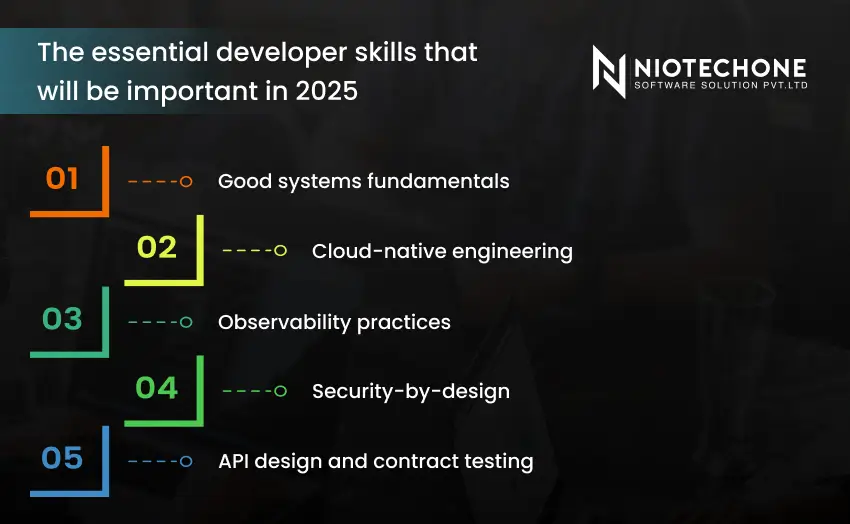
The minimum technical competence is still significant – but it has become table stakes. Best outsourcing companies should make sure that their teams possess the following mixed skills:
Good systems fundamentals: data structures, concurrency, algorithms, complexity analysis.
Cloud-native engineering: containerization, Kubernetes, serverless patterns, and multicloud deployment. It is here that the skills of Azure cloud application development come in handy.
Observability practices: distributed tracing, centralized logging, metrics-based SLIs/SLOs.
Security-by-design: threat modelling, secure SDLC, secrets management.
API design and contract testing: stable APIs, versioning, and backward compatibility.
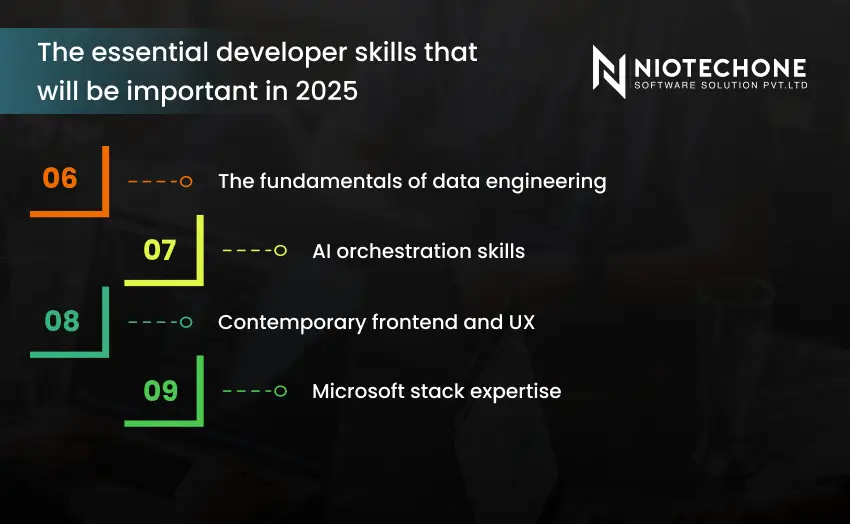
The fundamentals of data engineering: streaming, ETL, schema evolution.
AI orchestration skills: responsible integration of LLMs/ML models into apps (prompt engineering, safety checks, latency/perf tradeoffs).
Contemporary frontend and UX: SPAs, PWAs, mobile-first strategies – competencies in web development and mobile frameworks are directly connected to bespoke Enterprise mobility software solutions.
Microsoft stack expertise: in the case of most enterprise customers, extensive experience in ASP.NET Core development in Rajkot, ASP.NET Core development in India and .NET Core application development is a distinct competitive edge.
Outsourcing companies that certify teams with this combination of skills will secure more enterprise work and more lucrative projects.
Technical competence is required but not enough. Winning strategic engagements with outsourced teams demonstrate outstanding non-technical skills:
Customer empathy: Is it possible to reason about business impact and user outcomes?
Effective communication: Asynchronous updates, documentation that can be read, accurate ticketing.
Risk literacy: Security, regulatory, and model risk awareness (particularly when incorporating AI).
Attitude to ownership: Client systems are not temporary tickets.
These are the attributes that distinguish between the high-performing outsourcing companies and the commodity shops. Any talent strategy should include training programs that build client-facing communication and domain knowledge.
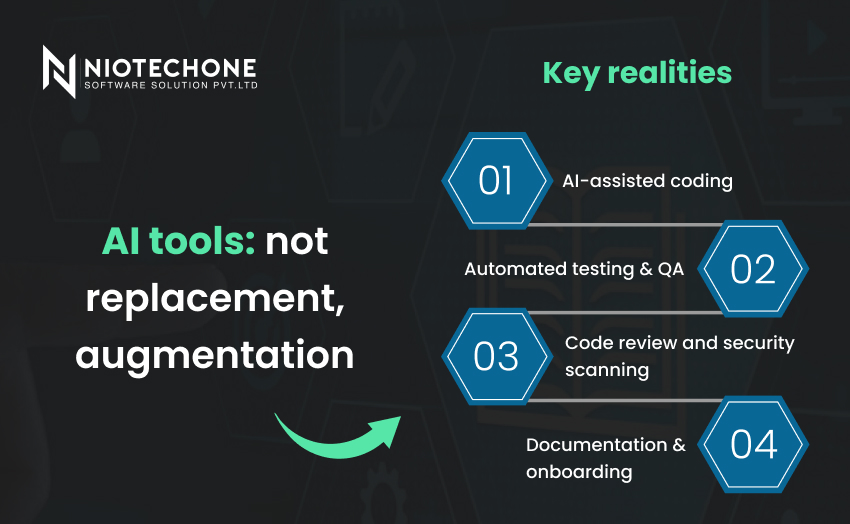
AI has become a developer toolchain component. Companies that make AI optional lose their efficiency to the companies that incorporate AI in their operations.
Key realities:
AI-assisted coding: Tools propose implementations, auto-complete patterns, and even generate entire modules. However, output still needs to be checked by humans to be correct, edge cases, and performance.
Automated testing & QA: AI speeds up the creation of unit tests, property tests, and regression suites. Nevertheless, exploratory and UX testing is still done by human testers.
Code review and security scanning: AI accelerates the process of static analysis and identifies probable vulnerabilities, but security engineers need to verify fixes and execute threat models.
Documentation & onboarding: AI can create current documentation based on code and commit history, speeding up the process of onboarding new employees and offshore teams.
Action plans that can be adopted practically by outsourcing companies:
This will allow companies, be it a custom software development company in Rajkot or a larger software house, to scale quality without losing control.
Customers are becoming more and more interested in outcome-based contracts: feature SLAs, system availability, business KPIs (e.g., conversion lift), and time-to-market guarantees.
Models that are growing in 2025:
Â
In the case of outsourcing companies, a shift to these models will demand delivery maturity, observability, and trust. This transition is possible with the demonstration of competence in the development of Azure cloud applications, cost optimization, and observability.
Shared bases in successful organizations:
Tooling standardization lowers the cognitive load to developers and accelerates onboarding, particularly in multi-vendor projects.
In the second half of 2025, automation, remote work, and the proliferation of AI-assisted development tools are transforming the global tech landscape. Cost advantages are no longer a sufficient factor to rely on, and the success of outsourcing companies now requires access to the highest skills of developers, the ability to develop flexibility, and the willingness to invest in AI-based development environments.
The organizations that will emerge victorious during this period will be those that can combine human skills with smart automation, constantly upskill their workforce, and embrace adaptable delivery frameworks that can be adjusted to the changing needs of clients. It can be AI in Software Development in India, scalable enterprise platform development in ASP.NET Core development in Rajkot, or agile custom software development workflow, but the emphasis should remain on value creation and innovation, and not on labor arbitrage.
No, AI increases the productivity of developers. It changes the skill mix to system design, AI coordination, observability, and domain knowledge. Human control is still necessary.
Both: T-shaped teams (deep skill and broad horizontal skills) are the most useful. Niche high-value specialization (FinOps, MLOps, SRE) attracts high-value work.
Proving domain depth (e.g. strong ASP.NET Core development in Rajkot), providing quantifiable results (MTTR, cost savings), and focusing on a limited number of high-need niches.
Cohorts Project-based, mentorship, and certification-based (Azure, Kubernetes, security) yield quantifiable outcomes in a short time.
Where feasible, replace hourly with outcome-based and shared-savings models. Customers are becoming more and more value conscious than time conscious.
3rd Floor, Aval Complex, University Road, above Balaji Super Market, Panchayat Nagar Chowk, Indira Circle, Rajkot, Gujarat 360005.
Abbotsford, BC
15th B Street 103, al Otaiba Dubai DU 00000, United Arab Emirates
3rd Floor, Aval Complex, University Road, above Balaji Super Market, Panchayat Nagar Chowk, Indira Circle, Rajkot, Gujarat 360005.
Abbotsford, BC
15th B Street 103, al Otaiba Dubai DU 00000, United Arab Emirates
Copyright © 2026 Niotechone Software Solution Pvt. Ltd. All Rights Reserved.