Generative AI for API Design: How AI Can Shape Modern Software Architectures

Introduction:

Over the past few years, APIs have emerged as the foundation of the majority of contemporary software architectures. They facilitate modularity, enable microservices to communicate, drive enterprise mobility, and create the connective tissue between web, mobile, cloud, and third-party systems. It is important to design APIs in a way that is performance-critical, maintainable, scalable, and user-friendly.

In the meantime, Generative AI has taken giant strides. It is now able to assist in code generation, spec drafting, documentation, testing, etc. Generative AI + API design is a potent combination: it is faster to iterate, fewer errors, and architectures that can be modified more readily to evolving requirements.

To a .NET development company in Rajkot, or any software development company in Rajkot that provides web development, custom software development, Azure cloud application development, ASP.NET Core development in Rajkot or adopting AI in Software Development in Rajkot, it is not a matter of choice to know how Generative AI can influence API design, but one of the ways to be ahead of the pack, not behind it.

A slide asking "What Is Generative AI in API Design?" with the letters "API" prominently displayed.

What Is Generative AI in API Design?

Generative AI in API Design Generative AI in API Design is the application of AI tools, particularly those capable of generating text or code based on a prompt, to support or automate aspects of API design. Generative AI could assist in some of the following:

  • Proposing API endpoints according to requirements or user stories.
  • Suggesting domain term data models (schemas, DTOs).
  • Creating OpenAPI / Swagger / GraphQL schema scaffolding.
  • Generating sample request/response payloads and error handling templates.
  • Writing documentation (docstrings, README, usage examples)
  • Suggesting design patterns: versioning, authentication/authorization, pagination, rate limiting, etc.

It is not that AI will replace architects or developers, but rather be co-creators: speeding up first drafts, identifying glaring problems, lessening boilerplate, and letting humans work on higher-level trade-offs: performance, security, maintainability, business logic.

Why This Matters in 2025

Generative AI is particularly helpful in API design today due to several trends:
Quickly Evolving Requirements

Businesses require quick pivots, new features, additional integrations. Clients in custom software development tend to shift gears in the middle of the project. The ability to regenerate or modify APIs in a short time is beneficial.

Microservices and Distributed Systems Everywhere

Many organizations are developing systems that consist of numerous services with the development of .NET Core applications and ASP.NET Core applications. APIs are how services talk. It is difficult to be consistent and well designed across a large number of APIs. AI can assist in keeping the patterns consistent.

Cloud & Serverless Adoption

Azure cloud application development simplifies the deployment of APIs at scale, serverless functions, managed API gateways etc. With cloud infrastructure and Generative AI, you can create endpoints or scaffolding that is more compatible with cloud services (e.g. Azure Functions, Logic Apps) faster.

AI & Data-Driven Components

Recommendation engines, predictive models, user personalization are now available in many apps. These models require APIs to be exposed or consumed. Friction can be minimized by using AI to propose schema designs and communication patterns to serve models. This alignment is highly applicable to companies undertaking AI in Software Development in Rajkot.

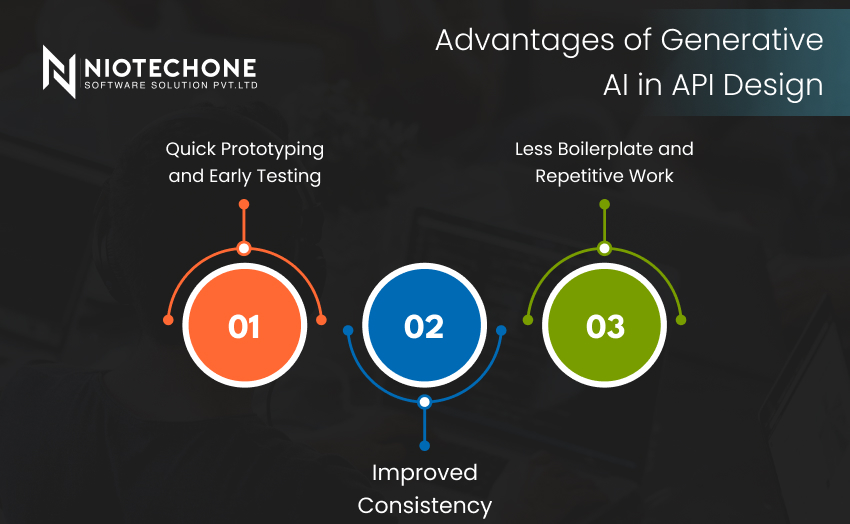
A list of advantages including Quick Prototyping, Less Repetitive Work, and Improved Consistency.

Advantages of Generative AI in API Design

Now, we can explore the tangible advantages. They are particularly applicable to API design in your stack: .NET, Azure, custom/mobility/back-end systems.

Quick Prototyping and Early Testing

You can create a rough initial version of the API, mock responses, sample payloads, documentation instead of/in addition to manually defining endpoints, data models, etc. Early review can be done by clients and stakeholders. This minimizes revision cycles.

Less Boilerplate and Repetitive Work

Most common API patterns are boilerplate (CRUD endpoints, error handling, parameter validation, pagination, etc.). Much of this can be scaffolded by generative AI, allowing developers to spend less time on setup and more time on business-specific logic.

Improved Consistency

Consistency in naming conventions, patterns (REST vs GraphQL vs gRPC), error codes, versioning etc. is important with multiple services/APIs. AI tools are able to identify inconsistent names, propose alignment, create schemas according to the guidelines of the team.

Difficulties, Hazards, and Things to Be Aware of

Naturally, there are no pitfalls when it comes to using Generative AI in API design. These are some of the major risks and how they should be handled by teams in your field.

Accuracy and Hallucination

AI may produce endpoints or schemas that appear plausible but are logically unsound, contain incompatible types, are security-compromised, or are domain-violating. Always: human review, testing, and requirement validation.

Lack of Business Context

AI does not necessarily understand your domain rules, business constraints, data privacy rules, regulations, or performance requirements. Design generated should be checked with domain experts.

Security and Compliance Risks

APIs generated automatically can lack security (authentication, authorization, input validation, rate limiting, etc.). The application of AI without proper configuration may lead to unsecured endpoints or data leakage.

Over-Engineering or Underperformance

The schemas proposed by AI may be too generic, contain unnecessary features, or have large payloads. May prefer some patterns that are not performance-optimal (e.g. deep nesting in JSON, or overhead in marshalling/unmarshalling).

Best Practices API Design with Generative AI, particularly in .NET/Azure/Mobile Environments

The following are the best practices that can be applied to achieve value and prevent pitfalls. Specifically, they may be used in your case: ASP.NET core development in Rajkot, Azure cloud application development, custom enterprise mobility software solutions, etc.

Design API Design Rules and Style Guides

Decide on your naming conventions, versioning policy, error code conventions, authentication scheme, pagination, data format (e.g JSON vs Protobuf), etc. Feed these into AI prompts or configure the tool to do so.

Definition / Specification Tools API

Add OpenAPI (Swagger), GraphQL schema tools, or other as a workflow. These standard formats should be developed by AI tools. Then you can automatically mock, automatically generate SDKs, client APIs, documentation, etc.

Timely Engineering and Situation Provisions

The prompt (or context) is important when applying generative AI. Give examples of existing APIs, domain terms, security constraints, performance expectations. Include sample payloads. This rules out generic or irrelevant suggestions.

Human Review & Feedback Loops

Always check generated schemas, endpoints, tests. Engage domain experts, API architects, security reviewers. Gradually develop feedback mechanisms to enhance AI prompt templates and minimize errors.

Future Trends and Where This is Going

Generative AI + API Design in the next years: What to expect:

  • Model Context Protocol (MCP) & increased standardization to allow AI tools to learn about your existing APIs, schemas, usage history, domain vocabulary.
  • More domain-specific AI models: Generative AI that has been trained on API design best practices, security rules, mobile constraints, etc., and potentially fine-tuned to .NET / Azure stacks.
  • Multi-modal API design tools: Tools that allow you to draw interfaces (UI or otherwise) and create corresponding API endpoints/specs and client SDKs.
  • Improved schema drift detection tooling: As your API spec evolves, tools identify clients that fail, create compatibility layers, or mark migration work.

Conclusion

Generative AI API Design is not a new thing, but it is becoming a necessity in the current software architecture. It promises speed, consistency, superior design decisions, reduced errors, enhanced documentation, and simpler evolution over time.

But like any potent instrument, it should be wisely applied. To prevent pitfalls, human oversight, domain context, security, versioning, performance, and cautious integration into your stack (particularly .NET, ASP.NET Core, Azure, mobile back-ends) are essential.

To a software development firm in Rajkot that focuses on web development, custom software development, custom enterprise mobility software solutions, .NET Core application development, Azure cloud application development, adoption of Generative AI in API design can open up actual competitive advantages: faster delivery, better quality, and more scalable, maintainable architectures.

Frequently Asked Questions FAQs

Generative AI is the application of artificial intelligence models, typically machine learning and natural language processing, to automatically design, generate, and document APIs. Rather than defining endpoints manually, developers can rely on AI-driven tools to suggest or even generate APIs that are most appropriate to a system architecture and data flow.

AI can be used to improve API design by examining the patterns of the current system, forecasting the best endpoint design, and maintaining data consistency. It is capable of automatically creating API specifications, test cases, and even integration code. This automation enables teams to concentrate on logic and innovation- ideal in organizations that deal with custom software development and .NET Core application development.

APIs are the binding force between applications, cloud services, and user interfaces. An API that is well designed guarantees flexibility, scalability, and performance of the system. With the move to microservices and hybrid cloud models, sound API architecture is needed to ensure reliable integrations, particularly in the development of Azure cloud applications and enterprise-scale ecosystems.

Not entirely. Although AI can automate most of the tasks, such as the creation of API documentation, endpoint testing, or schema design recommendations, human knowledge remains essential. Developers guarantee business logic accuracy, security, and compliance.

  • Reduced development cycles: AI minimizes the manual work in boilerplate code writing.
  • Consistency and compliance: AI implements design standards between APIs.
  • Better architecture choices: AI suggests the best endpoints according to data flow.
  • Automated documentation: Produces readable, developer-friendly API documentation.


These advantages make it the best choice in ASP.NET Core development in Rajkot and other frameworks where the quality of APIs directly affects performance.