Edge AI: Smarter Decisions Closer to Users

Introduction:

In a time when speed, privacy, and flexibility are essential, Edge AI is quickly becoming a significant paradigm. Instead of sending all data to remote cloud servers, Edge AI brings computation to the data source—on devices, at gateways, or locally in an infrastructure. This ensures faster response time, decreases latency, supports better privacy, and contributes to more robust applications.

Organizations like Niotechone, an IT consulting company specializing in .NET development in Rajkot, can leverage Edge AI to innovate new capabilities. Whether you care about web development, custom software development, Azure cloud application development, ASP.NET Core development in Rajkot, custom enterprise mobility software solutions, or .NET Core application development, Edge AI will help change how you design and build systems.

What Is Edge AI? An Explanation of Terms and Concepts

Edge AI occurs when artificial intelligence processing is performed “at the edge” of the network; on or near to the end-user device at the source of the data—not merely relying on computations back in the cloud.

Edge AI refers to artificial intelligence processing done at “the edge” of the network, either on or near the device generating the data, not exclusively in distant cloud servers. Important features are:

  • Edge inference: Models are executed in the local environment, enabling predictions or decisions with little or no dependency on the cloud.
  • Latency: The delay between the input and action is in the milliseconds, largely because the data does not have to traverse far.
  • Bandwidth: Only relevant, aggregated, or summary information is sent to the cloud, and raw data can be processed locally.
  • Privacy & security: Data considered sensitive remains on a device or within a local network.


Edge AI is both hardware, or edge devices, accelerators, or sensors, and scalable software, or lightweight models, deployment frameworks, or low-power inference.

A title card for "Edge AI" with the tagline "Smarter Decisions Closer to Users.

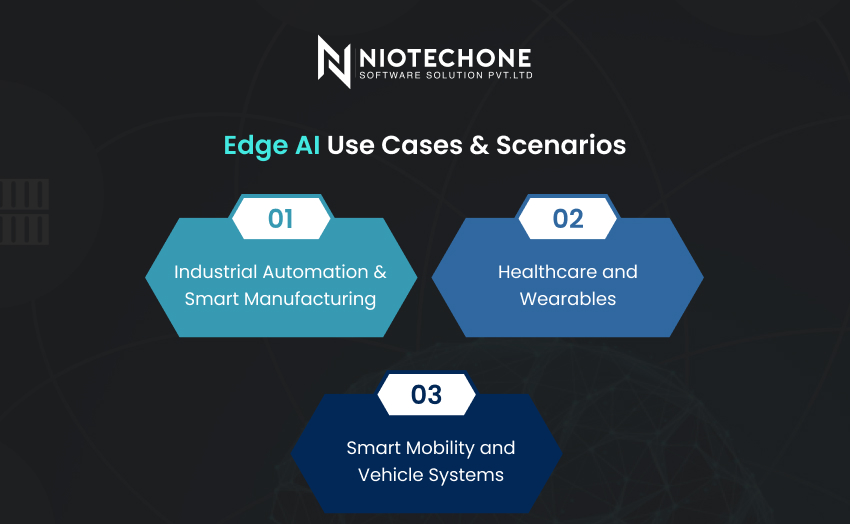
Edge AI Use Cases & Scenarios

These are legitimate and emerging scenarios in which Edge AI is highly beneficial. For a .NET development company in Rajkot, the above use cases can be opportunities for services. 

1. Industrial Automation & Smart Manufacturing 

Edge sensors are utilized to inspect production lines (for example, defect detection and predictive maintenance) and alerts are sent out if an anomaly occurs with the machinery you are inspecting. In this use case, Edge AI is ensuring that wait time is lessened and that machinery can stop before it causes damage. 

2. Healthcare and Wearables 

Wearables that monitor heart rate, motion, or vital signs are able to conduct anomaly detection locally (an arrhythmia or someone falling) and send alerts even though you have a weak signal while connected to the cloud. Conducting sensitive health information locally is also more private. 

3. Smart Mobility and Vehicle Systems 

In the automotive or transportation or mobility capacity, Edge AI always matters in cases of driver assistance, navigation, obstacle detection; all of these tasks have to take place locally so we don’t have the risk from delay that results in an unsafe outcome. 

Benefits & Impact for .NET / Azure / Enterprise Mobility Ecosystem

Given your domain, the following describes how Edge AI can specifically enhance what you are already doing, how Edge AI plugs into .NET, ASP.NET Core, Azure, and enterprise mobility.

For .NET Core /ASP.NET Core Applications

Build microservices that are Edge-friendly applications, and build local inference modules using libraries (e.g., ONNX runtime, ML.NET) that can run on local devices.

Use .NET Core code that is able to be deployed cross-platform onto devices running Windows IoT, Linux ARM, or other embedded Operating System.

The architect should define APIs that can switch from cloud to edge inference based on the capabilities of the device.

With Azure Cloud Application Development

Azure provides many capabilities that enhance Edge AI:

  • Azure IoT Edge, deploy modules (including AI inference) to Edge devices.
  • Azure Machine Learning; for training models in cloud, then export to Edge.
  • Azure Sphere, Azure Digital Twins, and other services that integrate Edge devices.

For clients in industries such as manufacturing, logistics, healthcare, the advantage of delivering inference at edge means you are able to provide more resilient and usable applications in extreme environments with low connectivity.

Challenges and Risks

Edge AI has considerable potential, however, it can be complicated by trade-offs and risks that need to be addressed—especially for a software development company in Rajkot looking to provide reliable solutions.

Hardware Limitations

Edge devices generally have limits in CPU, memory, battery. Running large models or high complexity inference may not work. Need to optimize.

Updating & Versioning Models

Updating or fixing models at scale is more difficult than cloud updates. Version inconsistencies can lead to bugs, or worse, security vulnerabilities.

Security Risks at Edge

Physical access, tampered devices, insecure firmware, faulty encryption—several possibilities. Decentralization means more attack surface.

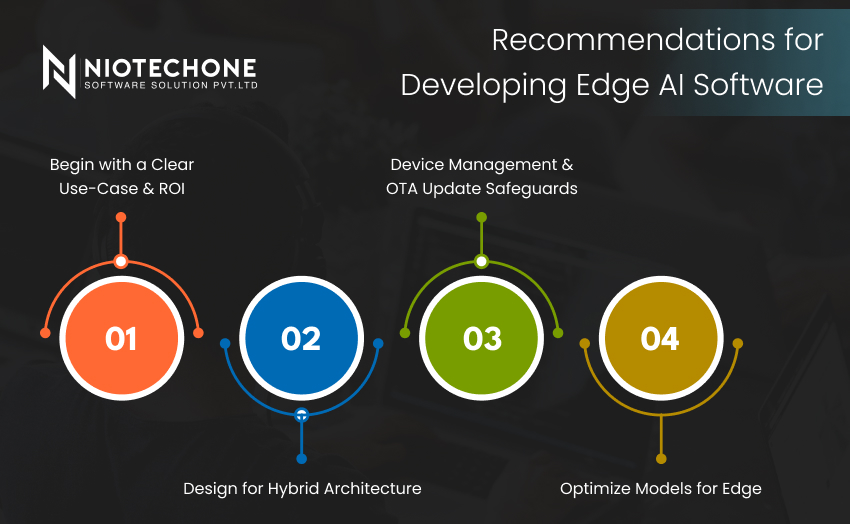
Recommendations for Developing Edge AI Software

For organizations doing complex software development, .NET Core application development, enterprise mobility solutions, etc., there are a few best practices to help make the implementation of Edge AIs an easier and more positive experience.

Begin with a Clear Use-Case & ROI

Not every problem requires to be solved with edge inference. Analyze latency, privacy, connectivity, cost, etc. to determine if the benefits justify building Edge AI. 

Optimize Models for Edge

To support edge inference, use techniques like quantization, pruning and lightweight architectures. Also use frameworks that allow built-in support for edge inference (e.g., ML.NET, ONNX, TensorFlow Lite), so integrations with your .NET or mobile stack are seamless.

Design for Hybrid Architecture

Make sure that cloud + edge will complement each other. The cloud should be used centrally to train and manage models, to perform analytics, and to store a copy of perfect backup models; while the edge will carry out inference and perform required immediate actions.

Device Management & OTA Update Safeguards

The edge device will also need over-the-air update safeguards in place to allow for model and firmware updates. Anytime you update the model or firmware, you must update it securely and completely. It’s always a best practice to leverage versioning and rollback options as well.

Conclusion

Edge AI is not merely a novelty—it’s a major shift in the design of intelligent systems. With inference closer to the user, we can achieve faster response times, better privacy, greater reliability, and new types of capabilities.

For businesses, including those developing web development, custom software development, .NET Core applications, ASP.NET Core applications in Rajkot, Azure custom cloud apps, and custom enterprise mobility software solutions, Edge-AI is an advancement that allows you to create improved user experiences, and differentiate offerings and/or minimize operational dependencies.

At Niotechone, a reputable software development company in Rajkot, we strive to enable clients to leverage Edge AI in their own context – from pilot projects to complete production. We believe that in 2025 and beyond, the most successful products will be those that integrate cloud and edge intelligence, in order to deliver smart decisions exactly where it matters.

Frequently Asked Questions FAQs

Not necessarily. Edge AI shines in scenarios where latency is critical, privacy is important, or connectivity is spotty. Cloud AI shines in scenarios that involve large amounts of computational training, analytics across many devices, or ability to perform model updates and compute using large datasets. Ideal systems utilize various hybrid architectures.

Devices that have adequate compute (CPU / accelerator / AI chip), have adequate power (battery, plug), secure hardware, and may have connectivity for updates. For example, IoT sensors, mobile devices, embedded systems, smart cameras and edge gateways.

By working with ML.NET or ONNX runtime and other compatible frameworks for edge inference. By utilizing Azure IoT Edge services. By designing APIs that support cloud and edge inference. By leveraging best practices of optimizing code for an Edge device.

You typically use over-the-air update systems, versioning of models, fallbacks for when the update fails, and continuous monitoring with logs to keep everything consistent.

The risks are device tampering, data leakage, theft of the model. The mitigations are secure hardware, encryption, secure boot, firmware validation, and limiting the data you send, as well as ensuring anything local is anonymized, and tight authentication.