Artificial Intelligence (AI) is now the backbone of the new innovation- changing industries, redefining customer experiences, and making automation smarter. However, as AI systems become more involved in decision-making, the question that is on the top of the list of all discussions is: Can we trust AI to make ethical decisions?
One of the challenges of our time is to create AI that is not only powerful but also responsible and ethical. To any .NET development company in Rajkot, or a software development firm in Rajkot that wants to develop intelligent and scalable digital solutions, it is not a choice to learn the ethics behind AI, but a requirement.
This is a complete guide on what ethical AI is, why it is important, and how development teams, particularly those working in web development, custom software development, and .NET Core application development can create AI systems that are ethically sound and aligned with human values and organizational integrity.
The current AI systems affect loan approvals, healthcare diagnostics, and hiring decisions. Nevertheless, the very technology that facilitates innovation also brings about complicated ethical issues: algorithm bias, data abuse, transparency, and the danger of substituting human judgment with uncontrolled automation.
With the increasing AI in Software Development in Rajkot, businesses are discovering that mistrust is the result of innovation without responsibility. It doesn’t matter whether you are creating an AI-based chatbot, a predictive analytics platform, or a bespoke machine learning-based ERP system, ethical considerations should be integrated into your workflow, not an afterthought.
Essentially, ethical AI is concerned with the development of systems that are:
Building User Trust
Users will not embrace AI-driven solutions without trust. Openness in the data collection, processing, and utilization can establish long-term customer trust, particularly in bespoke enterprise mobility software development and consumer-facing web development initiatives.
Minimizing Legal and Compliance Risk
The laws on data protection such as GDPR, HIPAA, and the DPDP Act in India require responsible AI management. Adherence to ethical principles in the development of Azure cloud applications guarantees adherence and preservation of brand reputation.
Improving Business Reputation
Ethical AI systems are a sign of integrity of a company. A Rajkot based .NET development company that incorporates fairness and accountability in its development lifecycle can win international clients who seek reliable partners.
Avoiding Algorithmic Bias
Unethical or biased AI may result in discrimination during recruitment, lending, or even automation of customer support. Early detection and correction of bias avoid reputational and financial damage.
Sustainable Innovation
Ethical practices promote sustainable AI implementation by making systems human-centered, inclusive, and useful to all users.
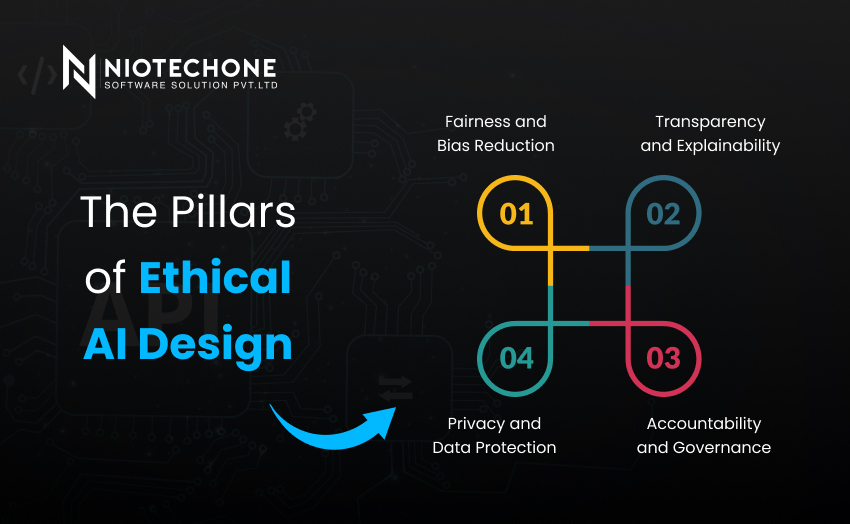
Ethical AI is not a single project, but a continuous process that should be supported by a set of principles that developers and organizations should follow.
1. Fairness and Bias Reduction
The AI models are as unbiased as the data they are trained on. Teams should be proactive in identifying, tracking, and fixing bias in datasets and algorithms.
Best Practices:
In the case of companies that are involved in AI in Software Development in Rajkot, fairness means that the products developed to serve the global users will work equally among the demographics.
2. Transparency and Explainability
AI models are frequently black boxes, and even developers cannot comprehend their reasoning. Explainable models are required in ethical AI, particularly in finance, healthcare, and governance.
How to Implement:
This is essential in the case of custom software development projects where clients need to understand how recommendations or predictions are made.
3. Privacy and Data Protection
AI is powered by data, and its misuse may result in privacy breaches. Ethical AI should safeguard user identity, adhere to regulations, and encourage data minimization.
Action Points:
3. Accountability and Governance.
When AI commits errors, someone has to be held accountable. Accountability in development teams is a way of ensuring accountability and constant improvement.
Recommended Practices:
By implementing formal AI governance frameworks, i.e. making accountability an inherent part of DevOps processes, a software development firm in Rajkot can become the leader of the regional ecosystem.
To be ethical, AI should be integrated throughout the SDLC, including concept to deployment.
1. Requirement Analysis
2.Design Phase
3.Development Phase
4. Testing and Validation
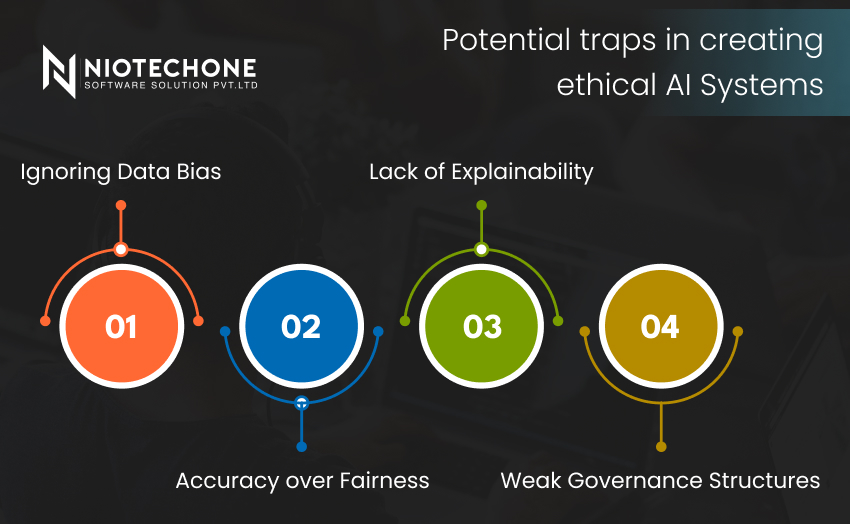
Even with the best intentions, teams can easily get into traps that undermine ethical integrity. These are some of the pitfalls to be avoided.
1. Ignoring Data Bias
Most developers believe that their datasets are neutral. However, the majority of real-world data is biased culturally or systemically and affects results. Always authenticate data sources prior to model training.
2. Accuracy over Fairness
Even a very precise discriminating model is unethical. Fairness should be considered as a performance measure that is equal to accuracy.
3. Lack of Explainability
The implementation of black-box models that cannot be interpreted results in distrust and possible abuse. Always strike a balance between complexity and transparency.
4. Weak Governance Structures
Ethical lapses are not noticed without clear accountability. All software development companies in Rajkot that use AI ought to have an internal ethics officer or committee.
ontemporary cloud ecosystems such as Azure are crucial in the application of ethical AI. They offer secure, compliant, and scalable tools that assist developers to manage data in a responsible manner.
Azure Ethical AI Capabilities:
Ethical AI governance, particularly in teams that specialize in either .NET Core application development or custom software development, is a potent ally when applied effectively to Azure cloud application development..
Healthcare Diagnostics
AI models help physicians to diagnose diseases more quickly. Ethical systems guarantee patient privacy, clarify diagnosis choices, and assist instead of substituting physicians.
Financial Risk Assessment
AI is used by banks to forecast loan eligibility. Checks of fairness and transparency make sure that AI does not discriminate against gender, region, or income group.
Smart Manufacturing
In industrial IoT systems, which are created by businesses that provide tailored enterprise mobility software solutions, AI forecasts equipment failures. Ethics guarantee the safety of workers and avoid unfair distribution of tasks.
Customer Support Chatbots
The development of AI chatbots in Rajkot based on ASP.NET Core can analyze sentiment and give correct answers without losing empathy, privacy, and user control.
The future of AI is not only in the extent to which intelligent machines will be, but also in the way they will act ethically. Each algorithm, each model, each decision has a price. To organizations in Rajkot and other places, it is not only a technical task to incorporate ethics in AI, but also a moral and strategic task.
You can be building enterprise-grade systems in .NET Core, moving to the Azure cloud, or building next-gen custom software development projects, but you should begin with one principle: AI should serve humanity, not the other way around.
Ethical AI is not only the correct path to take but the only one that will guarantee success, trust, and sustainability in the digital age.
Ethical AI is the creation of artificial intelligence systems that are transparent, fair, and accountable. It makes sure that technology choices are human rights-conscious, less biased, and do not compromise user trust.
Developers are encouraged to train on a variety of training data, perform fairness audits, and test bias by gender, geography, and demographics. Constant human control is necessary.
The use of diverse datasets, regular bias auditing and explainable AI models can help businesses ensure fairness and transparency. The trust is also maintained by documentation of the logic behind decision-making and free communication with users.
The significant ethical issues are the presence of data bias, transparency, privacy issues, and inadequate accountability infrastructure. These need to be addressed through governance systems, human controls and explicit ethical standards throughout the software development lifecycle.
To avoid the issue of losing user trust, breaking the law of data protection, and decreased brand credibility, the ethical AI assists software development companies to align their offerings with the ethical perspective. It guarantees that AI-based products are just, safe, and are in harmony with the human values, which are necessary to be long-term sustainable, and innovative.
Copyright © 2026 Niotechone Software Solution Pvt. Ltd. All Rights Reserved.