Cloud-Native State Management Patterns
- Niotechone Marketing Team
Table of Contents
- Introduction
- State in Cloud-Native Applications
- The Reason State Management is More Important in 2026
- Stateless Applications and Externalized State
- State Synchronization and Distributed Caching
- Modern Systems Event-Driven State Management
- Session state management based on tokens
- The Next Big Shift: AI-Aware State Management
- Conclusion
Introduction
With the rapid adoption of cloud in India, companies are no longer content with merely putting applications on cloud infrastructure. Organizations are currently working on the development of cloud-native systems that are scalable, resilient, intelligent, and future-ready in 2026. The core of this change is one important concept, which is state management.
Regardless of whether you are an enterprise, startup, or a software development company in Rajkot, it is important to know the patterns of cloud-native state management to provide high-performance applications. This blog discusses the current trends in cloud-native state management, best practices, and the way businesses in India are adopting them with ASP.NET Core, .NET Core, and Azure cloud technologies.
State in Cloud-Native Applications
State is any information that an application must store between user interactions or system events. This can be user sessions, shopping cart data, workflow progress, cached results, or AI context. Conventional monolithic applications stored this data in the application itself, which made scaling challenging and risky.
Cloud-native applications, on the contrary, have a different philosophy. They decouple application logic and state, enabling each component to scale independently. This has become a norm in custom software development in India, particularly among businesses that have global users.
The Reason State Management is More Important in 2026
Modern applications are not mere request-response systems anymore. They are decentralized, event-based, and AI-powered. The lack of proper state management may result in performance problems, downtime, security threats, and excessive cloud expenses.
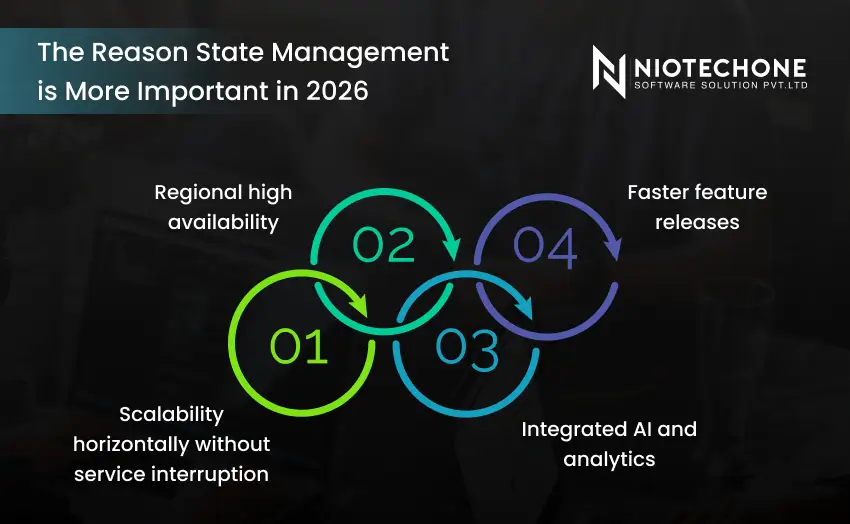
By 2026, successful state management will assist businesses in attaining:
- Scalability horizontally without service interruption.
- Regional high availability.
- Integrated AI and analytics.
- Faster feature releases
That is why all the .NET development Companies in Rajkot are focusing on cloud-native state strategies in system design.
Stateless Applications and Externalized State
Cloud-native design has been based on stateless architecture. In this model, the user or system state is not stored within applications. Rather, every request is processed separately, and the state is stored in external services like databases, caches, or storage systems.
This is a common practice in ASP.NET Core development in Rajkot since it enables applications to scale automatically according to demand. Stateless services can use Azure SQL, Cosmos DB, or Blob storage to store state safely when paired with Azure cloud application development.
Key advantages include:
- Improved fault tolerance
- Simpler scaling between containers and servers.
- Quick deployments and updates.
In the case of enterprises that invest in tailor-made Enterprise mobility software solutions, stateless design guarantees uniform performance across devices and locations.
State Synchronization and Distributed Caching
When the applications are scaled, it becomes inefficient to query databases repeatedly to get the same data. Distributed caching addresses this issue by storing common state information in fast cache systems that are shared among application instances.
Distributed caching is a norm in 2026 in platforms developed using custom software in India. Such technologies as Azure Cache for Redis are compatible with the development of the .NET Core application and allow real-time synchronization of states between microservices.
The advantages of distributed caching are:
- Faster response times
- Reduced database load
- Improved management of traffic spikes.
- Consistent user experience
This trend is particularly useful in systems developed by a Travel portal software development company in Rajkot where availability, pricing, and booking information should be updated in real-time.
Modern Systems Event-Driven State Management
Event-driven architecture has become a prevailing trend in the management of state in distributed systems. Rather than using direct service-to-service communication, applications post events when state changes are made. These events are asynchronously responded to by other services.
With Azure cloud application development, event-driven state management is easier to implement with ASP.NET Core development in Rajkot using services such as Azure Service Bus and Event Grid.
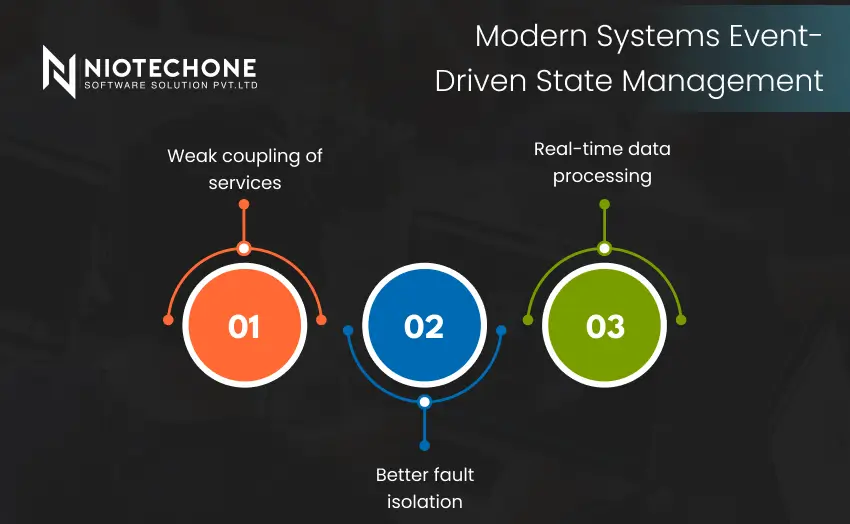
Key advantages include:
- Weak coupling of services.
- Better fault isolation
- Real-time data processing
As AI gains prominence in Software Development in Rajkot, event-driven patterns can also be used to support intelligent automation, including predictive recommendations and anomaly detection.
Session state management based on tokens
The management of sessions has changed a lot over the past few years. By 2026, token-based authentication like JWT and OAuth has mostly supplanted server-side session storage.
This approach caches session state in secure tokens exchanged between client and server, and does not require session affinity. It is widely applied in the development of scalable web and mobile applications in .NET Core.
Advantages include:
- Stateless authentication
- Enhanced security
- Mobile and API integration.
This method is best suited to businesses that develop tailor-made Enterprise mobility software to address remote and hybrid workforces.
The Next Big Shift: AI-Aware State Management
The use of AI-based applications demands a different way of managing the state. In addition to conventional data, applications need to handle AI context, user behavior history, and inference results.
State management in AI in Software Development in Rajkot frequently involves vector databases, AI caches, and context-aware storage systems. These allow quicker reactions, customized experiences, and intelligent automation.
The concept of AI-conscious state management is emerging as a major distinguishing factor among companies that provide high-level custom software development in India.
Conclusion
Cloud-native state management is no longer a back-end issue, but a business strategy. Whether it is travel portals and enterprise platforms or AI-driven systems, the selection of the appropriate patterns determines the success of applications in 2026 and beyond.
To find trusted partners in the development of custom software in India, particularly those who want to find a trusted company in the development of the .NET development company in Rajkot, the adoption of the modern cloud-native state management is the key to the creation of future-ready digital products.
Categories
Related Articles

Frequently Asked Questions FAQs
Cloud-native state management is the practice of managing application data (state) external to the application itself with scalable cloud services. Modern applications store state in databases, distributed caches, or event systems instead of storing sessions or data in server memory.
Stateless architecture enables applications to be scaled horizontally without relying on a particular server. The system is more resilient and manageable as each request is handled separately.
Azure offers a comprehensive application state management ecosystem, such as Azure SQL, Cosmos DB, Azure Cache for Redis, Service Bus, and Event Grid. These services are typically applied in the development of Azure cloud applications to externalize state and provide high availability to enterprise applications.
The best patterns in the case of enterprise systems are stateless services, distributed caching, event-driven architecture, the Saga pattern of transactions, and token-based session management.
AI-based applications need to handle more state, including user behavior, inference context, and prediction history. The current AI in Software Development in Rajkot is based on AI-conscious state management, vector databases, intelligent caching, and real-time event processing to provide faster and more personalized experiences.