AWS vs Azure in 2026: Which Cloud Platform Is Better for .NET Applications?
- Niotechone Marketing Team
Table of Contents
- Introduction
- Why This Comparison Matters in Real Projects
- Azure and AWS: How They Approach .NET Differently
- AWS vs Azure in 2026
- Real-World Experience: Where Azure Wins for .NET
- Where AWS Still Makes Sense in 2026 using .NET
- Common Mistakes Teams Make When Choosing AWS or Azure
- Best Practices That Work in Practice with .NET on the Cloud
- Impact on Scalability, Cost, and Maintenance
- Azure and AWS in the Age of AI-Assisted Development
- When Azure Is the Better Choice in 2026
- When AWS Is the Better Choice in 2026
- Conclusion
Introduction
The decision to use a cloud platform is no longer a technical one. It has a direct impact on the speed of delivery, long-term cost, security posture, and the ease with which a system can evolve in 2026. In the case of teams developing on the Microsoft stack, the AWS vs. Azure discussion is particularly pertinent, as cloud decisions influence core software development decisions over the years.
This is not a feature checklist article. It is grounded in actual project experience- migrations, scaling failures, cost overruns, and successful enterprise systems. It aims to help decision-makers and developers determine which platform is more suitable for .NET applications and why, depending on the situation.
Why This Comparison Matters in Real Projects
Most .NET systems today are:
- Long-lived enterprise applications
- Integrated with Microsoft tools
- Expected to scale without frequent rewrites
Cloud platforms influence:
- Software architecture best practices
- Cloud application development best practices
- Long-term maintenance and technical debt
A wrong choice does not fail immediately. It fails slowly—through rising costs, operational complexity, and fragile deployments.
Azure and AWS: How They Approach .NET Differently
Philosophy of Azure .NET Application
Azure is developed on the Microsoft ecosystem. In practice, this means:
- Premier support of .NET and ASP.NET Core.
- Native integration with Azure Active Directory.
- Close integration with Visual Studio, GitHub, and DevOps tools.
To teams that are already adhering to best practices in the development of .NET applications, Azure can seem like a natural continuation of current processes.
Philosophy of AWS .NET Applications
- AWS supports .NET as a runtime, among others.
- Well-developed infrastructure services.
- Powerful cross-platform and Linux-first strategy.
- Superior scalability and international coverage.
AWS is good when the teams appreciate flexibility and are at ease with designing infrastructure-intensive solutions.
AWS vs Azure in 2026
Aspect | Azure | AWS |
.NET & ASP.NET Core Support | Native, deeply integrated with the Microsoft stack | Strong support, but less opinionated for .NET |
Developer Experience | Smooth for teams using Visual Studio, GitHub, and Azure AD | Powerful but requires more cloud-specific expertise |
Architecture Approach | Opinionated, guided patterns for enterprise systems | Highly flexible, infrastructure-first |
ASP.NET Core Hosting | App Service, AKS, Functions | Elastic Beanstalk, ECS, EKS, Lambda |
Performance Optimization | Easier with Application Insights and built-in tooling | Excellent performance, but requires more tuning |
Security for .NET Apps | Strong defaults, managed identities, enterprise-friendly | Very granular controls, higher configuration responsibility |
Scalability | Predictable scaling for enterprise workloads | Excellent for extreme-scale and event-driven systems |
Cost Predictability | Easier to estimate for .NET-heavy applications | Can be cost-efficient but harder to forecast |
Enterprise Readiness | Strong alignment with Microsoft enterprise ecosystems | Ideal for cloud-native, multi-stack enterprises |
Learning Curve for .NET Teams | Lower | Higher |
Best Fit In 2026 | Enterprise .NET applications, long-term systems | Cloud-native, highly customized architectures |
Real-World Experience: Where Azure Wins for .NET
Based on actual enterprise and SaaS projects, Azure is more likely to be successful when:
- ASP.NET Core application architecture is important in applications.
- Teams are authenticated using Microsoft, Active Directory or Office integrations.
- Hybrid deployments (on-prem and cloud) are needed.
- Teams desire quicker onboarding and easier operations.
The managed services provided by Azure minimize friction, facilitating scalable software application design without regular infrastructure tuning.
Where AWS Still Makes Sense in 2026 using .NET
AWS remains a good choice when:
- Applications are distributed and cloud-native.
- Infrastructure-as-code is a team practice.
- Multi-cloud or vendor-neutral strategies are important.
- Performance tuning and low-level control are significant.
AWS is often suitable for companies where platform flexibility is valued more than ecosystem tightness.
Common Mistakes Teams Make When Choosing AWS or Azure
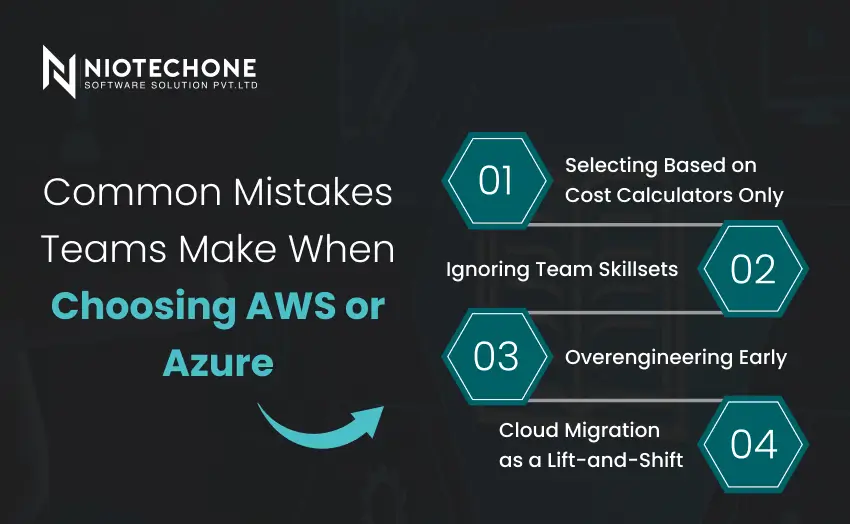
1. Selecting Based on Cost Calculators Only
Early estimates are seldom equal to actual use. Both platforms have unforeseen cloud bills due to poor architecture.
2. Ignoring Team Skillsets
A platform that appears to be powerful may slow down delivery when the team finds it difficult to use it.
3. Overengineering Early
Attempts to make infrastructure future-proof tend to add complexity and technical debt to software projects.
4. Cloud Migration as a Lift-and-Shift
The issues of cloud migration and solutions demand architectural modifications, rather than redeployment.
Best Practices That Work in Practice with .NET on the Cloud
Adhere to Cloud-First Architecture Principles.
Regardless of platform:
- Design stateless services
- Use managed services where feasible.
- Do not rely on VM-based scaling.
These are fundamental cloud application development best practices that minimize maintenance effort.
Impact on Scalability, Cost, and Maintenance
Scalability
- Azure makes scaling easier with managed services and auto-scaling defaults.
- AWS provides more control over highly customized scaling strategies.
Both scale and Azure tend to scale with less operational overhead for .NET teams.
Cost Management
Cloud cost problems typically arise due to:
- Bad architecture choices.
- Over-provisioned services
- Lack of monitoring
Azure is more predictable with .NET workloads, whereas AWS can be cheaper when highly optimized.
Long-Term Maintenance
Raw performance is less important than maintainability.
Clean architectures, consistent with writing clean code and code maintainability in large applications, minimize:
- Operational complexity
- Bug frequency
- Migration pain
The opinionated defaults of Azure tend to keep teams on track.
Azure and AWS in the Age of AI-Assisted Development
AI in software development has become a daily routine.
Both platforms support:
- Software developer of AI tools.
- AI-assisted code review
- Cloud-based ML services
Nevertheless, Azure is more compatible with developer productivity tools in .NET ecosystems, whereas AWS provides greater flexibility in AI infrastructure.
When Azure Is the Better Choice in 2026
Azure tends to be more appropriate when:
- You are developing enterprise-level .NET systems.
- You desire quicker delivery and fewer infrastructure choices.
- Hybrid and Microsoft integrations are fundamental requirements.
This congruency minimizes friction throughout the software development lifecycle described in practice.
When AWS Is the Better Choice in 2026
AWS makes sense when:
- Teams desire the greatest control of infrastructure.
- Applications are polyglot and cloud-native.
- Vendor neutrality is a strategic need.
It rewards experienced teams that are proactive in dealing with complexity.
Conclusion
The AWS vs Azure decision in 2026 is not about features but alignment. The platform that aligns with the skills of your team, architecture style, and long-term objectives will always work better.
To the majority of organizations that are oriented to the use of .NET, Azure minimizes the friction in the development, security, and operations. AWS is still strong among teams that appreciate control and customization. The actual success factor is not the cloud you select- but how your software architecture, clean code practices and operational discipline support your selection over time.
Categories
Related Articles

Related Tags
Frequently Asked Questions FAQs
No. Azure can be easier to use for .NET teams, but AWS can be more efficient in highly customized or multi-cloud environments.
Yes, Scalability is more about architecture than platform selection.
Yes, often, but only when the applications are designed in accordance with the principles of cloud-native design.
Yes, when architecture is closely bound to platform-specific services.
Azure generally requires less operational effort for .NET teams because many services are tightly integrated with the Microsoft ecosystem, reducing configuration and ongoing maintenance.