ASP.NET Core Development Trends in 2026
- Niotechone Marketing Team
Table of Contents
- Introduction: Why 2026 Is a Turning Point of ASP.NET Core
- The Future of ASP.NET Core Development in 2026
- AI-Driven Development Becomes Native
- ASP.NET Core Applications are replaced by cloud-native applications
- Scalable Web Applications with ASP.NET Core
- Enterprise ASP.NET Core Solutions Go Modular
- Security-First Development Is Non-Negotiable
- Headless Architectures and API-First Dominate
- DevOps Automation and CI/CD Maturity
- .NET Expands Cross-Platform Development
- Sustainability and Cost Efficiency Are More Important Than Ever
- Conclusion
Introduction: Why 2026 Is a Turning Point of ASP.NET Core
In 2026, the software development environment is entering a decisive stage. Businesses no longer want applications that merely work, they want them to be fast, intelligent, scalable and secure by default. This has made ASP.NET Core the focus of the current application development.
With organizations moving towards AI-first, cloud-native, and microservice-based systems, ASP.NET Core development trends 2026 indicate a framework that is moving forward faster than demand. Enterprise-grade scalability to a smooth integration with the cloud, ASP.NET Core remains the way future-ready applications are developed.
Regardless of whether you are developing a new digital product or upgrading old systems, it is important to know what the future of .NET development will be in 2026. This blog discusses the most influential trends that are defining ASP.NET Core and how companies can use them to develop high-performance, secure, and scalable applications.
The Future of ASP.NET Core Development in 2026
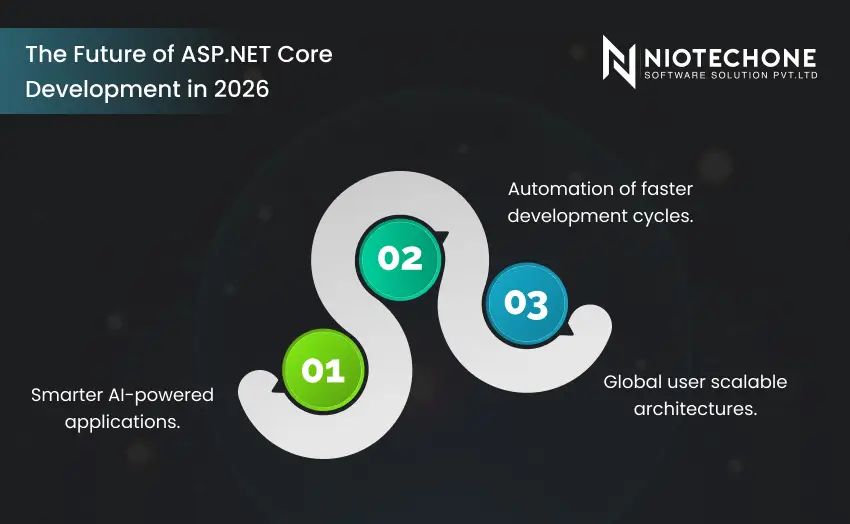
ASP.NET Core is no longer a powerful web framework but a full ecosystem of creating intelligent, distributed, and cloud-native systems. Three fundamental demands drive its evolution in 2026:
- Smarter AI-powered applications.
- Automation of faster development cycles.
- Global user scalable architectures.
These requirements are affecting all levels of the development stack.
AI-Driven Development Becomes Native
The extensive adoption of artificial intelligence in the development process and application behavior is one of the most characteristic ASP.NET Core development trends 2026.
AI is not confined to analytics dashboards or chatbots anymore. ASP.NET Core applications are designed to think, adapt, and predict in 2026.
Key advancements include:
- AI-assisted refactoring and coding.
- Detection of predictive errors in development.
- Smart performance tuning.
- Intrinsic support of Azure AI and ML.NET.
AI-driven enterprise ASP.NET core solutions are assisting organizations in achieving a competitive advantage, whether through personalized user experiences or automated decision-making systems.
ASP.NET Core Applications are replaced by cloud-native applications
In 2026, cloud adoption is not optional anymore, it is a prerequisite. Cloud-native ASP.NET Core applications are built to take advantage of modern cloud infrastructure, not merely deployed to it.
These applications embrace:
- Microservices architecture
- Docker containerization.
- Kubernetes orchestration
- Serverless components
- Event-driven communication
This method allows companies to grow fast, implement changes without issues, and be highly available even when the load is high. Learn about our Cloud Application Development Services to develop cloud-native ASP.NET Core applications that are performance and scalability-optimized.
Scalable Web Applications with ASP.NET Core
Scalability is one of the priorities of businesses in 2026. ASP.NET Core remains superior to most frameworks because of its lightweight nature and high-throughput.
Scalability features are:
- Asynchronous programming model.
- Optimized Kestrel web server.
- Lightweight services with minimal APIs.
- GRPC and HTTP/3 support.
- Effective memory control.
Organizations that develop scalable web applications with ASP.NET Core can comfortably manage:
- Sudden traffic spikes
- Global user bases
- Real-time data processing
- High-concurrency workloads
This renders ASP.NET Core suitable for SaaS applications, fintech applications, eCommerce applications, and enterprise portals.
Enterprise ASP.NET Core Solutions Go Modular
By 2026, big businesses are abandoning monolithic architectures. They are instead moving towards modular, composable systems that run on ASP.NET Core.
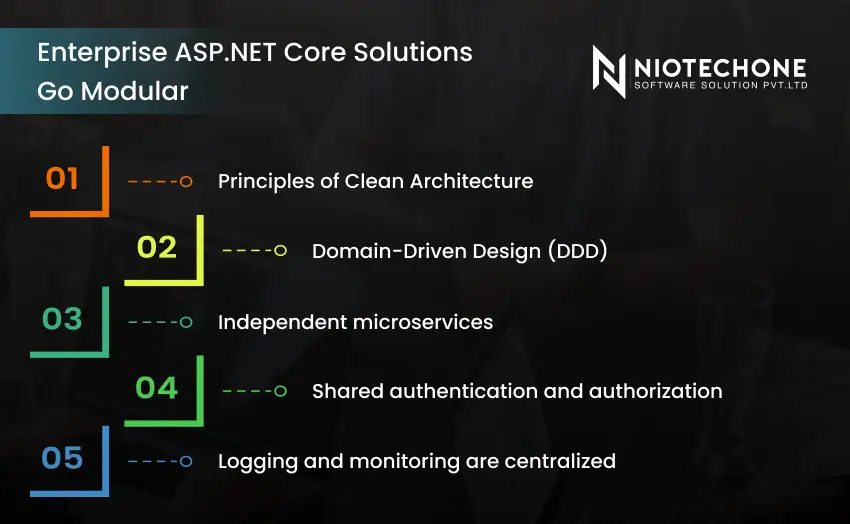
Contemporary enterprise ASP.NET Core solutions focus on:
- Principles of Clean Architecture.
- Domain-Driven Design (DDD)
- Independent microservices
- Shared authentication and authorization.
- Logging and monitoring are centralized.
This modularity enables organizations to innovate more quickly and minimizes technical debt and maintenance expenses. Get to know more about our Custom Enterprise Software Development Services that are scalable and long-term growth oriented.
Security-First Development Is Non-Negotiable
Security is not a feature anymore, it is a foundation. ASP.NET Core uses a security-by-design approach in the future of .NET development in 2026.
The major security improvements are:
- Zero Trust architecture
- Secure API authentication (OAuth 2.0, OpenID Connect)
- Passwordless and token-based authentication.
- Intrinsic defense against OWASP Top 10 threats.
- Ready-to-use compliance configurations (GDPR, ISO, HIPAA).
These characteristics render ASP.NET Core a reliable option in such industries as healthcare, finance, and government.
Headless Architectures and API-First Dominate
In 2026, applications will be used on various platforms, including web, mobile, IoT, and even AI agents. This has increased the pace of adoption of API-first and headless architectures.
ASP.NET Core is good at creating:
- RESTful APIs
- GraphQL services
- gRPC-based microservices
- Event-driven backends
This scalability enables companies to grow frontend experiences on their own without compromising a strong backend infrastructure. Our API Development Services offer high-performance, secure ASP.NET Core APIs.
DevOps Automation and CI/CD Maturity
In 2026, DevOps is completely automated, intelligent, and highly integrated with ASP.NET Core development processes.
Modern pipelines include:
- Automated testing and deployment.
- Code quality checks powered by AI.
- Ongoing security scanning.
- Infrastructure as Code (IaC)
- Blue-green and canary deployments.
This guarantees quicker time-to-market and stability and security of the application.
.NET Expands Cross-Platform Development
ASP.NET Core is not restricted to the traditional web applications anymore. Together with Blazor and .NET MAUI, developers can now create applications in:
- Web browsers
- Desktop systems
- Mobile devices
- Hybrid environments
This integrated ecosystem saves time in development and provides uniform user experiences across platforms.
Sustainability and Cost Efficiency Are More Important Than Ever
Businesses are focusing on sustainability and performance in 2026. The efficient runtime of ASP.NET Core assists organizations:
- Reduce cloud resource usage
- Lower infrastructure costs
- Reduce energy use.
- Construct environmentally friendly applications.
This renders cloud-native ASP.NET Core applications cost-effective and future-ready.
Conclusion
The trends of ASP.NET Core development 2026 are a clear indication that the framework is being developed to address the needs of intelligent, cloud-first, and scalable software systems. ASP.NET Core remains the leader in modern application development, with AI-driven development, enterprise-grade security, and modular architectures.
Companies investing in the future of .NET development in 2026 will have a potent edge, namely, accelerated innovation, lower costs, and applications that can be scaled with business expansion.
Categories
Related Articles

Frequently Asked Questions FAQs
ASP.NET Core is not outdated because of its performance, cloud-native architecture, high-security capabilities, and easy integration with AI, DevOps, and modern architectures.
Yes, Enterprise ASP.NET Core solutions are modular, highly scalable, and compliant, which is why they are suitable in large organizations.
ASP.NET core is compatible with containers, Kubernetes, microservices, serverless, and smooth integration with the cloud, which is ideal in cloud-native applications.
Absolutely. ASP.NET Core has a high-performance runtime and asynchronous processing, which makes it possible to support millions of users in many scalable web applications.
Yes, The long-term vision of Microsoft, the continuous updates, and the strong community support make ASP.NET Core a technology that will be used in 2026 and beyond.