Why Software Documentation Matters More Than Ever in 2026
- Niotechone Marketing Team
Table of Contents
- Introduction
- What Software Documentation Means in 2026
- Why Software Documentation Was Ignored in the Past
- The Direct Business Impact of Poor Documentation
- Documentation and Scalable Software Applications
- The Role of Documentation in Software Project Management
- Remote and Distributed Development Team Documentation
- How Documentation Improves Developer Productivity
- Knowledge Retention Strategy: Documentation
- Real-World Use Case: Scaling Without Documentation vs With It
- Best Practices in Documentation 2026
- How Leading Software Companies Approach Documentation
- Conclusion
Introduction
Software documentation is no longer a secondary activity that is done at the end of a project. It has now become a vital pillar of scalable software applications, effective software project management, and long-term product success. With the development of increasingly complex systems driven by AI in software development, the lack of documentation leads to confusion, delays, and unwarranted risk as custom software development companies develop more sophisticated systems.
To business owners, CTOs, and product leaders who are engaged with a software development company or a mobile app development company, documentation has a direct effect on the speed of delivery, onboarding, compliance, and product quality. As remote teams, AI-assisted coding, and fast cloud adoption become the norm, good documentation is now a strategic benefit and not an operational liability.
What Software Documentation Means in 2026
The current state of software documentation is much more than technical manuals or API references. It is a common knowledge system that links developers, managers, stakeholders, and future teams.
Modern records contain:
- Design and architecture of systems.
- Workflows and business logic explanations.
- API contracts and integration guidelines.
- Deployment, security, and scalability observations.
- AI model behavior, constraints, and use of data.
In the case of any custom software development company that provides enterprise or cloud-based solutions, documentation will provide continuity even after the original developers have left.
Why Software Documentation Was Ignored in the Past
In the past, documentation was usually considered optional because of time constraints and delivery-oriented attitudes. Teams were more focused on features than clarity, believing that code was all that was needed.
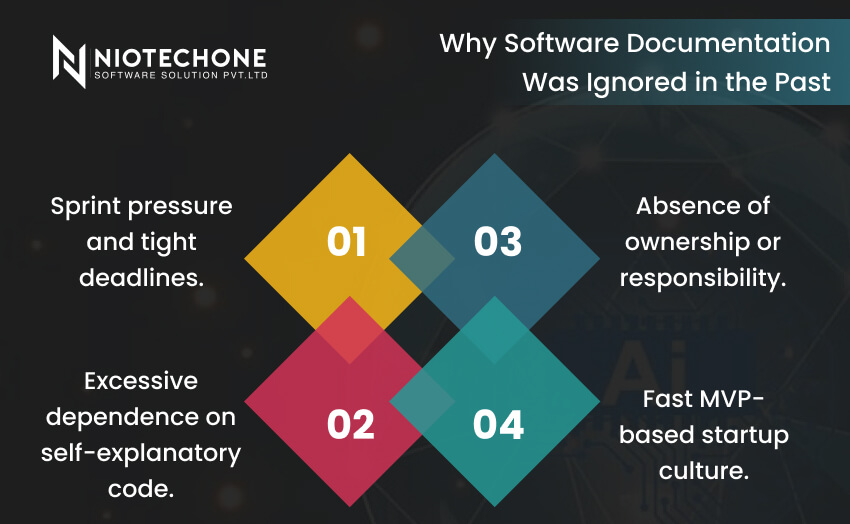
Typical causes of documentation omission:
- Sprint pressure and tight deadlines.
- Excessive dependence on self-explanatory code.
- Absence of ownership or responsibility.
- Fast MVP-based startup culture.
This attitude is no longer effective in 2026. Software systems are more distributed, larger, and intertwined with AI and cloud infrastructure.
The Direct Business Impact of Poor Documentation
Poor documentation causes silent operational harm that accumulates with time. Although the product can still work, the organization suffers the cost in terms of inefficiency and risk.
The major business implications are:
- Delayed training of new developers.
- Greater reliance on certain people.
- Increased maintenance and support expenses.
- Slower development rate with age.
In the case of companies that employ full-time developers or collaborate with external teams, the lack of documentation transforms knowledge into a bottleneck rather than an asset.
Documentation and Scalable Software Applications
Scalability is not only a matter of infrastructure, but also a matter of people and processes. With the increase in the size of teams, documentation becomes the cement that binds systems.
Properly documented systems allow:
- More rapid feature addition without disturbing existing logic.
- Standardized coding between teams.
- Less complex debugging and performance optimization.
- Scalability across regions and platforms.
A software development company that specializes in scalable software applications cannot afford tribal knowledge or informal communication.
The Role of Documentation in Software Project Management
In 2026, documentation is a key component of modern software project management. It balances technical implementation and business expectations and minimizes misconceptions.
There is good documentation of:
- Defined scope and requirement traceability.
- Improved sprint planning and estimation.
- Open communication with non-technical stakeholders.
- Less rework due to gaps in assumptions.
Documentation is becoming a key tool used by project managers to coordinate distributed teams and long-term product roadmaps.
Remote and Distributed Development Team Documentation
Remote work is not a temporary phenomenon anymore, but the default operating model in 2026. Documentation substitutes hallway discussions and informal knowledge exchange.
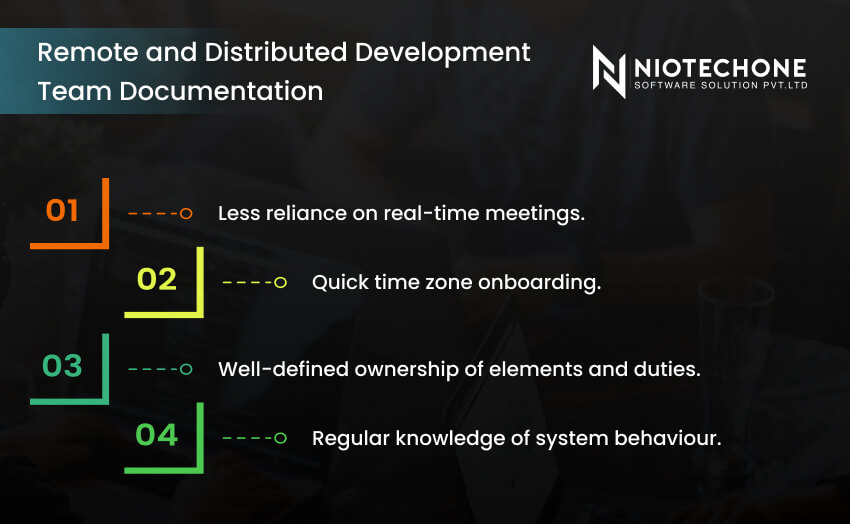
Distributed teams have the following benefits:
- Less reliance on real-time meetings.
- Quick time zone onboarding.
- Well-defined ownership of elements and duties.
- Regular knowledge of system behaviour.
In the case of companies that employ dedicated developers worldwide, documentation is the main layer of communication.
How Documentation Improves Developer Productivity
Documentation does not retard development as was believed in the olden days. It speeds it up by minimizing friction and uncertainty.
Properly documented projects enable developers to:
- Learn systems more quickly without having to ask questions.
- Reduce the risk of making confident changes.
- Build more and guess less.
- Work well in interdisciplinary teams.
An established mobile app development company does not consider documentation as an overhead but as a productivity tool.
Knowledge Retention Strategy: Documentation
The tech industry is characterized by employee turnover. Organizations lose important knowledge each time an individual leaves without documentation.
Good documentation will guarantee:
- Continuity of business in team transitions.
- Quickened onboarding.
- Less reliance on senior developers.
- Conservation of architectural determinations.
In the case of any custom software development company that develops long-term products, documentation safeguards institutional knowledge.
Real-World Use Case: Scaling Without Documentation vs With It
Take the example of two emerging SaaS companies that introduce similar platforms.
Company A (Poor Documentation):
- It takes months before new developers can be productive.
- Features disrupt current functionality.
- Technical debt grows exponentially.
- Founders are still engaged in all technical decisions.
Company B (Strong Documentation):
- Onboarding is not a month-long process.
- Teams scale independently
- Product development is consistent.
- Leadership is about development, not fighting fire.
The difference is not talent it is documentation discipline.
Best Practices in Documentation 2026
The modern documentation should be alive, organized, and seamlessly integrated into workflows.
Best practices include:
- Documentation is a component of the definition of done.
- Prefer straightforward language to complicated explanations.
- Document changes and code changes.
- Isolate high-level architecture and low-level details.
- Flowcharts, leverage diagrams, and examples were useful.
Documentation should evolve with the product, not lag behind it.
How Leading Software Companies Approach Documentation
The best performing teams incorporate documentation into their culture of development and do not delegate it as an additional task.
Common approaches:
- Development teams with shared ownership.
- Periodic review of documentation at sprints.
- Searchable documentation repositories that are centralized.
- Alignment between technical and business documentation.
At Niotechone Software Solution Pvt. Ltd., documentation is considered a fundamental delivery element that facilitates scalability, maintainability, and client success in the long term.
Conclusion
Software documentation is not optional or secondary anymore; it is a strategic requirement in 2026. To any software development company that wants to create scalable, secure, and future-ready products, documentation has a direct influence on speed, quality, and resilience. With the advent of AI in software development and distributed teams, clear documentation is the only way to make sure that systems are readable and maintainable in the long term.
Companies investing in documentation today minimize risk, safeguard knowledge, and facilitate sustainable growth tomorrow. Regardless of whether you are developing an enterprise platform or a mobile app development company, good documentation is one of the most intelligent long-term investments you can make.
Categories
Related Articles

Related Tags
Frequently Asked Questions FAQs
Due to the complexity, distributed nature, and AI-driven systems, undocumented knowledge is risky and unsustainable.
No. It minimizes rework, miscommunication, and reliance, and eventually accelerates delivery.
Architecture choices, business logic, APIs, deployment processes, and AI behavior explanations.
Yes. Early documentation eliminates future technical debt and scaling problems.
Development and project management teams should share the responsibility of documentation.