The advent of cloud computing has transformed it from being a source of competitive advantage to becoming an essential part of all modern businesses. Many companies and organizations from many industries migrate their application, infrastructure, and data to the cloud to gain better scalability, perform faster, and improve operational efficiency.
In 2026, as organizations focus more than ever on agility, resiliency, and cost optimization, multi-cloud architecture (the use of multiple cloud providers) will provide organizations with a way to reduce their dependence on one vendor, while still retaining a level of flexibility and control of their cloud Platform.
Multi-cloud approaches make use of multiple services from different cloud providers (such as AWS, Azure & GCP) in order to run applications, store data, and manage enterprise workloads. Businesses adopt a multi-cloud approach.
Example of a Multi-Cloud Approach
The following are examples of how enterprises use a multi-cloud approach:Â
Vendor lock-in creates reduced levels of flexibility and numerous problems for companies that use just one cloud service.
1. Define Objectives for Your Business
Clear goals must be established by an organization that will use multi-cloud strategies, regardless of the end goal (lower cost, better resilience, or quicker innovation).
2. Use Standardized Application Architecture
By utilizing technologies such as .NET, Blazor WebAssembly, and ASP.NET Core backend development, companies can develop and deploy apps across multiple cloud providers without significant development-to-production issues.
3. Utilizing Cloud Native Resources
Cloud Native technologies, including Docker containers and Kubernetes orchestration, allow for seamless workload migrations between various clouds, enabling a greater level of resource agility.
4. Implementing a Security Model based on Zero TrustÂ
A centralized monitoring system with a zero-trust security model allows for consistent security compliance across different clouds.
5. Collaborate with a Development PartnerÂ
A qualified custom software development firm can assist a company with developing scalable multi-cloud backend architectures for long-term growth, interoperability, and operational efficiency.
Â
Â
Â
Organizations can evaluate the effectiveness of a multi-cloud approach by using the following Key Performance Indicators (KPIs):
Â
Â
Â
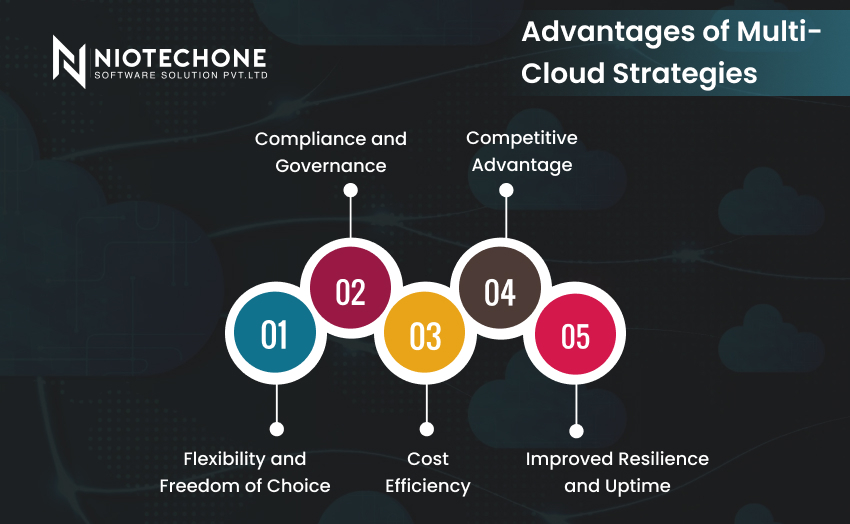
1. Flexibility and Freedom of Choice
With multi-cloud, companies can select the right capabilities from different service providers, enterprise tools from Azure, and extend their infrastructure.
2. Compliance and Governance
When using multiple cloud vendors, organizations can more easily ensure compliance with regional data regulations and international law across jurisdictions.
3. Lowering Costs
Multi-cloud enables businesses to negotiate better rates for services offered by multiple vendors, thus lowering their overall costs for cloud services and avoiding excessive dependence on only one vendor.
4. Competitive Advantage
When using multiple ecosystems, organizations can innovate more quickly, experiment with new ideas, and develop at a scale faster than organizations constrained by a single cloud platform.
5. Improved Resilience and Uptime
When one cloud vendor goes offline, an organization can seamlessly transfer workloads to another cloud vendor to continue running without interruption.
Multi-Cloud can be very beneficial for organizations, but there are also some challenges associated with running a multi-cloud strategy. Some of those include:
1. Management Complexity
Green Cloud Running multiple cloud vendors requires experienced people in those teams, and clarity of accountability amongst the teams.
2. Increased Risk for Security Breaches
Multi-cloud creates a larger attack surface than a single-cloud solution, which creates additional challenges in protecting against cyber threats.
3. Integration Issues
To work effectively between different clouds, applications must have interoperability across cloud ecosystems.Â
4. Lack of Skills
Developers and IT personnel will have to constantly upskill so they can utilize the tools, systems, and best practices of each cloud vendor.
Cloud orchestration based on artificial intelligence (AI) is anticipated to manage and distribute workloads over various cloud service providers automatically.Â
The trend towards serverless applications will continue, with developers creating serverless applications that operate across many cloud service providers.
Multi-cloud solutions tailored to specific industries will be adopted by enterprises and cloud service providers.
Multi-cloud environments offer many advantages for organizations, but they require careful planning and development before implementing them.Â
1. Application Workload Considerations
Not all applications should be hosted on multiple cloud providers. Assess the resiliency and performance of each application before deciding to host it on multiple clouds vs. just one cloud provider.
2. Cloud Management Platform
Using different dashboards, tools, and billing systems to manage multiple cloud service providers can become increasingly complex.
3. Automation
Automation is critical to be able to successfully scale a multi-cloud environment. By utilizing Infrastructure as Code (IaC) tools such as Terraform or Pulumi.
4. Provide Security from Day 1
A multi-cloud strategy creates an expanded attack vector for an organization. Organizations must take the following steps to minimize attacks:Â
Merely using multi-cloud is not enough—organizations must track results to verify the investment is, indeed, driving value. ROI can be increased through:
Performance Tracking: In conjunction with constant comparisons of affordability and performance among providers, identify the best allocation of workloads.
Negotiating Leverage: Multiple providers can give you negotiating leverage for the best pricing.
Modernization of Applications: Migrate legacy applications to cloud-native frameworks, such as ASP.NET Core development, that are agnostic to multi-cloud providers.
Innovation Enablement: Leveraging providers together provides access to the best generative AI, analytics, and DevOps tools to enhance innovation cycles.
Multi-cloud solutions will not just be important components of every digital transformation initiative through 2026; they will ultimately be imperatives that all enterprises adopt as part of their overall strategic plans. Companies that leverage/make use of a multitude of cloud options will benefit from incrementally improved operations, budgeting accuracy, and missed/brain-mapping opportunities to drive innovation, while eliminating their current and future risks of dependence on any one vendor.
Organizations will only thrive if they choose multi-cloud as a key aspect of their business transformation, not just trail for operational IT efficiency.

A multi-cloud strategy is an approach that uses services from more than one cloud provider (e.g. AWS, Azure, and Google Cloud) to run applications, store data, and provide flexibility.
Through this diversification of workloads across several vendors, organizations limit their reliance on any individual vendor.
Typically, workloads that can achieve greater scalability process greater amounts of data using artificial intelligence/machine learning (AI/ML).
Challenges associated with multi-cloud strategies include the complexity of managing multiple vendors and gaps in integration among vendors.
The success of a multi-cloud strategy can be evaluated based on multiple measurements, including reduced interruptions in service, cost savings, faster innovation, and increased levels of scalability.
3rd Floor, Aval Complex, University Road, above Balaji Super Market, Panchayat Nagar Chowk, Indira Circle, Rajkot, Gujarat 360005.
Abbotsford, BC
15th B Street 103, al Otaiba Dubai DU 00000, United Arab Emirates
3rd Floor, Aval Complex, University Road, above Balaji Super Market, Panchayat Nagar Chowk, Indira Circle, Rajkot, Gujarat 360005.
Abbotsford, BC
15th B Street 103, al Otaiba Dubai DU 00000, United Arab Emirates
Copyright © 2026 Niotechone Software Solution Pvt. Ltd. All Rights Reserved.