
How Poor Architecture Decisions Hurt Software ROI in 2026
- Niotechone Marketing Team
Table of Contents
- Introduction
- The Architecture Perspective of Software ROI
- What Is a Poor Architecture Decision?
- How Poor Architecture Impacts Software ROI
- Top Architecture Errors that Damage ROI
- Role of .NET Architecture in Improving Software ROI
- Software Project Management Alignment and Architecture
- Real-World Case: Architecture Effect on ROI
- Poor vs Good Architecture: ROI Comparison
- Best Practices in Architecture Decisions in 2026
- Conclusion
Introduction
The choices of software architecture at the beginning of a project can be the difference between a digital product being a long-term business asset or an expensive liability. When competitive advantage is determined by scalability, AI integration, and speed-to-market in 2026, poor architectural decisions can quietly eat software ROI.
Business owners, CTOs, and product leaders often spend a lot of money on development only to find out later that their application is not scalable, adaptable, or compatible with new technologies. This is where the services of a seasoned custom software development company come in.
This paper describes why poor architecture choices are detrimental to software ROI, what to avoid, and how to address current issues. NET-based architectures can assist organizations in creating scalable and future-proof systems.
The Architecture Perspective of Software ROI
Software ROI is not merely a matter of the cost of development and revenue. It includes:
- Maintenance costs in the long term.
- Scalability and performance efficiency.
- Speed of feature delivery
- The capability to embrace emerging technologies such as AI.
- Risk of operational instability and downtime
All these factors are directly affected by architecture. A system that is effective today but cannot withstand the pressure of growth will decrease ROI every year.

What Is a Poor Architecture Decision?
A poor architecture choice is not necessarily a poor technology choice. In more instances, it is a mismatch between business objectives and technical design.
Typical features are:
- Close interconnection of components.
- Lack of a definite scalability plan.
- Disregarding future integrations or adoption of AI.
- Overengineering or underengineering.
- Trading maintainability for speed.
Such decisions might seem cost-effective in the short run but generate unseen losses in the long run.
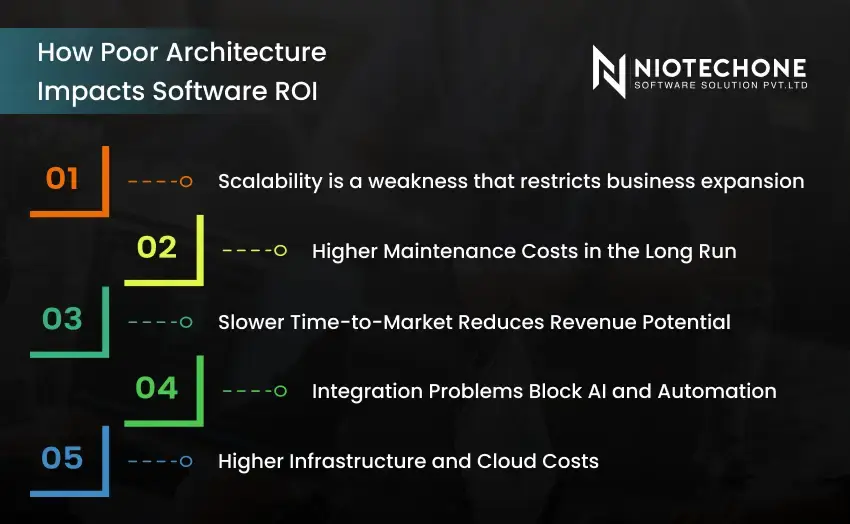
How Poor Architecture Impacts Software ROI
1. Higher Maintenance Costs in the Long Run
In architecture that is not modular, even minor modifications necessitate access to various components of the system. Maintenance is slow and costly over time.
Symptoms include:
- High bug-fix effort
- Fear of making changes
- Growing technical debt
Teams use budgets to keep the system alive instead of investing in innovation.
2. Scalability is a weakness that restricts business expansion
A scalable software application should be able to support growing users, data, and transactions without rework. The poor architecture usually compels companies to rewrite systems completely as the growth rate increases.
This results in:
- Unforeseen redevelopment expenses.
- Delayed market expansion
- Lost competitive advantage
- Scalability must be built in, not as an afterthought.
3. Slower Time-to-Market Reduces Revenue Potential
Architecture influences the speed of feature release. Unstructured systems delay development cycles because of dependencies and the complexity of testing.
This affects:
- Feature rollout speed
- Customer satisfaction
- Market responsiveness
In competitive industries, the speed of delivery has a direct effect on revenue.
4. Integration Problems Block AI and Automation
By 2026, AI in software development will cease to be optional. Systems should be connected to AI models, analytics platforms, and automation tools.
Poor architecture usually lacks:
- Clean APIs
- Data accessibility
- Modular services
Consequently, the use of AI will be costly or technically impossible, which will reduce the ROI in the future.
5. Higher Infrastructure and Cloud Costs
Poor architecture results in:
- Scaling whole systems rather than individual components.
- Poor resource utilization
- Increased cloud spend
Modern architectures are efficient in terms of infrastructure utilization, which has a direct positive impact on ROI.
Top Architecture Errors that Damage ROI
Constructing Monoliths Without Growth Planning
Monolithic architectures may be suitable for small systems, but without explicit modular boundaries, they are hard to scale.
Problems arise when:
- Teams grow
- Features increase
- Performance demands rise
A monolith that is not designed well is weak and costly.
Early-Stage Product Overengineering
Other teams implement complicated microservices or sophisticated patterns prematurely. This adds to the cost of development without immediate payback.
Good architecture is a balance between the present and the future.
Ignoring Non-Functional Requirements
Most projects concentrate on features and overlook:
- Performance
- Security
- Reliability
- Maintainability
These non-functional factors have a direct effect on long-term ROI.
Role of .NET Architecture in Improving Software ROI
When properly used, modern .NET platforms offer powerful architectural underpinnings.
ASP.NET Core Modular and Scalable Systems.
ASP.NET Core enables:
- Clean layered architecture
- API-first development
- Scalability and high performance.
It favors monolithic and microservices-based designs in accordance with business objectives.
.NET MAUI Cost-Effective Cross-Platform Development
.NET MAUI enables developers to create cross-platform apps using a common codebase.
Benefits include:
- Reduced development effort
- Faster time-to-market
- Consistent user experience
This enhances mobile and desktop product ROI directly.
Cloud-Native .NET Architecture
Modern .NET applications are compatible with cloud platforms, which allow:
- Auto-scaling
- Fault tolerance
- Cost optimization
Cloud-native design minimizes infrastructure waste and enhances availability.
Software Project Management Alignment and Architecture
The decisions made in architecture should be in line with the software project management strategy.
Poor alignment causes:
- Unrealistic timelines
- Budget overruns
- Delivery risks
Good teams make sure that architecture supports:
- Agile delivery
- Incremental scaling
- Long-term maintainability
This alignment safeguards ROI across the product lifecycle.
Real-World Case: Architecture Effect on ROI
A medium-sized company developed a tailor-made CRM with fast development in mind. The system was initially effective but not designed in a modular manner.
After user growth:
- Performance degraded
- Feature updates slowed
- Maintenance costs doubled
An incremental architectural refactor with ASP.NET Core modular services enhanced:
- Release speed by 40%
- Efficiency of infrastructure.
- Long-term maintainability
The refactor reinstated ROI and allowed the integration of AI-driven analytics.
Poor vs Good Architecture: ROI Comparison
Factor | Poor Architecture | Well-Planned Architecture |
Maintenance Cost | Increases yearly | Controlled and predictable |
Scalability | Requires rebuild | Scales incrementally |
Feature Delivery | Slow and risky | Fast and reliable |
AI Integration | Difficult or costly | Built-in readiness |
Long-Term ROI | Declines over time | Grows sustainably |
Best Practices in Architecture Decisions in 2026
- Design to scale, not to launch.
- Select established frameworks such as ASP.NET Core.
- Make systems modular and API-driven.
- Plan AI readiness early
- Align business strategy with architecture.
Such practices make architecture an asset, rather than a liability.
Conclusion
Software architecture is a long-term financial business decision in 2026. Bad architecture silently kills ROI by increasing costs, sluggish innovation, and reduced scalability.
Companies that invest in considerate, scalable, and future-oriented architecture, with the help of the appropriate development partner, create software that increases in value over time. Architecture should precede ROI.
Categories
Related Articles

Frequently Asked Questions FAQs
No. Monoliths can still be used with MVPs and smaller systems when properly designed.
Microservices are more scalable, but only when done right. Ineffective implementation adds complexity.
Yes, ASP.NET Core is popular in the development of high-performance microservices.
Usually no. A monolith that is modular is more feasible in the initial stages.
Ineffective architecture raises the cost of the cloud due to inefficient scaling and resource utilization.