Home Data-Driven Software Development: Transforming Business in 2026
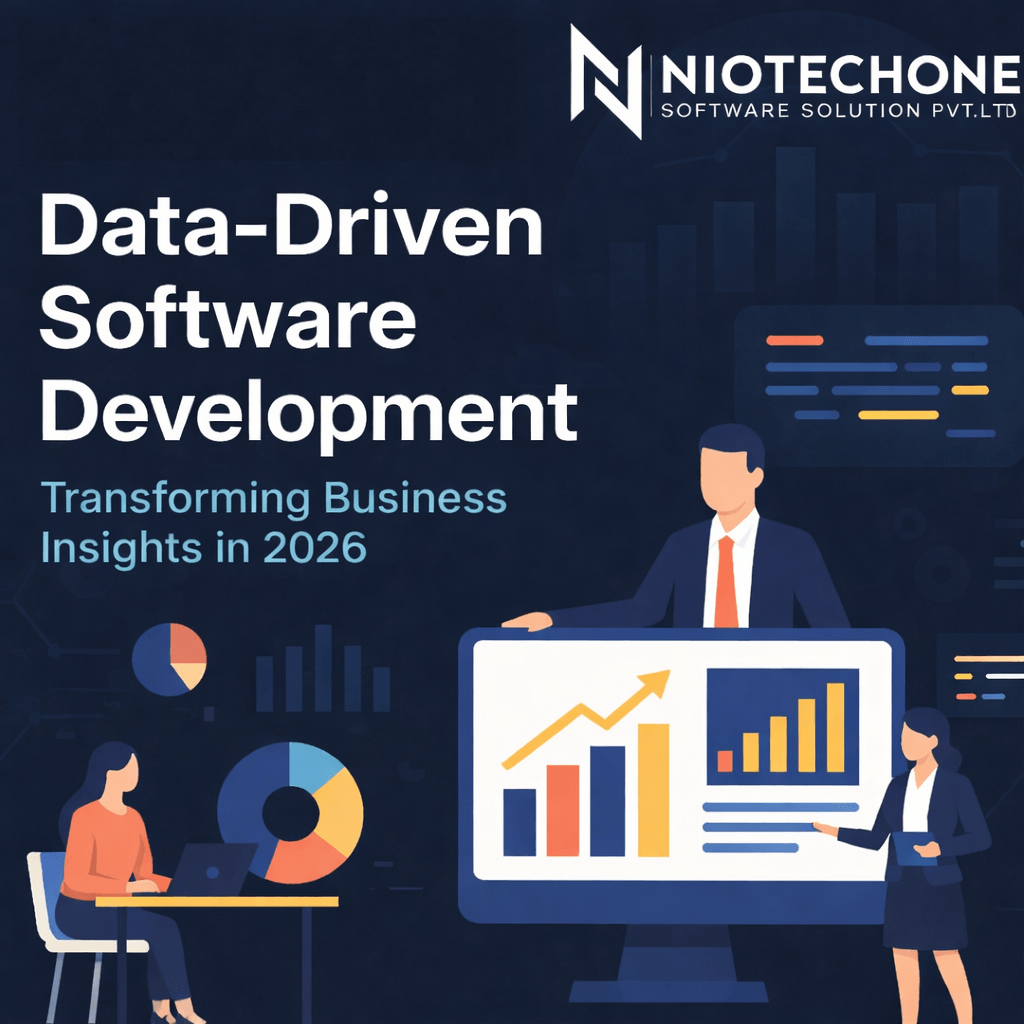
In 2026, data will be at the core of how businesses today are making their business decisions using data-driven decision-making software development (DDSD). By using data-driven software development, organizations can convert their unstructured data into useful, actionable information.
Data-driven software development uses real-time analytics, machine learning (ML), artificial intelligence (AI), and continuous monitoring to inform each step of the development process in a way that other traditional development methodologies have failed to do before.
ASP.NET Core is an important technical framework used to build high-performance, scalable data-driven apps. As a result, many companies are now investing in whether or not to develop their applications.
Creating software using a data-driven approach is a method of software development that allows for the use of insights derived from data.
With the aid of analytics, artificial intelligence, and real-time performance metrics, many organizations have moved beyond relying on just their own instincts.
Several components make up the process of developing with a data-driven approach:
1. Data Collection: Data can come from a variety of different sources, such as applications, users, IoT devices, and Enterprise Mobility Solutions, to collect as much structured and unstructured data as possible.
2. Data Analytics and Visualization: BI Tools are used to turn raw data into relevant and actionable insights to help make more effective decisions.
3. Predictive Modeling: With the help of AI and machine learning, you can predict user behavior, improve performance, and identify trends.
4. Continuous Improvement: Applications can be improved over time using performance data and user feedback.
As a result of the exponential growth in digital resources and digital content, all businesses today must pursue In 2026, data will be at the core of how businesses today are making their business decisions using data-driven decision-making software development (DDSD). By using data-driven software development, organizations can convert their unstructured data into useful, actionable information.
Data-driven software development uses real-time analytics, machine learning (ML), artificial intelligence (AI), and continuous monitoring to inform each step of the development process in a way that other traditional development methodologies have failed to do before.
ASP.NET Core is an important technical framework used to build high-performance, scalable data-driven apps. As a result, many companies are now investing in whether or not to develop their applications.
1. Integrating AI & ML With Your Software
AI (artificial intelligence) and ML (machine learning) are examples of how businesses use large datasets to find patterns within the data and create predictive insights that can assist companies in making decisions.
2. Scalability and Flexibility
Organizations can use a framework like ASP.NET Core to create scalable applications that can easily accommodate increasing levels of traffic and any future integrations.
3. Cloud-Powered Insights
Cloud-based solutions provide companies with real-time analytics and collaborative and organized management of their data.
4. Better Customer Experience
With the help of data-driven applications, businesses will be able to provide their customers with personalized services.
1. Data Collection and Integration
Gathering and combining the data from various sources (such as, but not limited to, applications, IoT devices, customer interactions, and systems within your organization) is the first step of implementing an Analytics Solution. By leveraging ASP.NET Core development in Rajkot.
2. Analytics and Data Visualization
The true value of raw data is achieved through proper analysis. Using tools such as Power BI, Tableau, custom dashboards, and other analytics platforms can assist businesses in visualizing trends and monitoring KPIs in order to make timely, data-driven decisions.
3. Machine Learning Integration
Machine Learning Models have become essential to the operation of predictive analytics and automating processes, so many organizations work with an ASP.NET Developer company located in Rajkot to facilitate the integration of these intelligent features into their enterprise applications.
4. Data Security and Compliance
In today’s environment, Security is a critical component when developing modern enterprise software, and compliance with global data regulations such as the General Data Protection Regulation (GDPR) and the California Consumer Privacy Act (CCPA) is extremely important for any application. ASP.NET Core includes many built-in features such as Encryption, Authentication, and Role Based Access Control.
5. Continuous Improvement (CI) and Feedback Loops:
Data-driven applications will continue to change. There will be constant iterations of improvements that occur based upon performance metrics, user activity, and AI information to ensure that the application remains relevant, efficient, & business focused.
To successfully integrate data-driven software development within the next five years, organizations need modern tools and technologies.
1. AI-Powered Development Tools
With the emergence of AI-assisted coding tools for software development, the way code is developed will change significantly.
2. Business Intelligence & Analytics Platforms
BI and analytics platforms, such as Power BI, Tableau, and Looker, allow organizations to analyze vast amounts of data, visualize insights, and generate interactive dashboards.
3. Cloud and Microservices Architecture
Modern businesses use cloud computing and microservices architectures to build their applications due to the flexibility and scalability they provide.
4. Low-Code and No-Code Platforms
Low-code/no-code development platforms are anticipated to see increasing use as organizations look for ways to quickly and easily build applications with minimal programming.
5. ASP.NET Core Framework
The ASP.NET Core framework has been an effective way to build safe, efficient, and expandable applications for many years.
6. Tools for DevOps and CI/CD Automation
Some examples of tools that fall into the category of DevOps/TSD automation are Jenkins, Azure DevOps, and GitHub Actions.
E-Commerce Platforms
By 2026, AI-powered data mining will have a distinct impact on how we create and develop e-commerce sites. Companies now use information about how consumers behave online to create personalized products.
Healthcare Applications
Healthcare providers are increasingly adopting analytical data-based software to help improve the quality of care and the overall efficiency of their organizations.
FinTech solutions
Financial services companies depend heavily on real-time data to detect fraud, manage risk, and monitor transactions. The majority of FinTech companies develop their data-driven applications using ASP.NET Core frameworks.
Enterprise operations
Enterprise operations (HR, logistics, etc.) are also utilizing applications that use data analysis to add value to their operations.
There are many benefits of utilizing software development that is based on data.
Working with an ASP.NET developer company located in Rajkot will provide a business the ability to more easily overcome many challenges.
To effectively adopt a data-driven approach to software development, organizations should do the following:
Establish measurable key performance indicators (KPIs) aligned with business goals.
Create secure and scalable pipelines for collecting, processing, storing, and analyzing large quantities of data quickly and securely.
Leverage artificial intelligence (AI) and predictive analytics only in situations.
Train employees to incorporate insights from data into daily decisions and longer-term strategic plans.
By creating partnerships with experts in ASP.NET Core development in Rajkot, organizations can create scalable, secure, and ready-for-the-future software solutions.
By 2026, the future of data-driven application development will be impacted greatly by Artificial Intelligence (AI), Edge Computing, Internet of Things (IoT), and Advanced Data Analytics Technologies. These types of technology enable businesses to analyze large amounts of data quickly and turn it into real-time actionable insight.
Data-Driven Software Development has become a must for enterprises wanting to remain competitive in a continually evolving digital world by 2026. Enterprises implementing data-driven strategies are able to build secure, scalable, and intelligent applications that turn raw data into actionable insights for business.
By utilizing ASP.NET Core Development and partnering with a seasoned ASP.NET Development Company in Rajkot, organizations will be able to easily integrate AI, predictive analytics, and cloud technology into their software.
Data-driven software development is the strategy of using real-world data and analytical methods for creating to improve performance and make well-informed decisions.
As we move into 2026, businesses need to create applications using a data-driven approach to help them make better decisions and ultimately design better digital products based on real data.
The ASP.NET Core framework is an excellent choice for building data-driven applications because it has high performance, making it a good fit for modern applications.
Artificial Intelligence, Machine Learning, and Cloud-based Platforms are just some of the emerging technologies for Data-Driven Software Development.
Some of the challenges posed by data-driven software development are: the large volume of data being processed.
3rd Floor, Aval Complex, University Road, above Balaji Super Market, Panchayat Nagar Chowk, Indira Circle, Rajkot, Gujarat 360005.
Abbotsford, BC
15th B Street 103, al Otaiba Dubai DU 00000, United Arab Emirates
3rd Floor, Aval Complex, University Road, above Balaji Super Market, Panchayat Nagar Chowk, Indira Circle, Rajkot, Gujarat 360005.
Abbotsford, BC.
15th B Street 103, al Otaiba Dubai DU 00000, United Arab Emirates.
Copyright © 2026 Niotechone Software Solution Pvt. Ltd. All Rights Reserved.