Zero Trust Coding for App Security

Introduction

With the increasing sophistication of cyber threats, the old-fashioned security models that are based on perimeter are no longer effective. Previously, developers thought that everything was safe once they were within a network, as they could trust all applications and users. That is a dangerous assumption today.

At Niotechone Software Solution Pvt. Ltd., a top .NET development company in Rajkot and software development company in India, we directly incorporate the principles of Zero Trust into our custom software development, web development, and Azure cloud application development processes – making all of our apps secure by default.

What is Zero Trust Coding concept with digital lock and cybersecurity interface

What Is Zero Trust Coding?

Zero Trust Coding refers to the practice of writing software in which no user, system, or API call is implicitly trusted. All interactions should be authenticated, authorized and continuously validated.

In contrast to the traditional coding models, which are based on perimeter defense (firewalls, VPNs, etc.), Zero Trust presupposes that breaches are unavoidable – and is aimed at minimizing the damage by isolating access and verifying each action.

Basic Tenets of Zero Trust Coding

  • Check Each Request: Authenticate users and APIs on each step.
  • Least Privilege Access: Only allow permissions that are necessary to perform a task.
  • Micro-Segmentation: Divide applications into small, independently secure units.
  • Constant Surveillance: Track and trace all requests and transactions.
  • Encrypt Everything: API calls and data at rest.

The Importance of Zero Trust in Contemporary App Development

The security perimeter has disappeared with applications that cut across cloud, mobile, and hybrid environments. Contemporary attackers use all the weak points, including open-source libraries and third-party APIs.

The main reasons why zero trust coding should be adopted

  • Cloud Complexity: Multiple environments (Azure, AWS, hybrid) expose risks.
  • Remote Teams: Distributed development needs decentralized access control.
  • Third-Party Integrations: APIs and SDKs may create vulnerabilities.
  • AI-Driven Threats: Automated attacks evolve more quickly than conventional defenses.


Zero Trust should be implemented at the beginning of the design to allow designing secure apps, achieving quicker compliance, and lowering the cost of incidents.

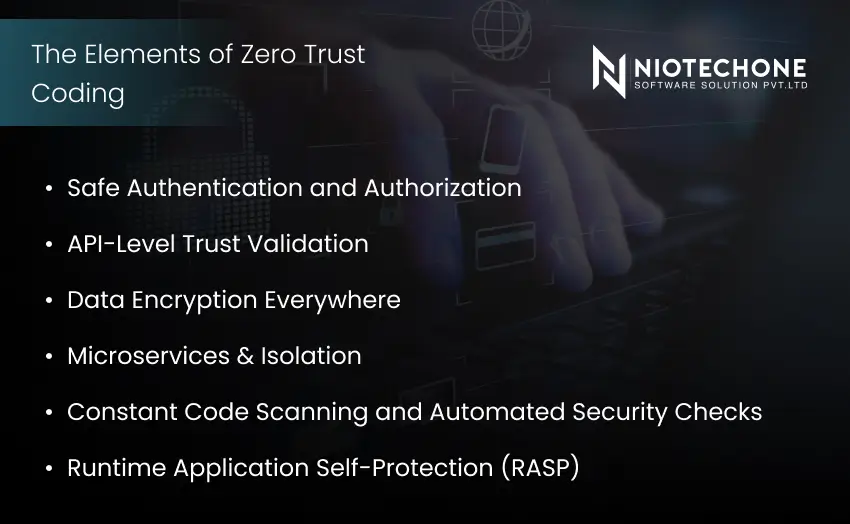
Key elements of Zero Trust Coding including authentication, encryption, microservices, and security checks

The Elements of Zero Trust Coding

The following are some of the ways that enterprises and developers can inject Zero Trust principles into their software development lifecycle (SDLC):

1. Safe Authentication and Authorization

  • Apply multi-factor authentication (MFA) to users and services.
  • Use OAuth 2.0, OpenID Connect, or JWT to provide access using tokens.


Azure Active Directory (AAD) is a well-known Zero Trust identity management strategy that is integrated in ASP.NET Core development in India.

2. API-Level Trust Validation

  • Enterprise systems have a weak point in APIs.
  • Authenticate all API calls.
  • Check payloads and clean up inputs to avoid injection attacks.
  • Apply rate limiting and API gateways (such as Azure API Management).


This makes APIs not only functional but also secure by design.

3. Data Encryption Everywhere

  • Encrypt data in transit and at rest with AES-256 and TLS 1.3.
  • Manage secrets, keys, and certificates with Azure Key Vault.
  • Do not store sensitive information in code or configuration files.


Encryption is used to make sure that even when data is intercepted, it cannot be read.

4. Microservices & Isolation

Modern applications are built on microservices architecture, in which every service is independent.

By isolating services:

  • You inhibit lateral movement in breaches.
  • You allow access control on a service-by-service basis.
  • You enhance scalability and containment.


We are Niotechone Software Solution Pvt. ltd., and we integrate microservices and containerized .NET Core application development to create strong Zero Trust environments.

5. Constant Code Scanning and Automated Security Checks

Incorporate DevSecOps:

  • Automate dynamic application security testing (DAST) and static application security testing (SAST).
  • Apply such tools as SonarQube, GitHub Advanced Security, and Azure DevOps Pipelines.
  • Scan open-source vulnerabilities with OWASP Dependency-Check.


6. Runtime Application Self-Protection (RASP)

RASP tools are used to monitor applications in real-time, identifying and preventing suspicious behavior in real-time.

The SDLC and the Effect of Zero Trust

Zero Trust is not a single-time setting, but a culture of lifecycle-long security.

SDLC Phase

Zero Trust Practice

Planning

Define threat models and compliance goals.

Development

Implement secure coding standards (OWASP Top 10).

Testing

Run automated security tests and peer code reviews.

Deployment

Use CI/CD pipelines with integrated access validation.

Monitoring

Continuously audit, log, and respond to anomalies.

This is because by integrating security at each stage, you are guaranteed of defense-in-depth, whereby vulnerabilities are resolved before they are even in production.

Zero Trust in Action: Scenario Examples

Scenario 1: Banking Application

A bespoke software development project of a fintech customer combines:

  • Tokenized transactions
  • User authentication APIs with zero trust.
  • Coded financial information at all levels.


Result:
85 percent decrease in unauthorized access attempts.

Scenario 2: Healthcare Platform

Zero Trust coding is applied to protect patient records in a web development project:

  • RBAC of various medical roles.
  • Constant session validation.
  • Automated audit trail creation.


Result
: 100 percent HIPAA compliance and better data integrity.

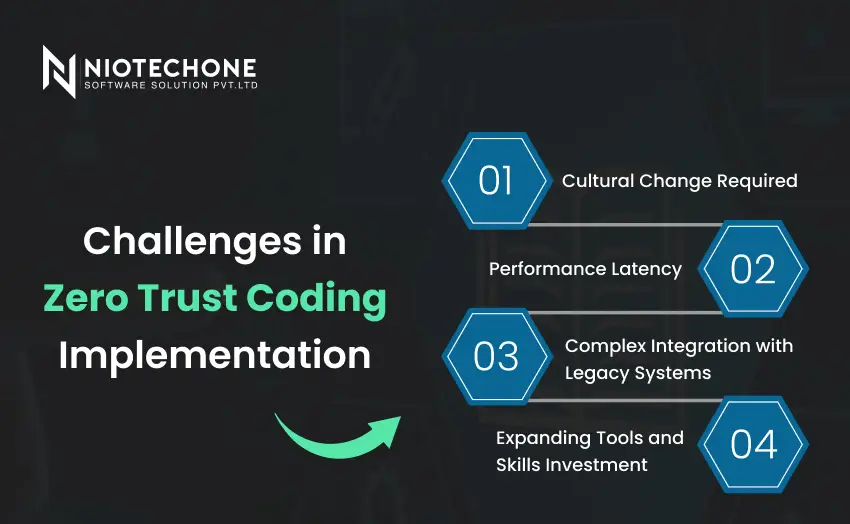
Challenges in Zero Trust Coding Implementation

Zero Trust Coding can be very effective solutions for systems security, however, there are challenges concerning how exactly solutions are developed to be ‘secure-by-design’: 

1. Cultural Change Required

To work in this new secure way, developers and teams will need to change their thinking to a ‘security-first’ mindset; thinking differently about traditional coding practices and integrating security as part of the development journey.

2. Performance Latency

With continuous authentication, encryption, and request validation, there will be a level of latency for performance; developers have to make necessary adjustments to performance so it can handle more security than previously designed solutions.

3. Complex Integration with Legacy Systems

Older or monolithic systems do not always have the type of architecture to support Zero Trust architectures and implementing Zero Trust means the system must be redesigned (to some extent) while providing extra layers of identity, and possibly changing access controls.

4. Expanding Tools and Skills Investment

Zero Trust anticipates better tools, continuous monitoring tools, training initiatives, and new developments in on-going maintenance pipelines. These costs assume that upfront costs will increase, but longer-term security improvements will be realized once back-filling the current gap for lost or misused systems. 

Conclusion

In a world where digital transformation and cyber threats are changing at the same pace, Zero Trust Coding Practices will keep your applications resilient, compliant, and trustworthy.

We combine AI-based security, .NET Core application development, and Azure cloud application development at Niotechone Software Solution Pvt. Ltd. to provide secure-by-design enterprise solutions that are compatible with the Zero Trust model that enables organizations to innovate without fear of compromising security.

Security is not an option anymore, it is the essence of contemporary app development.

Frequently Asked Questions FAQs

It is a security-first development model in which no user, system, or process is trusted by default - all access requests are authenticated.

It reduces attack surfaces and data breaches by applying authentication, encryption, and micro-segmentation at all levels.

Yes, but it needs architectural enhancements and integration layers to implement authentication and visibility.

No, although cloud adoption is the driver of Zero Trust, it can be applied to on-premise and hybrid environments.

Niotechone is a .NET development company in Rajkot and software development company in India that incorporates Zero Trust and AI-based security in all phases of custom software development, making your apps scalable and secure.

Â