
Why Scalability Planning Fails in Most Mid-Sized Companies
- Niotechone Marketing Team
Table of Contents
- Introduction
- Understanding Scalability Beyond “More Users”
- The Mid-Sized Company Scalability Blind Spot
- Core Factors Behind Scalability Failures in Mid-Sized Companies
- Comparison Table: Non-Scalable vs Scalable Software
- Why Mid-Sized Companies Choose Niotechone Software Solution Pvt. Ltd.
- Conclusion
Introduction
One of the most misconceived aspects of software development, particularly in mid-sized companies, is scalability planning. Startups focus on survival. Businesses scale by default. Mid-sized companies are in the middle-ground- and that is where the trouble starts.
By 2026, mid-sized organizations will process:
- Growing customer bases
- Growing volumes of transactions.
- Multiple digital platforms
- Workloads based on clouds and AI.
However, many of them continue to use software architectures that were initially designed to support small teams and limited use. Consequently, scalability planning does not fail due to the absence of technology but due to incorrect assumptions, poor architectural choices, and short-term thinking.
This article describes the reasons why scalability planning is a failure, what mid-sized companies always get wrong, and how modern .NET application development, ASP.NET Core architecture, and Azure cloud architecture address these problems.
Understanding Scalability Beyond “More Users”
Scalability is defined by most teams as the ability to serve more users. That definition is not complete.
A scalable software application should support:
- Reduced latency traffic.
- Increased data volume without performance degradation.
- Expand features without disrupting current systems.
- Foreseeable infrastructure expenses.
- Scalability is structural rather than reactive.
When you have to rewrite your system each time you grow, then it is not scalable.
The Mid-Sized Company Scalability Blind Spot
Mid-sized companies tend to think that they are not large enough to be concerned about scalability.
This results in hazardous assumptions:
- “Our user base isn’t that large.”
- “We can optimize later.”
- It will be automatically managed by the cloud.
As a matter of fact, mid-sized systems have the most volatile and rapid growth patterns, and scalability planning is even more important.
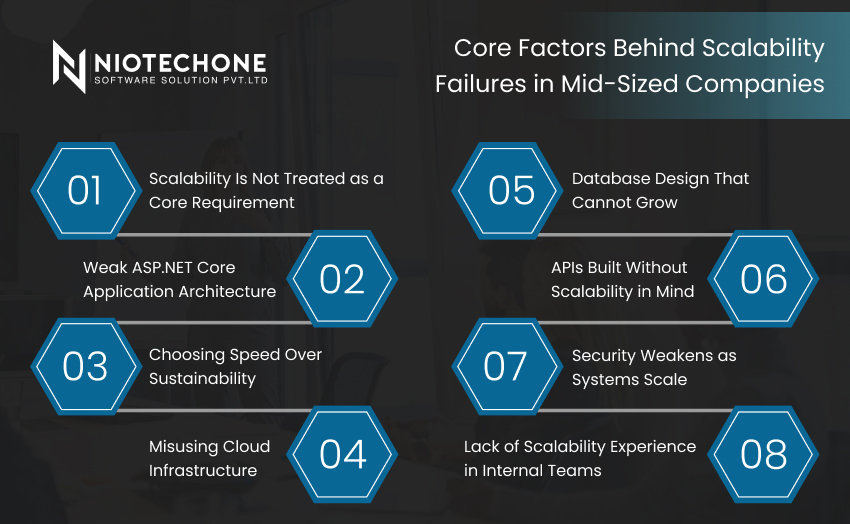
Core Factors Behind Scalability Failures in Mid-Sized Companies
1. Scalability Is Not Treated as a Core Requirement
Scalability is not a requirement that is documented in most software projects.
Requirements focus on:
- Features
- UI flows
- Business logic
Scalability is talked about casually, at best.
What this causes:
- Only the current load was optimized in the architecture.
- Databases that are not growth-oriented.
- APIs are constructed in a non-concurrent manner.
A professional custom software development company considers scalability as an architectural requirement, not an enhancement in the future.
2. Weak ASP.NET Core Application Architecture
Scalability is defined by architecture.
A lot of mid-sized companies continue to depend on:
- Monolithic applications that are tightly coupled.
- UI logic and business logic.
- Direct controller access to databases.
- This method does not work under load.
The ASP.NET Core Application Architecture of the modern world focuses on:
- Pure separation of concerns.
- Service-based or modular design.
- Stateless API layers
- Clear domain boundaries
A professional ASP.NET development company will make sure that the architecture is in place to support scaling even before the first line of code is written.
3. Choosing Speed Over Sustainability
Quick delivery usually gains executive favor.
But development that is speed-oriented results in:
- Hardcoded logic
- Poor error handling
- Little performance optimization.
Such shortcuts cause technical debt, which is a blocker to scalability.
Speed and scalability do not have to be mutually exclusive with custom .NET development services, but only when decisions are made by experienced architects.
4. Misusing Cloud Infrastructure
The adoption of clouds is misconstrued.
Most mid-sized businesses migrate to Azure but retain:
- Single-instance applications
- Fixed resource allocations
- Manual scaling processes
This is counterproductive to cloud computing.
Scalable Azure Cloud Architecture Requires:
- Stateless application design.
- Auto-scaling app services
- Load-balanced API gateways
- Caching and managed databases.
Azure is not a scalability solution, but rather an expensive hosting solution without a cloud-native design.
5. Database Design That Cannot Grow
The first component to scale is databases.
Common mistakes include:
- Single workload database instance.
- Poor indexing strategies
- Application layer chatty queries.
A scalable system plan:
- Optimization of queries at the outset.
- Separate read/write where necessary.
- Horizontal scaling plans.
Neglecting database scalability ensures future performance problems.
6. APIs Built Without Scalability in Mind
Modern software is API-based.
Nevertheless, most APIs fail due to:
- They are stateful
- They do not have an appropriate authentication flow.
- They do not respond to simultaneous requests.
A trusted ASP.NET Core API development company develops APIs to:
- High concurrency
- Secure token-based access
- Independent scaling from UI
APIs are not to be an afterthought.
7. Security Weakens as Systems Scale
Security complexity increases with the increase in applications.
Scaling is introduced without early planning:
- Authorization gaps
- Data exposure risks
- Compliance issues
Secure enterprise .NET solutions incorporate security at:
- Architecture level
- API level
- Level of identity and access management.
Security added later always costs more.
8. Lack of Scalability Experience in Internal Teams
Small internal teams are common in mid-sized companies.
These teams might not have:
- Experience in enterprise-scale architecture.
- Knowledge of cloud cost optimization.
- Exposure to high-availability systems.
This is why many organizations choose to hire dedicated developers or partner with experienced companies rather than learning scalability through failure.
Comparison Table: Non-Scalable vs Scalable Software
Area | Non-Scalable Software | Scalable Software Application |
Architecture | Tightly coupled | Modular, API-driven |
Cloud usage | Static hosting | Azure-native auto-scaling |
Performance | Degrades with growth | Stable under load |
Security | Reactive | Built-in |
Maintenance | High cost | Predictable |
Why Mid-Sized Companies Choose Niotechone Software Solution Pvt. Ltd.
Businesses collaborate with Niotechone Software Solution Pvt. Ltd. because of:
- Extensive knowledge of ASP.NET Core and .NET MAUI.
- Established Azure.NET development services.
- Enterprise-grade, secure architectures.
- Adaptable engagement frameworks, such as contracting full-time developers.
Scalability is not assumed, but engineered.
Conclusion
Scalability planning does not work in mid-sized companies as it is usually underestimated, delayed, or not done well. The disciplined architecture, cloud-native design, and seasoned technical leadership are needed to build a scalable software application in 2026.
The collaboration with an established custom software development company and an experienced .NET development company will guarantee that scalability is designed into the core- not added afterwards. Early scalability planning is not a choice, but a necessity for mid-sized businesses that want to grow sustainably.
Categories
Related Articles

Frequently Asked Questions FAQs
Scalability is the capacity of a software system to support more users, data, and workloads without a significant drop in performance or a significant architectural redesign. Scalable software application expands effectively and maintains costs, security and maintenance at a manageable level.
Mid-sized businesses tend to have systems that were designed to meet initial requirements, but experience rapid expansion like other businesses. Their software will hit scalability limits sooner than anticipated without enterprise-grade planning, architecture, and cloud strategy.
Yes, ASP.NET Core is popular in high-performance and scalable enterprise applications because of its lightweight architecture, high concurrency, built-in security, and easy integration with Azure cloud services.
No. Cloud platforms allow scalability, but do not architect it. Applications hosted on Azure can experience high costs, performance bottlenecks, and reliability problems without an appropriate Azure cloud architecture.
Scalability planning must begin before development, in the architecture and discovery phase. Scalability retrofitting can be costly to do later and leads to technical debt in the long term.