Why Over-Engineering Kills More Projects in 2026
- Niotechone Marketing Team
Table of Contents
- Introduction
- What Over-Engineering Really Means
- The Business Damage No One Talks About
- The Microservices Trap
- AI in Software Development: Innovation or Distraction?
- Over-Engineering vs Smart Engineering
- Real-World Scenario
- Why Experienced Teams Avoid Over-Engineering
- Trend 2026: Lean Scalable Architecture
- When Over-Engineering Is Actually Necessary
- How to Avoid Over-Engineering
- Conclusion
Introduction
Technology is stronger than ever in 2026. Businesses can create virtually anything with modern cloud platforms, sophisticated AI tools, and scalable frameworks. However, the bad news is that most software projects fail not because they are too simple, but because they are too complex.
One of the most costly and least-discussed risks in digital projects is over-engineering. Owners of businesses demand future-proof systems. CTOs desire strong architecture. Developers desire clean, extensible frameworks. The intention is good. The execution often isn’t.
As a professional .NET development company, we have seen companies waste time, money, and market opportunities because they attempted to create a perfect one rather than the right one.
What Over-Engineering Really Means
Over-engineering occurs when software is over-designed to be more complex than is required by the business at the moment.
It tends to manifest itself in subtle forms:
- Deploying microservices without demand validation.
- Developing an enterprise-level ASP.NET Core application architecture of a product at an early stage.
- Implementing AI modules without a defined business impact.
- Premature optimization of Azure cloud architecture is not worth it.
- Developing layers of abstraction that retard development.
The result? Development slows down. Budgets increase. The product is made more difficult to maintain.
An overbuilt application is not a scalable software application. Scalability is strategic. Over-engineering is speculative.
The Business Damage No One Talks About
Over-engineering is not a technical problem only. It is a business risk.
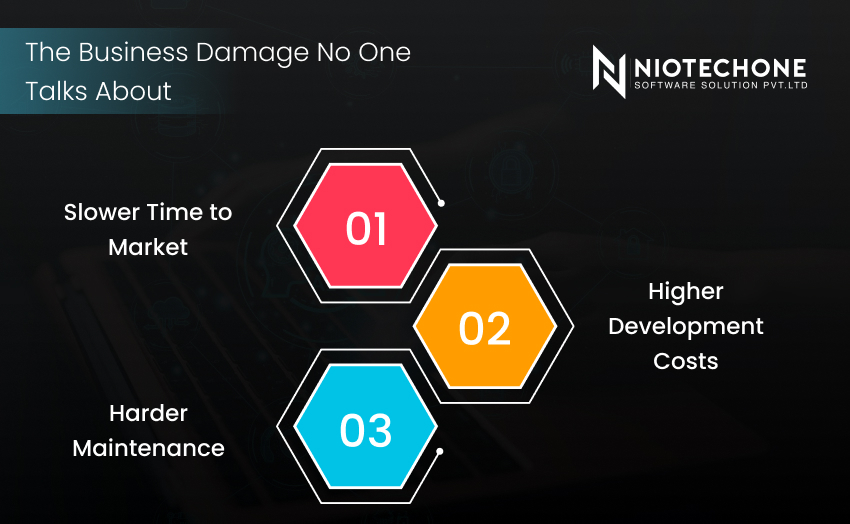
- Slower Time to Market
Speed is important in competitive markets. Competitors gain an advantage when teams take months to design complicated infrastructure rather than providing a minimum viable solution.
In 2026, AI-based startups will be launched within weeks. When your project is a year behind due to architectural over-design, you are already behind.
- Higher Development Costs
Each extra architectural layer adds:
- Development time
- Testing complexity
- Deployment effort
- Debugging difficulty
Hiring a professional software development company implies creating what the business requires, not what looks good on paper.
- Harder Maintenance
Complex systems need very qualified engineers to maintain them. This poses a risk of dependency.
When companies subsequently attempt to recruit .NET developer in Rajkot or expand their internal staff, they find it difficult since the architecture is excessively complex.
The Microservices Trap
Microservices are powerful. However, they are not necessarily needed.
In the case of early-stage products, a properly designed modular monolith developed by a competent ASP.NET Core development company can be more stable and incrementally scalable.
Microservices introduction:
- Network latency
- DevOps overhead
- Distributed debugging problems.
- Complicated deployment pipelines.
Unless your system already has scaling pressure, microservices will only make you slow down rather than speed up.
AI in Software Development: Innovation or Distraction?
AI in software development is ubiquitous in 2026. Predictive analytics, automation engines, recommendation systems – they sound impressive.
However, introducing AI without a clear ROI is problematic:
- Increased cloud costs
- More complex data pipelines
- Security and compliance issues.
- Longer testing cycles
Smart architecture incorporates AI when it can deliver quantifiable results, not because it is trending.
Over-Engineering vs Smart Engineering
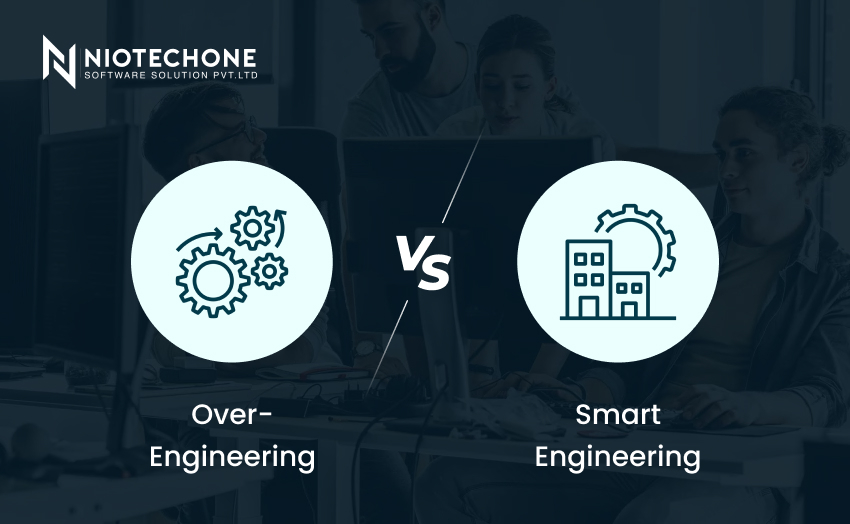
Here’s the difference decision-makers must understand:
Over-Engineering | Smart Engineering |
Designs for a hypothetical future scale | Designs for validated growth |
Adds AI without a business case | Adds AI for measurable impact |
Implements microservices too early | Starts modular, evolves gradually |
Optimizes infrastructure prematurely | Optimizes based on usage data |
Focuses on technical perfection | Focuses on business results |
A responsible ASP.NET development company understands this balance.
Real-World Scenario
One of the mid-sized logistics startups came to us after 10 months of developing a complex distributed system with several services, AI predictions, and advanced analytics dashboards.
The problem? There were fewer than 300 active users.
Their former supplier had developed an enterprise-level .NET application development framework that they did not need at their scale.
We made their architecture simpler, minimized infrastructure overhead, and matched development to actual growth goals. In four months, their platform became stable, costs were reduced, and feature delivery became faster.
That is the distinction between complexity and clarity
Why Experienced Teams Avoid Over-Engineering
An experienced custom software developer in Rajkot knows business-first development.
We have three principles at Niotechone Software Solution Pvt. Ltd.:
- Construct to existing proven needs.
- Designer of real, not imaginary, development.
- Only scale when it is supported by data.
We do not need to impress with technical buzzwords. We are interested in sustainable growth.
Trend 2026: Lean Scalable Architecture
The winning strategy in 2026 is lean scalability:
- Modular monolith first
- Clean API design (particularly in the case of an ASP.NET Core API development company)
- Cloud-ready, not cloud-heavy.
- AI integration is only measurable.
- Incremental scaling
This strategy minimizes risk and enhances flexibility.
When Over-Engineering Is Actually Necessary
Complexity is justified in some cases:
- Multi-region compliance enterprise systems.
- Financial platforms of high frequency.
- Millions of users on large-scale SaaS.
- Mission-critical healthcare infrastructure.
However, the majority of startups and mid-sized businesses do not begin there.
The error is to construct it as a business before it is a business.
How to Avoid Over-Engineering
Before development, inquire:
- Is there validated user demand for this feature?
- Is this architecture addressing a real business risk?
- Is it possible to scale later rather than now?
- Are we complicating or eliminating risk?
These decisions will be taken by a trusted custom .NET development services provider.
Conclusion
Over-engineering doesn’t look like a mistake at first. It looks ambitious. It looks advanced. It looks future-ready. However, in practice, it slows innovation, adds costs, and postpones market impact.
The most successful companies in 2026 are not creating the most complex systems. They are constructing the most aligned systems – aligned with business objectives, proven growth and quantifiable ROI.
When you are planning your next product and need the advice of a practical, business-oriented software development company, Niotechone Software Solution Pvt. Ltd. assists you in creating scalable solutions without the needless complexity.
Categories
Related Articles


Frequently Asked Questions FAQs
Scalability is also significant, but it must be in proportion to the existing business size and growth expectations.
No. They are strong, yet must be applied when the scale of the system warrants them.
It must directly enhance quantifiable results such as efficiency, automation, or customer experience.
When timelines are growing faster than users, or the complexity of infrastructure is greater than the real traffic, then you are over-engineering.
Yes, an effective ASP.NET Core application architecture enables scaling without the complexity that is not needed.