Businesses across the globe have made digital transformation a priority. Businesses desire to upgrade old systems, enhance customer experience, and develop scalable software applications that can expand with market demand. Technologies such as cloud application development, Azure cloud architecture, and AI in software development are expected to be more innovative and efficient in their operations.
But the truth is otherwise. Most digital transformation initiatives begin with a lot of enthusiasm but fail midway through the process. Budgets grow, schedules lengthen, and anticipated outcomes do not materialize.
To business owners, CTOs, and enterprise leaders, it is important to know why these initiatives fail. Choosing the right .NET development company can be the key difference between project failure and successful digital transformation.
Digital transformation is commonly misinterpreted as the mere adoption of new technologies. It is actually a strategic shift in the way a company conducts its business, creates value, and relates with customers.
It usually entails several major areas:
Digital transformation needs to be coordinated between business strategy, software architecture, and operational processes.
In the absence of coordination between these factors, even the initiatives that are well-financed may not be able to proceed.
Numerous organizations are able to implement digital transformation programs successfully. They establish objectives, recruit development teams, and initiate implementation.
However, after a few months, the progress becomes slow. Teams are faced with unforeseen technical complexity. There is a disagreement between stakeholders on priorities. Budgets grow, and observable results decline.
Projects rarely fail at this stage. Instead, they stall.
This stall stage usually involves:
Â
Knowing the underlying factors that lead to these problems can help organisations prevent them before they escalate to serious levels.
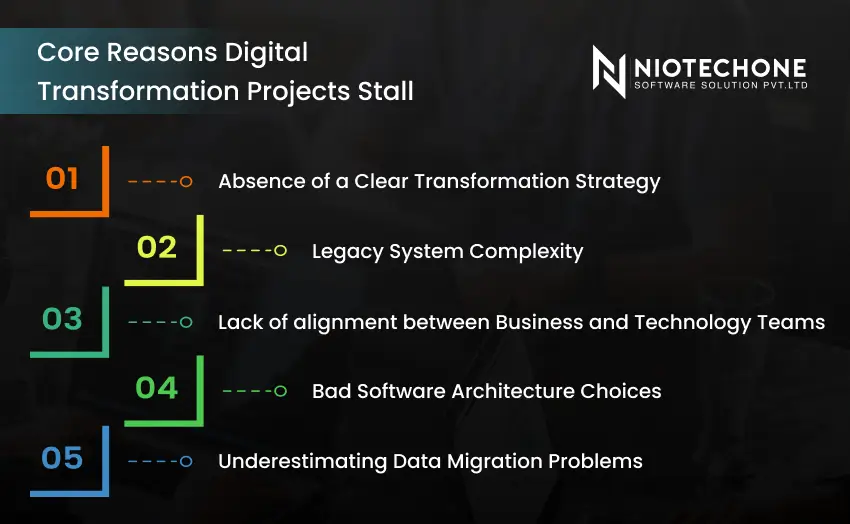
Lack of a clear strategy is one of the most prevalent causes of project stalling.
Organizations occasionally embark on digital projects because their competitors are doing it. They embrace cloud solutions or AI applications without determining how the technologies can be used to achieve actual business goals.
Development teams cannot make architectural decisions without strategic direction.
For example:
An effective transformation plan provides answers to these questions at an early stage.
Most businesses use old software that has been in use for years. These systems tend to drive the main business processes like inventory, accounting, or customer management.
These legacy systems pose a major technical challenge when companies are trying to modernize.
Common challenges include:
The process of migrating these systems to cloud application development environments should be planned.
The approaches that are usually employed by experienced development teams include:
In the absence of this knowledge, projects stall very fast.
Digital transformation is not merely a technology project; it is a business project.
Nevertheless, it is perceived as an IT project by many organizations. Business executives set objectives, and technical teams execute solutions with minimal coordination.
The result of this disconnection is:
Effective change involves constant communication between:
Alignment makes sure that technology solutions contribute to business results.
Software architecture is an important aspect of transformation projects.
Early architectural choices define the ability of systems to scale, integrate, and evolve.
Inappropriate architecture decisions may cause long-term issues, such as:
It is usually advantageous to an organization to engage an established ASP .NET development company that is aware of the current architectural trends.
Strong architecture can contain:
These strategies facilitate scalability and flexibility in the long term.
One of the most complicated areas of digital transformation is data migration.
Businesses tend to underestimate the complexity of transferring large amounts of historical data out of old systems and into new ones.
The obstacles usually involve:
New systems cannot work effectively if data migration fails or becomes unreliable.
A planned migration plan typically involves:
This stage alone can put a whole project on hold without proper planning.
Factor | Successful Projects | Stalled Projects |
Strategy | Clear roadmap aligned with business goals | Technology adopted without a strategic direction |
Architecture | Scalable and modular | Monolithic and inflexible |
Team Collaboration | Business and tech teams aligned | Communication gaps |
Data Migration | Planned and automated | Underestimated complexity |
Cloud Infrastructure | Optimized cloud architecture | Poor cloud resource planning |
Understanding these differences helps organizations avoid common mistakes.
There are a number of technology trends that are transforming the way organizations are approaching digital transformation.
AI-Powered Development
Software development AI is speeding up the process of coding, testing, and deployment. AI-assisted tools assist developers in detecting bugs at an earlier stage and optimizing performance.
Nevertheless, AI is most effective when it is incorporated into a properly designed development process.
Cloud-Native Architectures
Companies are not just migrating to the cloud. They are instead developing cloud-native applications that are specific to distributed environments.
The main features are:
Â
These architectures support highly scalable software applications.
Automation and DevOps
Automation pipelines enhance the speed and reliability of development.
The current DevOps strategies involve:
Such practices minimize the chances of stagnant development cycles.
Digital transformation is not a smooth ride, yet it has great rewards. Unclear strategies, complex legacy systems, poor architecture, and a lack of business-technical team collaboration are some of the reasons why many projects fail midway.
The technical expertise required to overcome these challenges can be achieved by working with an experienced software development company.
The majority of projects fail because of poor strategy, complexity of the legacy system, bad architecture choices, and business-technical team misalignment.
The schedule is different according to the scope. Smaller projects can be completed in 6-12 months, whereas large enterprise transformations can take years.
Cloud systems allow scalable infrastructure, accelerated deployment, and enhanced system reliability. Such technologies as Azure cloud architecture assist organizations in supporting modern applications.
AI is optional, yet it can greatly improve the process of automation, data analysis, and software development.
Good architecture makes applications scalable, secure and flexible to changing business needs.
3rd Floor, Aval Complex, University Road, above Balaji Super Market, Panchayat Nagar Chowk, Indira Circle, Rajkot, Gujarat 360005.
Abbotsford, BC
15th B Street 103, al Otaiba Dubai DU 00000, United Arab Emirates
3rd Floor, Aval Complex, University Road, above Balaji Super Market, Panchayat Nagar Chowk, Indira Circle, Rajkot, Gujarat 360005.
Abbotsford, BC
15th B Street 103, al Otaiba Dubai DU 00000, United Arab Emirates
Copyright © 2026 Niotechone Software Solution Pvt. Ltd. All Rights Reserved.